Its relative is a lodger. This one is a parasite, and the difference is what it does once it is inside.
Both species live in sea cucumbers, entering tail-first through the rear opening. But where the silver pearlfish leaves at night to hunt over the sand and returns, this one largely stays, and what it eats is the host: the gonads first, then other internal tissue, consumed steadily while the cucumber goes on living. A sea cucumber can regenerate a good deal of its interior, which is exactly what makes this arrangement sustainable for the fish. The organ grows back and is eaten again.
It is a clean illustration of how thin the line is between the categories. The same body plan, the same host, the same entry through the same opening, and the difference between commensal and parasite comes down to feeding behavior that took decades of dissection and observation to establish.
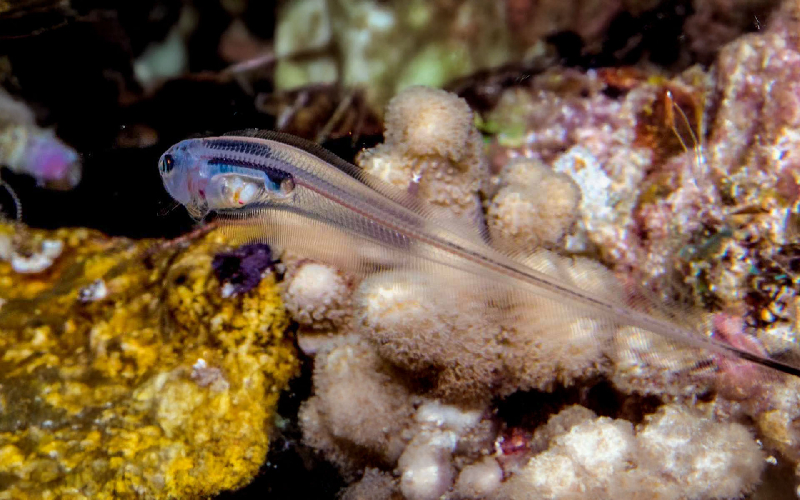
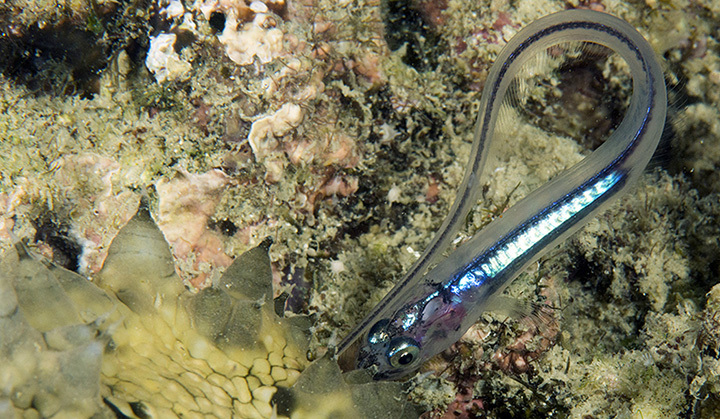
The fish itself is a translucent ribbon up to thirty centimeters, scaleless, with no pelvic fins and a body that tapers to a point rather than ending in a tail. The usual sighting is a head protruding from a sea cucumber that appears otherwise unremarkable.
The genus. Encheliophis Müller 1842 - énchelys (eel) + óphis (serpent). ETYFish
- long translucent ribbon of a body with no scales and no pelvic fins
- inside a sea cucumber, occasionally with the head showing at the rear opening
- longer and heavier-bodied than the silver pearlfish
- up to 30 cm
Why it's threatened
There are no known major threats.
Threat classification from the IUCN Red List.