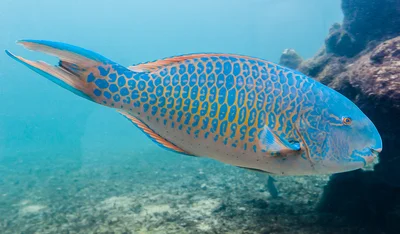
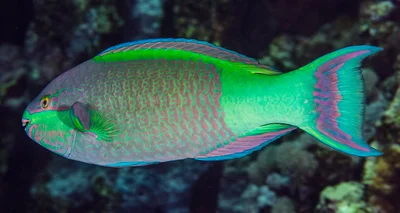
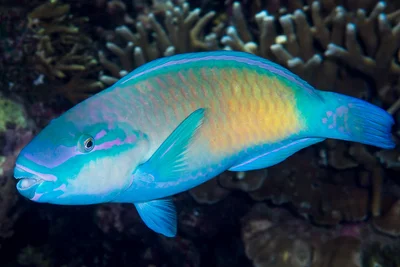
A parrotfish of shallow inshore reef, to 33 cm (13 in), the males blue-green with pink bands at the tail base and the females a plainer brown-red. It lives in this sea and nowhere else, one of a set of parrotfishes that replaced their Indo-Pacific relatives here when the basin was isolated.
It eats rock. The fused beak scrapes algae and the thin living film off dead coral, taking the limestone with it, and a throat mill grinds the lot before it is digested. What comes out the other end is sand: a single parrotfish can produce a few hundred kilos of it a year, and much of the pale sand on a reef beach has been through one.
At night it does something stranger. The fish wedges into a crevice and secretes a transparent bag of mucus around itself, taking half an hour to build it, and sleeps inside. The cocoon appears to mask its scent from night hunters like moray eels, and it also blocks blood-sucking parasites - a sleeping bag that is both a blanket and a mosquito net.
Like other parrotfishes it starts as a female and the largest fish become the colorful territorial males.
The genus.Scarus Forsskål 1775 - skaros (ancient Greek name of Sparisoma cretense). ETYFish
How to recognise it
beak of fused teeth, scraping visibly at rock and dead coral
males blue-green with pink bands at the tail base, females plainer brown-red
sleeps in a crevice inside a bag of mucus
length up to 33 cm
Why it's threatened
There are no major threats known for this species.
Parrotfishes show varying degrees of habitat preference and utilization of coral reef habitats, with some species spending the majority of their life stages on coral reefs, while others primarily utilize seagrass beds, mangroves, algal beds, and /or rocky reefs. Although the majority of the parrotfishes occur in mixed habitat (primarily inhabiting seagrass beds, mangroves, and rocky reefs) approximately 78% of these mixed habitat species are experiencing greater than 30% loss of coral reef area and habitat quality across their distributions. Of those species that occur exclusively in coral reef habitat, more than 80% are experiencing a greater than 30% of coral reef loss and degradation across their distributions. However, more research is needed to understand the long-term effects of habitat loss and degradation on these species populations. Widespread coral reef loss and declining habitat conditions are particularly worrying for species that depend on live coral reefs for food and shelter especially as studies have shown that protection of pristine habitats facilitate the persistence of adult populations in species that have spatially separated adult and juvenile habitats. Furthermore, coral reef loss and declining habitat conditions are particularly worrying for some corallivorous excavating parrotfishes that play major roles in reef dynamics and sedimentation (Comeros-Raynal et al. 2012).
Threat classification from the IUCN Red List.
Comments
Please, sign in to leave a comment
Continue with a social account - yours will be created automatically.