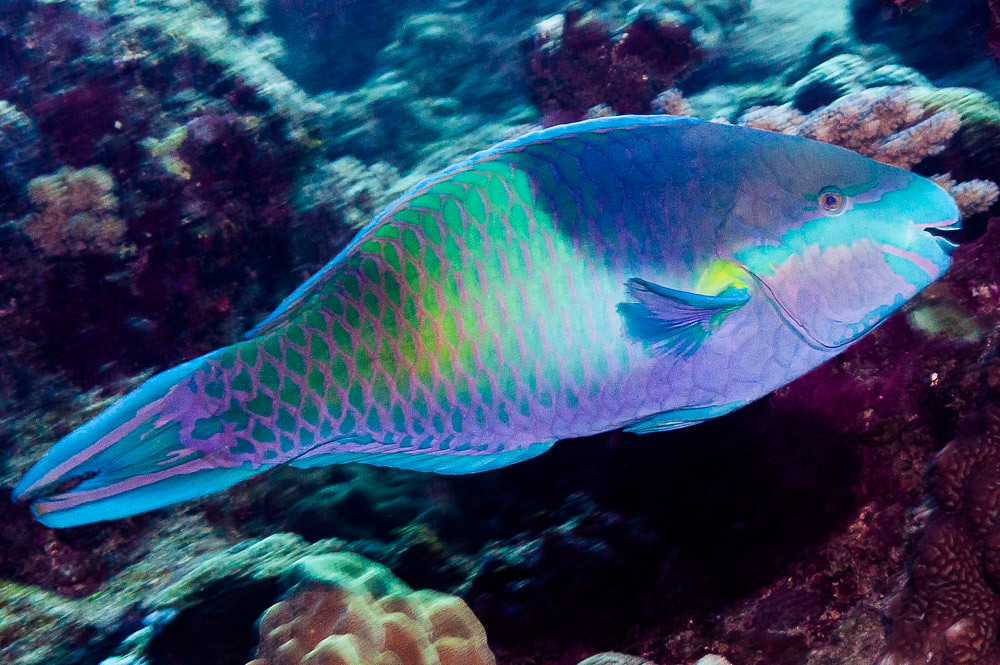
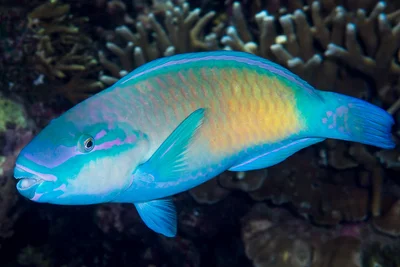
The beak is the family in one piece of anatomy. The teeth are not separate: they are fused into a pair of solid plates, upper and lower, forming a hard cutting edge that grows continuously from behind as the front wears away.
It has to. Biting rock destroys teeth, and a parrotfish takes tens of thousands of bites a day. A conventional set of teeth would be gone in a season. A beak that renews itself from the base is the only way to make a living from stone, and the enamel-like material at its tip is among the stiffest biological substances measured in any animal.
The scars are how you read a reef. Look at any large coral head here and you will find pale oval bite marks in rows across it, each one a mouthful. They heal over months, and on a reef with a healthy parrotfish population they are everywhere.
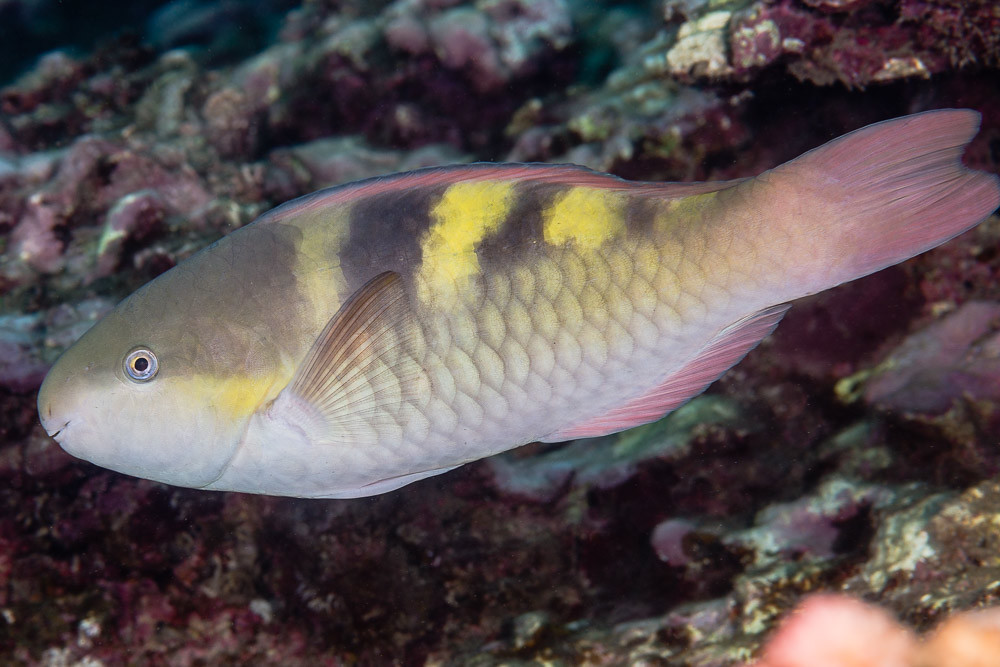
This species is a smaller shallow-water parrotfish with a row of five pale saddles along the back and a dark cap over the head, which is what the regional guide names it for: dusky-cap.
The genus.Scarus Forsskål 1775 - skaros (ancient Greek name of Sparisoma cretense). ETYFish
The species.Scarus scaber Valenciennes 1840 - rough. ETYFish
How to recognise it
row of five pale saddles along the back in initial-phase fish
dark cap over the top of the head, which the book names it for
fused white beak, often chipped
up to 37 cm
Why it's threatened
There are no major threats known for this species.
Parrotfishes show varying degrees of habitat preference and utilization of coral reef habitats, with some species spending the majority of their life stages on coral reefs, while others primarily utilize seagrass beds, mangroves, algal beds, and /or rocky reefs. Although the majority of the parrotfishes occur in mixed habitat (primarily inhabiting seagrass beds, mangroves, and rocky reefs) approximately 78% of these mixed habitat species are experiencing greater than 30% loss of coral reef area and habitat quality across their distributions. Of those species that occur exclusively in coral reef habitat, more than 80% are experiencing a greater than 30% of coral reef loss and degradation across their distributions. However, more research is needed to understand the long-term effects of habitat loss and degradation on these species populations. Widespread coral reef loss and declining habitat conditions are particularly worrying for species that depend on live coral reefs for food and shelter especially as studies have shown that protection of pristine habitats facilitate the persistence of adult populations in species that have spatially separated adult and juvenile habitats. Furthermore, coral reef loss and declining habitat conditions are particularly worrying for some corallivorous excavating parrotfishes that play major roles in reef dynamics and sedimentation (Comeros-Raynal et al. 2012).
Threat classification from the IUCN Red List.
Comments
Please, sign in to leave a comment
Continue with a social account - yours will be created automatically.