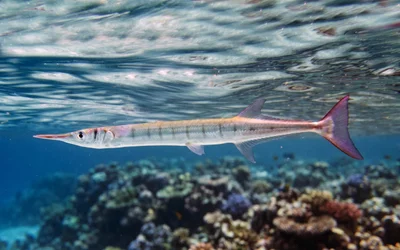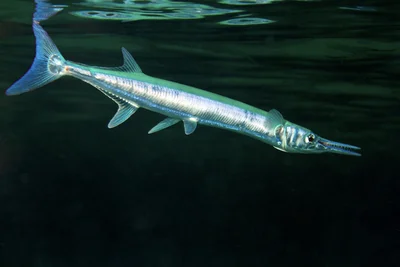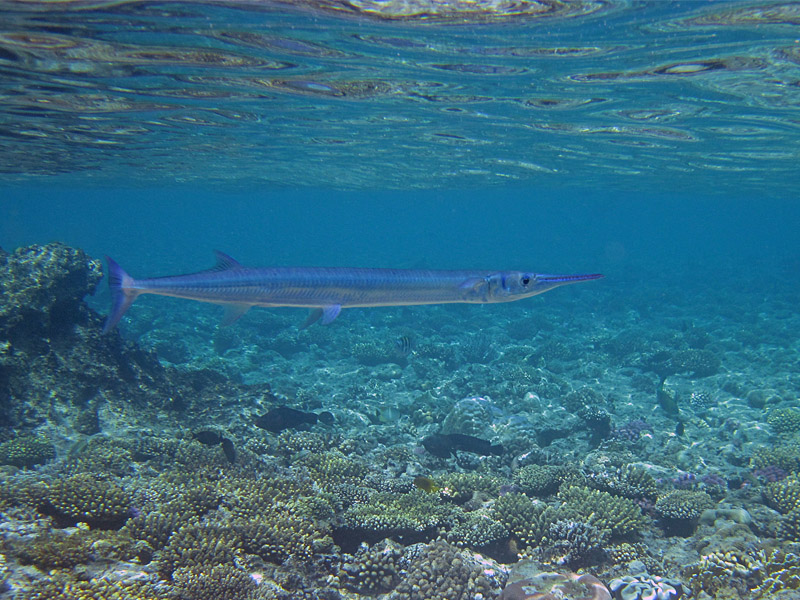
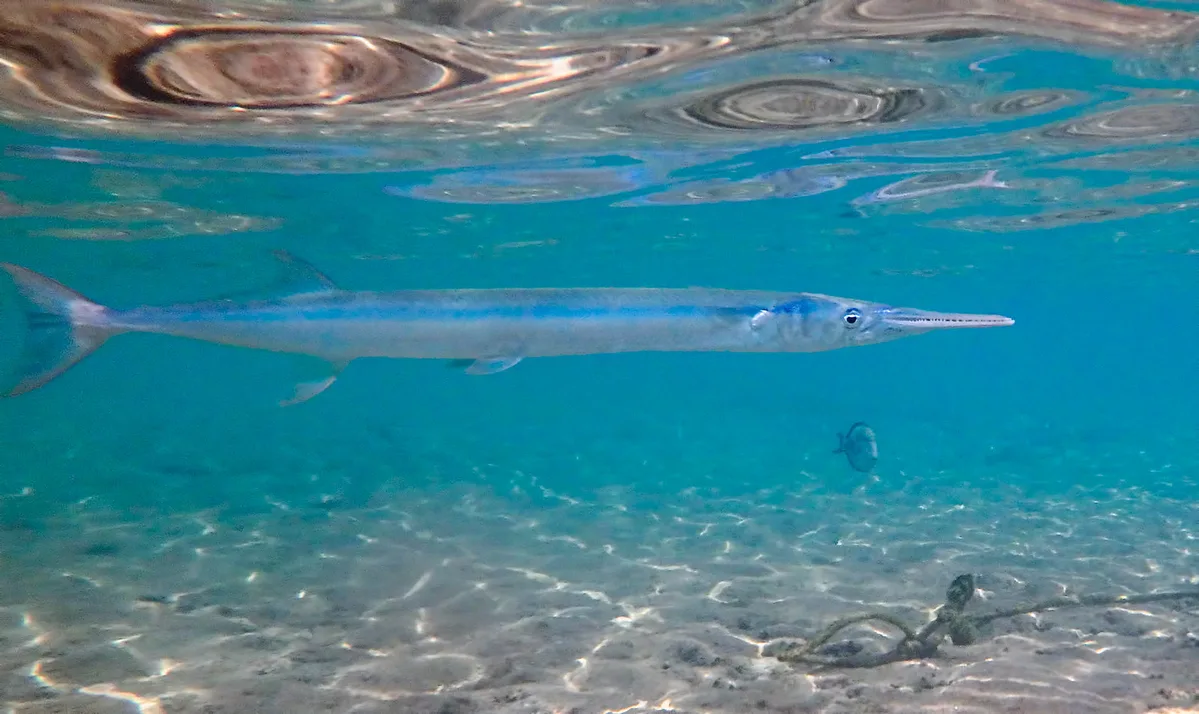
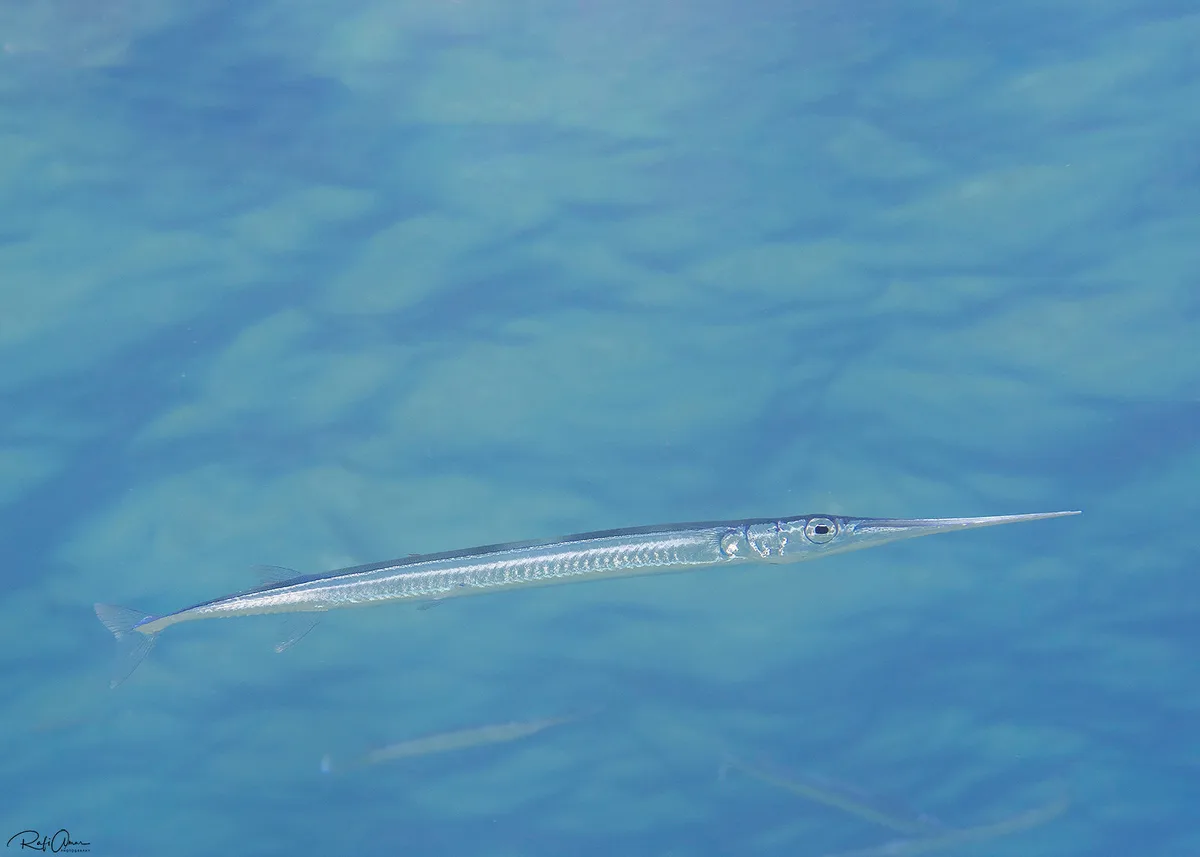
The needlefish of this sea: slim, silver, a meter or so long, lying at the surface in small groups above the reef flat with a beak full of fine teeth. Divers see it from below as a row of dark lines against the light, and snorkelers meet it face to face.
It hunts small schooling fish in the top half meter of water, where a fish looking up sees nothing but glare - which is the whole point of living in a layer everything else avoids. The green bones, incidentally, are real: needlefishes deposit biliverdin in their skeletons, and the flesh and bones of one on a market slab are startlingly green.
The hazard is the same as with its larger relative. A startled needlefish accelerates in a straight line at the surface, and at night a torch beam is what startles it. Injuries here are rare and not unknown.
Juveniles look like a different animal: the lower jaw grows out first and the young fish is a halfbeak for a while, with a short upper jaw, before the two catch up. The same equipment, used two ways, at two stages of one life.
The genus. Tylosurus Cocco 1833 - tylos (callus) + oura (tail). ETYFish
The species. Tylosurus choram (Rüppell 1837) - Arabic name for this fish. ETYFish
- slim silver fish at the surface with a long toothed beak
- blue-green back and a dark keel along the tail stalk
- usually in small groups, holding station against the current
- length up to 1.2 m
Why it's threatened
There is no directed fishery for Tylosurus choram in the Persian Gulf. It is collected as bycatch, however, this is not thought to be a major threat.
Threat classification from the IUCN Red List.