
MulletsMugilidae
Mullets eat the ground itself.
Almost every fish in this catalogue eats an animal or a plant. A mullet takes mouthfuls of the top millimeter of the bottom: sand, mud, the brown film of diatoms and bacteria growing on it, and the remains of everything that died upstream. That is the very bottom of the food chain, the material that is normally worked over by microbes and nothing larger, and mullets are one of the few vertebrates that have made a career of it. It is why a school of them moves across a shallow flat in a slow line with every head angled down and a haze of stirred sediment trailing behind.
The equipment is all downstream of that decision. The mouth carries almost no teeth worth the name, because nothing needs to be caught or cut. Behind it a fine filtering apparatus in the throat sorts what is worth keeping from the sand that came with it. Part of the stomach is a thick muscular chamber that mills the mouthful against the grit the fish swallowed on purpose, the same solution the surgeonfishes reached for algae, and the intestine that follows is several times the length of the fish, because food this poor has to be held a long time to be worth anything.
They are also indifferent to salt. The same species can be found in clear ocean water, in the wash of a harbor, in a lagoon at the top of a gulf that has evaporated to well above sea strength, and some distance up a freshwater creek, sometimes within one life. Gills that pump salt out in one of those places have to hold it in at another, and mullets switch between the two jobs as a matter of routine.
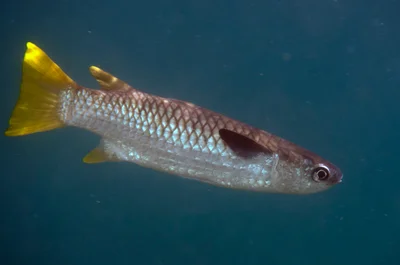
Living low on the chain has made them the world's pond fish. A mullet grows on what a pond produces by itself, with nothing added, which is why they have been farmed along this coast and in the Nile delta for a very long time. Their salted, pressed and dried roe, batarekh, is among the oldest preserved foods still sold in 🇪🇬 Egypt. Six are listed here, and they are the fish you see from a jetty rather than on a reef: blunt-headed, silver, two clearly separated dorsal fins, and in several species a transparent fatty eyelid grown partly across the eye.
- elongate, somewhat cylindrical body
- large, silvery scales
- two widely separated dorsal fins
- constantly sifting sand or grazing algae
6 species in Mullets




Other elongated groups
Similar silhouette underwater - worth a look if this was not your animal.


Last Update: August 23, 2026