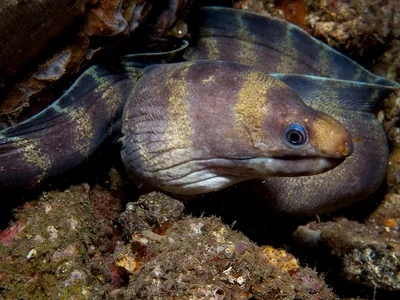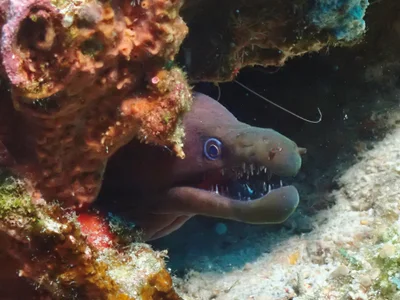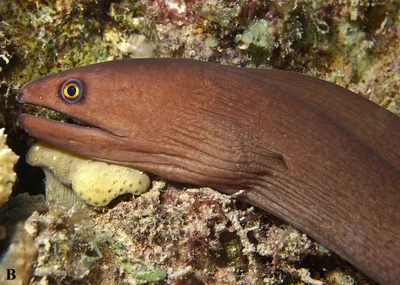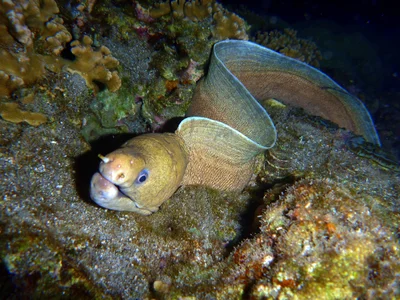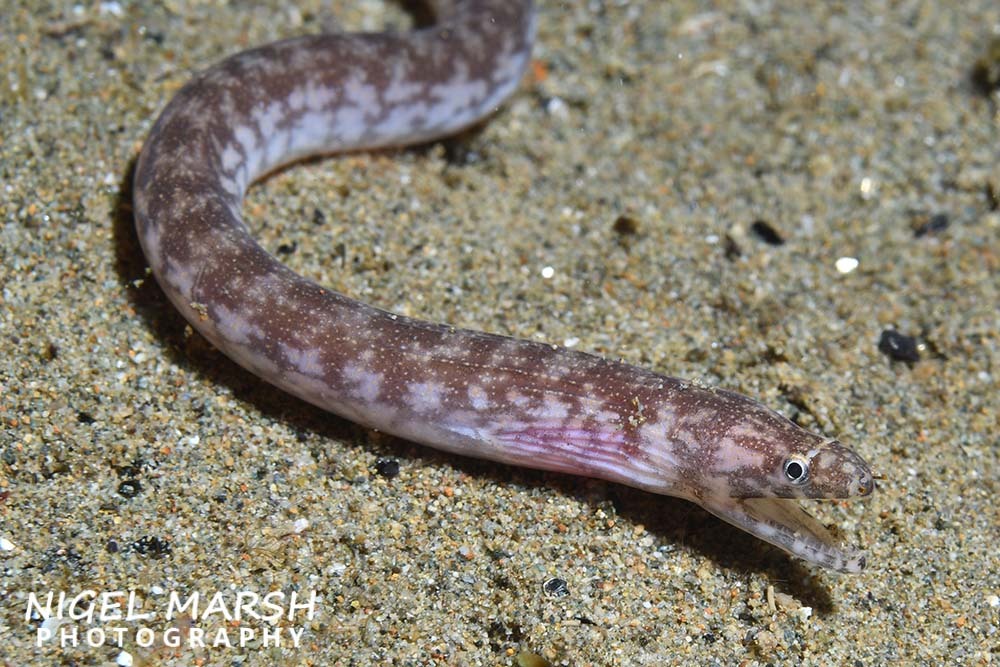
The net is not drawn on. What looks like a pale mesh over the body is the gaps between dark blotches: the blotches grew until they touched, and what is left of the original background is the lines between them. Most reticulated patterns in animals work this way, which is why they get finer where the blotches are denser and open out where they are not, and why no two individuals carry quite the same net.
That matters for identification more than it sounds. Half the small morays here are distinguished on pattern, and pattern of this kind changes as the animal grows and the blotches spread. A young eel and an old one of the same species can look meaningfully different, which is one reason this group has been named, renamed and merged repeatedly.
The species name comes from Nago, on Okinawa (🇯🇵 Japan), where it was first described. It reaches eighty centimeters, which makes it one of the larger snakemorays, and it lives the same way as the rest: inside the reef, out at night, essentially never seen.
The genus. Uropterygius Rüppell 1838 - uro (tail). ETYFish
- pale network over a darker ground, finer toward the tail
- round body with fins reduced to low ridges
- up to 80 cm
Why it's threatened
There are no major threats known to this species. However, it may be impacted by coastal development and habitat degradation in some parts of its range.
Threat classification from the IUCN Red List.