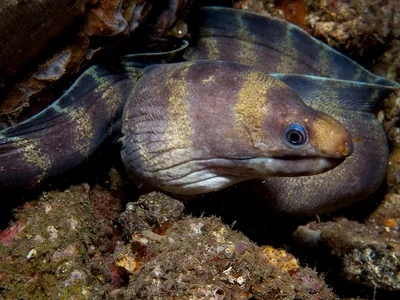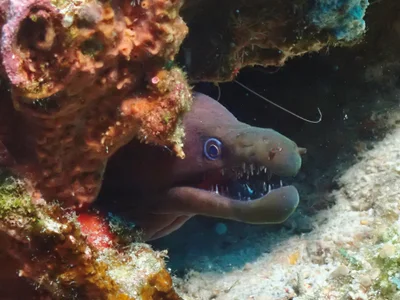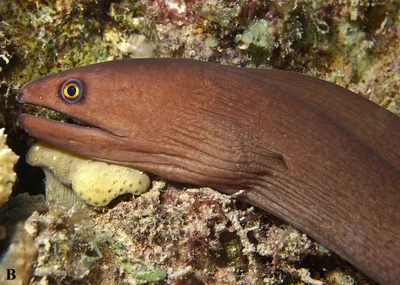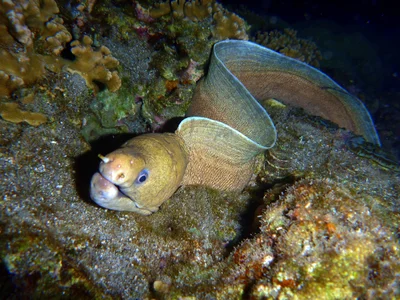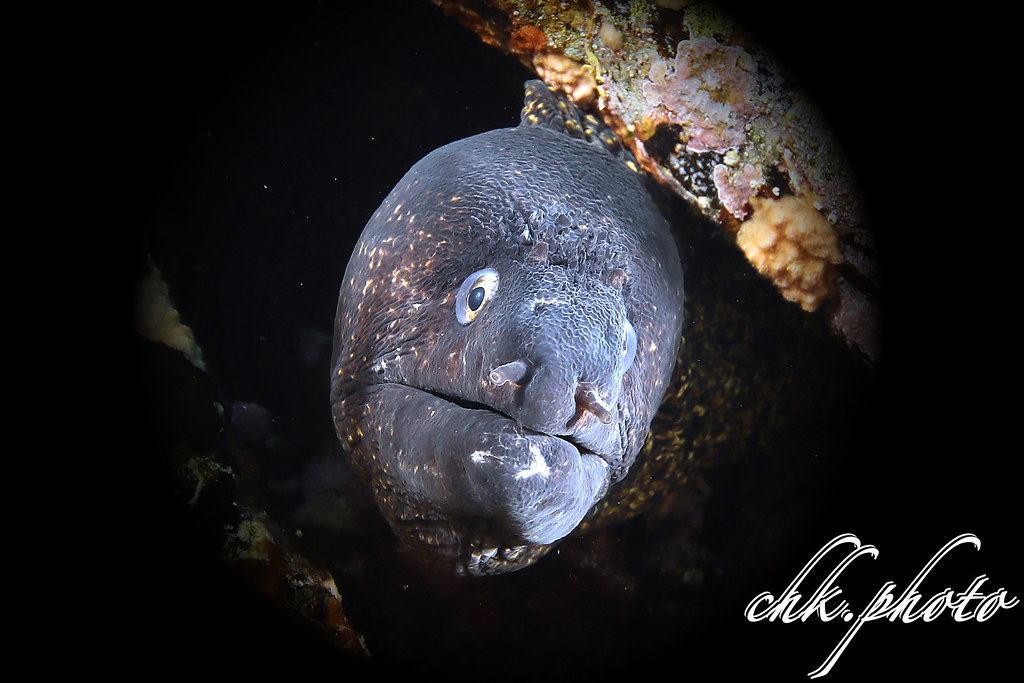
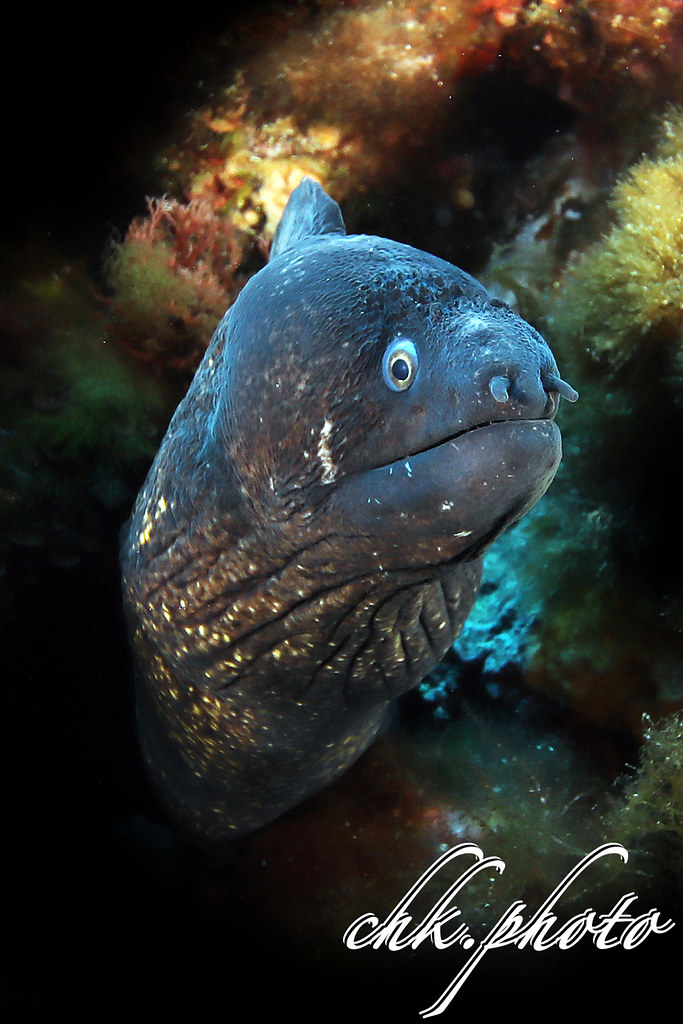
A plain brown moray with no markings whatsoever, a meter (3 ft) long, in shallow water that is often too murky to see it in anyway.
Which raises the question of how it hunts, and the answer is that eyes barely come into it. Morays have poor vision and enormous nostrils - two pairs, the front pair in raised tubes, drawing a constant stream of water over an olfactory organ that fills much of the head. A moray tracks prey by smell the way a dog does, and it can find a wounded fish in a reef it cannot see at all.
That is also why they turn up at spearfishing, and why feeding them is such a bad idea: an animal that associates human smell with food and cannot see well enough to distinguish a hand from a fish is a predictable accident.
It takes fish, octopus and crustaceans at night, and spends the day wedged into a hole with only its head out.
The genus. Gymnothorax Bloch 1795 - gymnós (bare or naked) + thṓrax (breast or chest). ETYFish
- uniform brown body with no pattern at all
- paler below, darker toward the tail
- short snout, small eye
- length up to 100 cm
Why it's threatened
There are no major threats known to this species. However, it may be impacted by coastal development, pollution and habitat degradation in parts of its range.
Threat classification from the IUCN Red List.