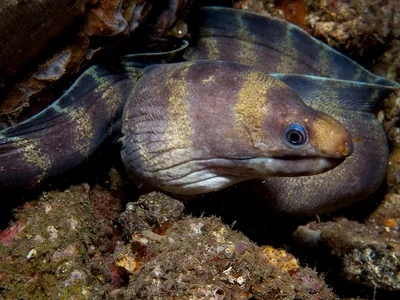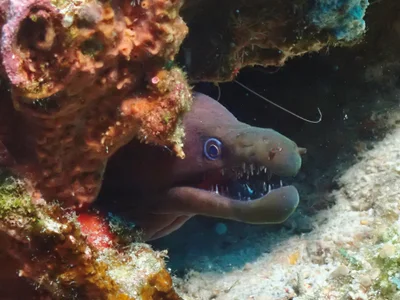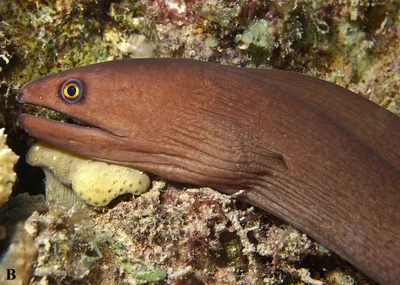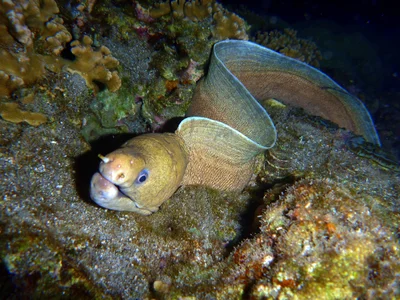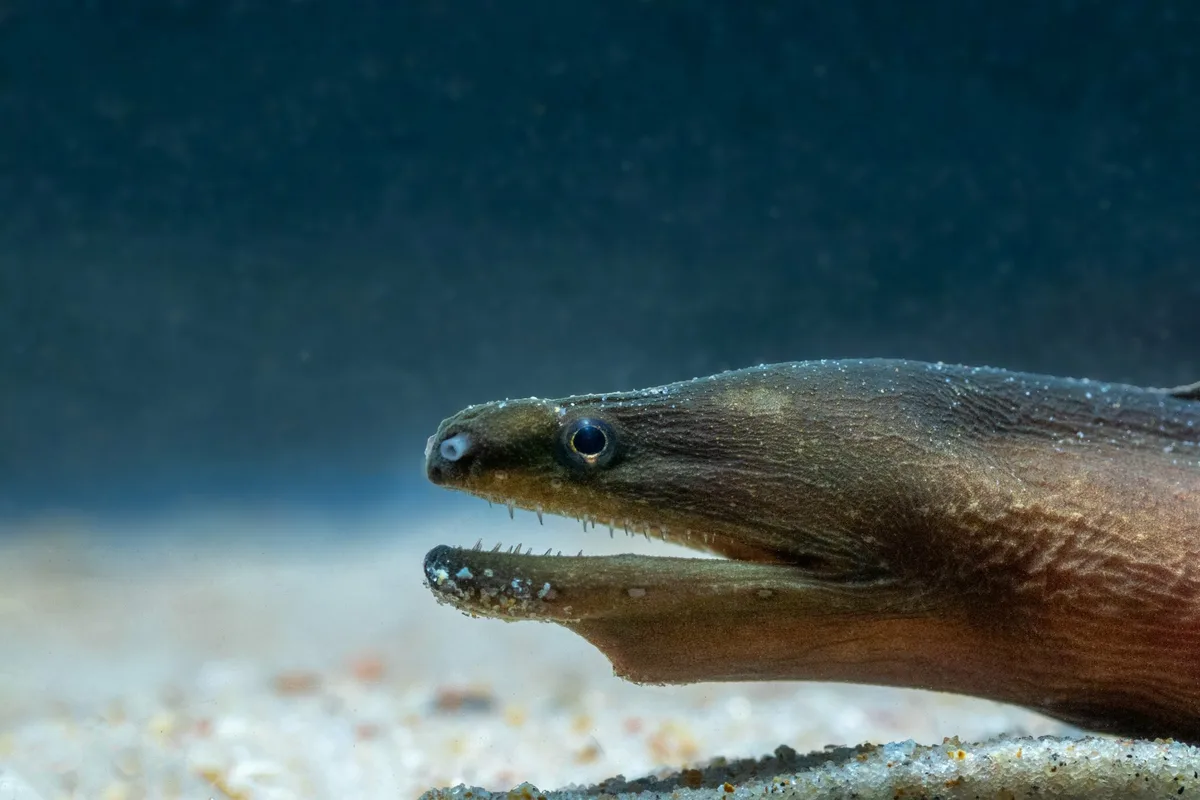
The longest moray in the world - four meters (13 ft) of eel, most of it tail, living in mud rather than coral. It is also one that almost no diver has seen, because it lives where nobody dives: silty bays, estuaries, harbor bottoms and river mouths.
Everything about it is stretched. The head is small, the body is thin, and more than half the total length is behind the vent, which lets the animal thread itself into burrows in soft sediment and reverse out again. Where a reef moray occupies a hole in rock, this one makes its own in mud.
It tolerates brackish water and goes well up into estuaries, which is unusual for a moray and part of why the species is so rarely recorded - the habitat is unattractive, the water is turbid, and a four-meter animal in it is invisible.
Like all morays it has a second set of jaws in the throat that reach forward to drag prey down. A bite from an animal this size is a serious injury; the flag on this card reflects that rather than any tendency to use it.
The genus. Strophidon McClelland 1844 - strophḗ (turning point). ETYFish
- extremely long thin brown body, the tail more than half the total length
- small head for the size of the animal, eyes set well forward
- in mud and silt rather than on coral
- length up to 4 m
Why it's threatened
Although this species is harvested and consumed on a local scale (Castle 1984, Ho et al. 2015, Psomadakis et al. 2020), this is not thought to negatively affect the population. There are no known major threats.
Threat classification from the IUCN Red List.