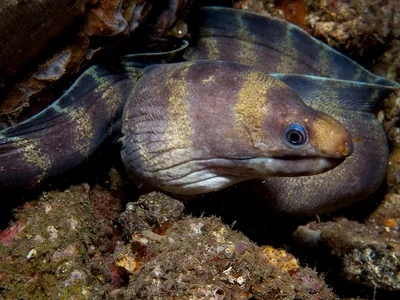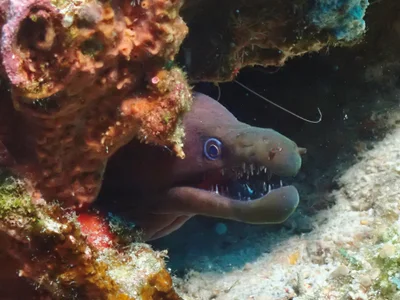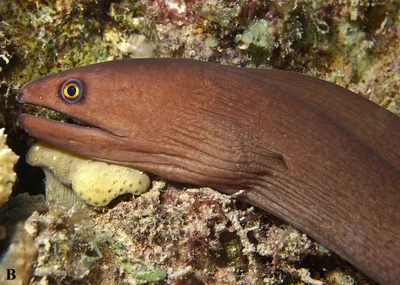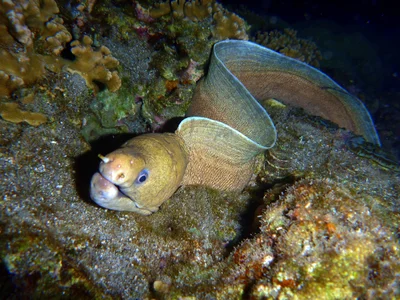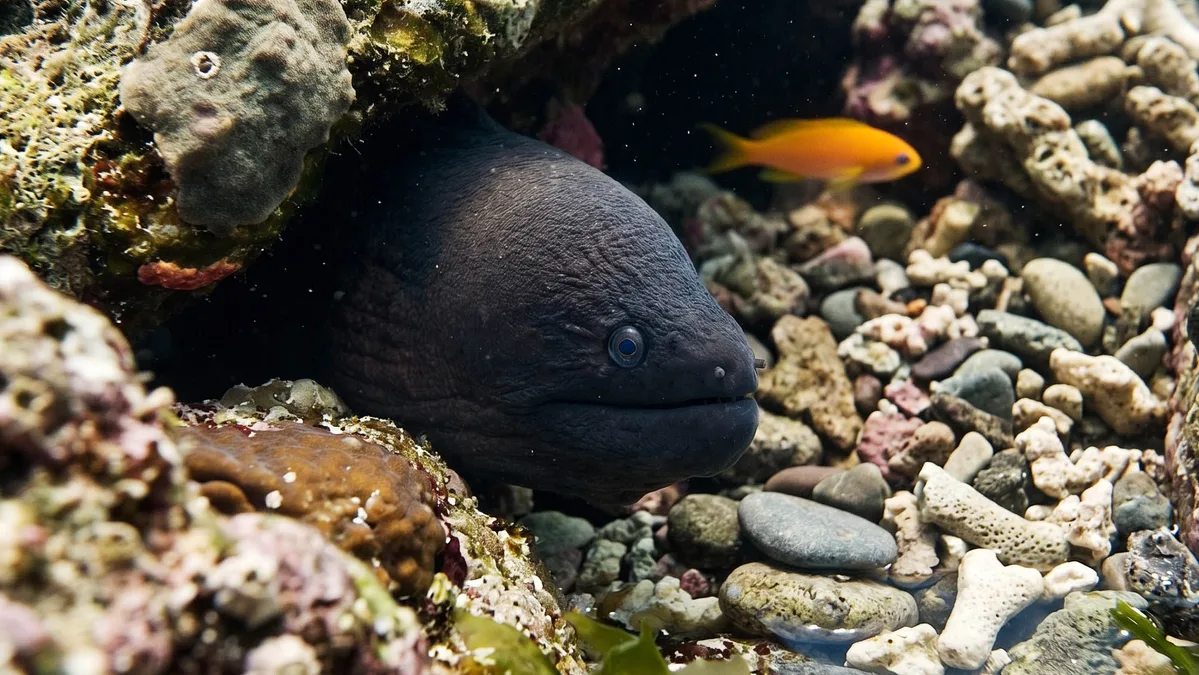
A thin brown eel with no fins to speak of, living so deep inside rubble that it is almost never seen whole. Forty-five centimeters (18 in).
The snakemorays gave up the fin that runs along a normal moray's back and tail, keeping only a trace of it at the very end. What is left is a smooth cylinder, and that is the point: an animal shaped like a rope can push through gaps in rubble that no finned eel could enter, hunting small fish and crustaceans inside the reef itself rather than out on it.
They are also among the eels that can survive out of water for extended periods, breathing through the skin, which matters in the shallow rubble and intertidal zones where they live.
Named for Daniel Golani, who has spent a career on the fishes of this region and the Lessepsian migrants moving through Suez. Finding one is a matter of turning rubble, which is why it is best not to look for it.
The genus. Uropterygius Rüppell 1838 - uro (tail). ETYFish
The species. Uropterygius golanii McCosker & Smith 1997 - Honours Israeli ichthyologist Daniel Golani. ETYFish
- slender brown eel with almost no visible fin at all
- tail tip blunt and rounded, without the fin fringe of a true moray
- nostrils in short tubes at the tip of the snout
- length up to 45 cm
Why it's threatened
Threat classification from the IUCN Red List.