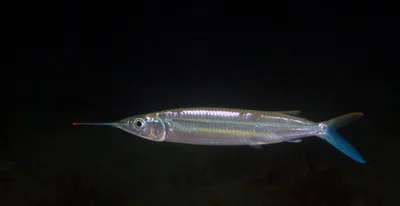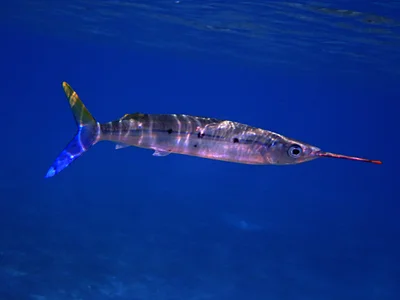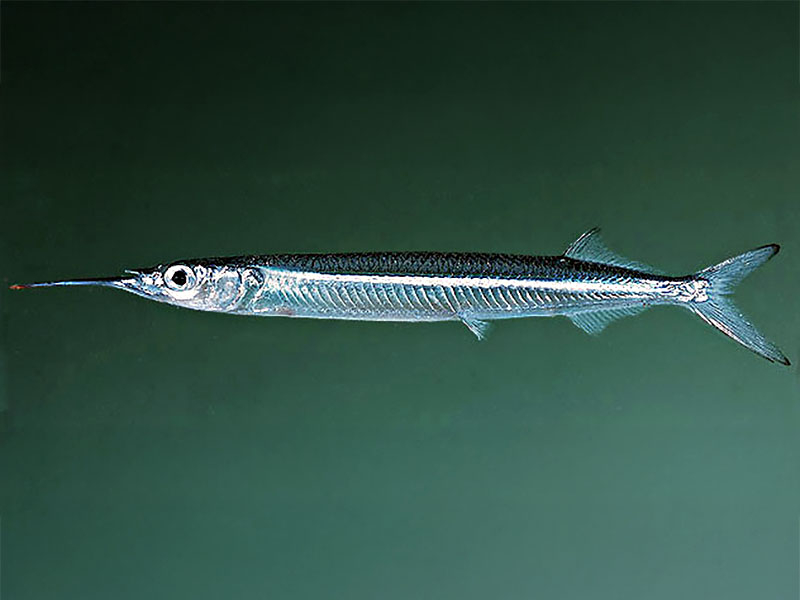
A slim silver fish lying just under the surface, with a lower jaw extended into a long beak tipped in orange and an upper jaw that stopped at normal size. That asymmetry is the whole family and it is the opposite of what a needlefish does with the same starting material.
The beak is a scoop, not a spear. Halfbeaks feed on floating algae, seagrass fragments and small animals at the surface film, and the long lower jaw skims through that layer while the short upper jaw closes on what it catches. Young needlefish, incidentally, pass through a halfbeak stage before the upper jaw grows out - the same equipment, used two ways.
Living at the surface makes them everyone's food. Halfbeaks are the staple of terns, jacks, needlefish and anything else hunting the top meter of water, and they escape by skittering across the surface on the lower lobe of the tail rather than diving.
They are also the reason a night boat should keep its lights pointed down: a spooked school skips across the surface, and every fish here that jumps toward a light is a hazard to whoever is standing in the way.
The genus. Hyporhamphus Gill 1859 - hypo- (below) + rhamphus (beak). ETYFish
The species. Hyporhamphus gamberur (Rüppell 1837) - from Massaua Gamberur. ETYFish
- slim silver fish just under the surface, with only the lower jaw extended into a beak
- beak tipped bright orange-red
- swims in loose schools right at the surface, scattering when disturbed
- length up to 37 cm