The first specimen science ever saw of this fish came off a rope. In October 2009 a collector working the wreck of the Umbria, a few miles east of Port 🇸🇩 Sudan, found a line hanging from the ship at 23 meters with a coat of red sponge growing on it, and a goby living on the sponge. That animal, a male of 24.5 millimeters, became the holotype when the species was described in 2012.
It is a 🌊 Red Sea animal and nothing else. Beyond the Sudanese wreck it is known from the southeast Sinai coast, and that is close to the whole record; the fish was new to science well inside living memory and has been photographed by very few people since.
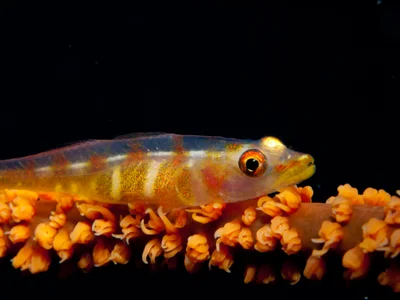
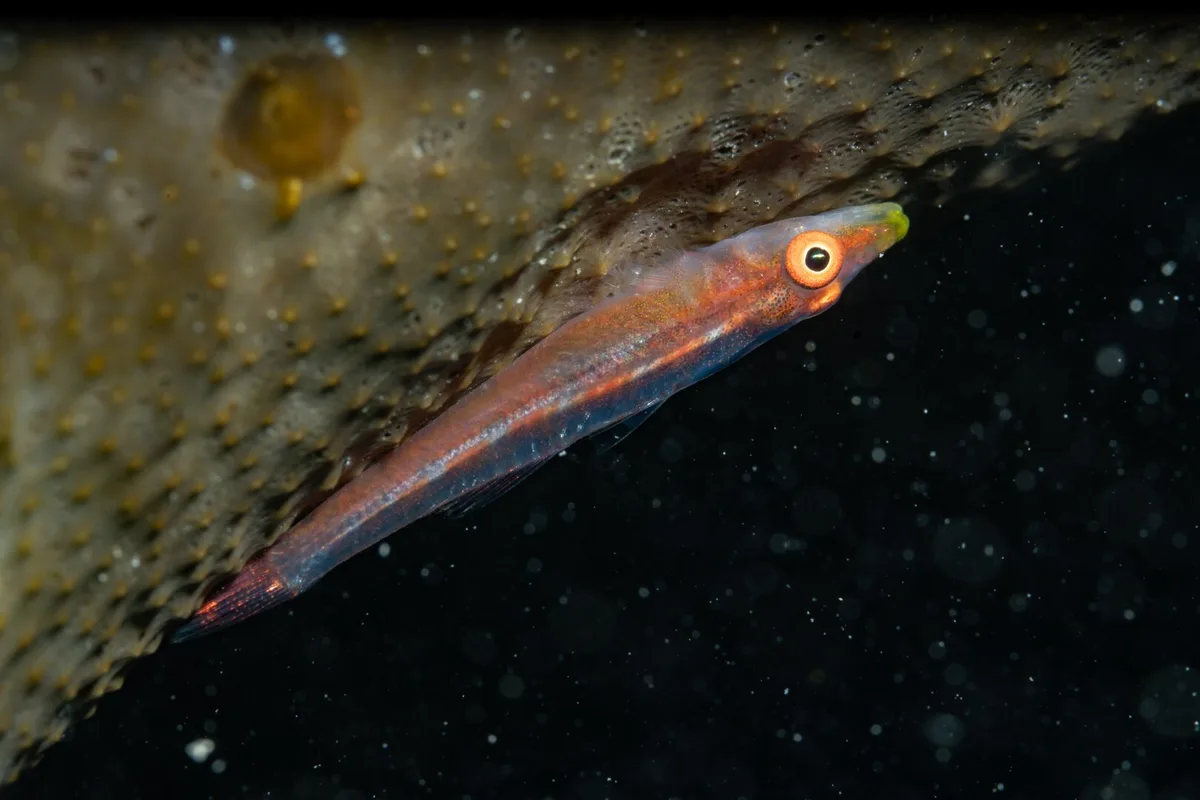
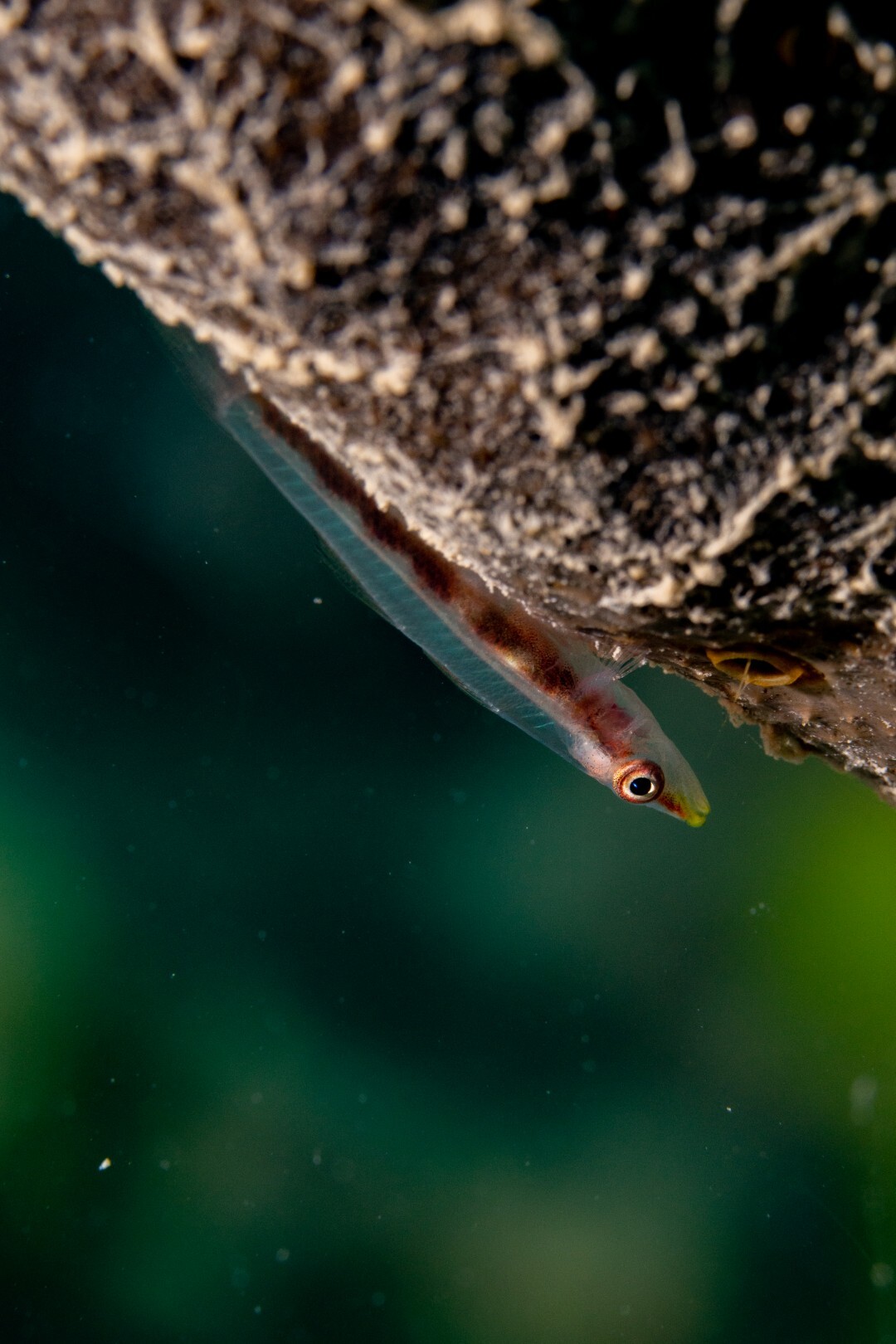
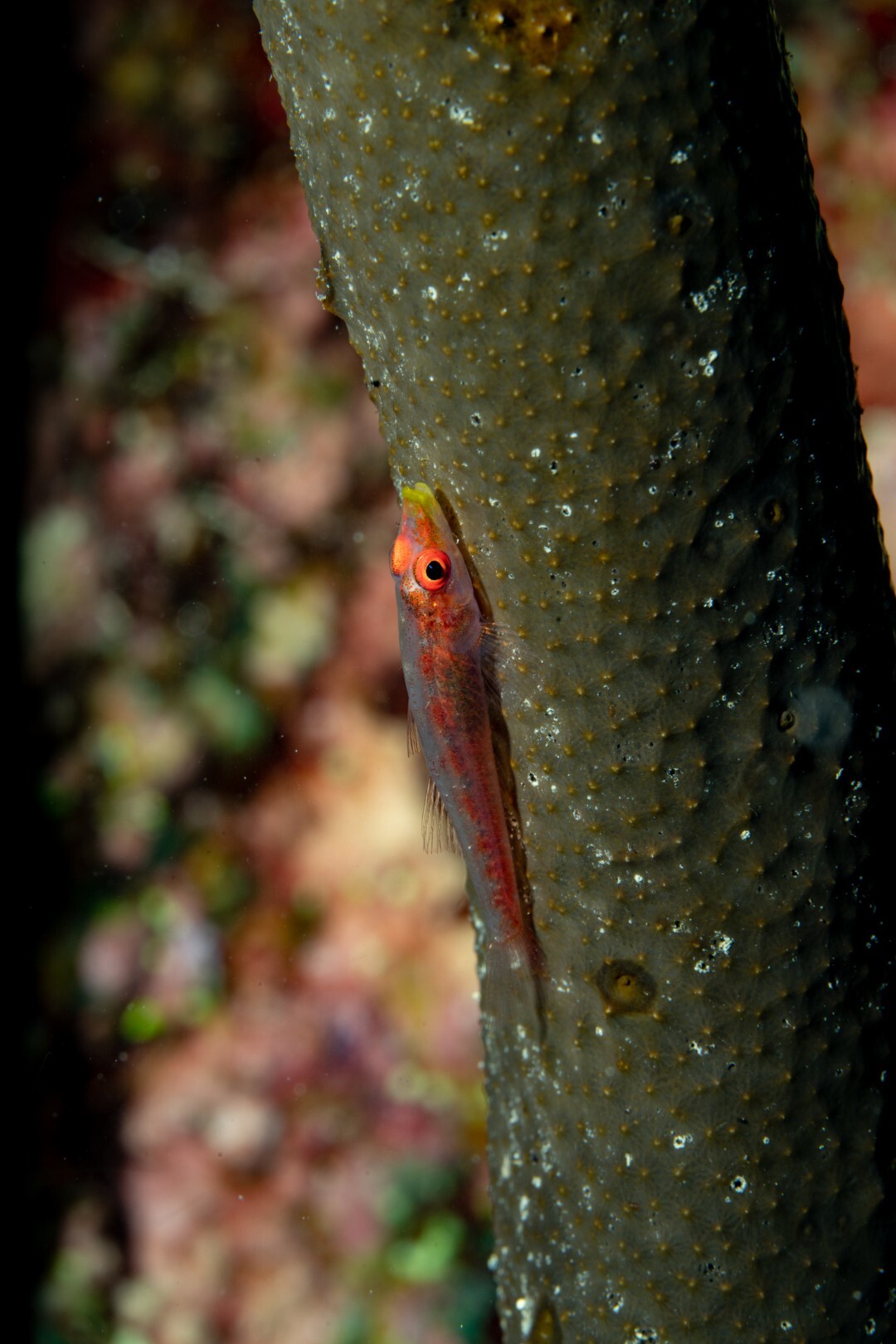
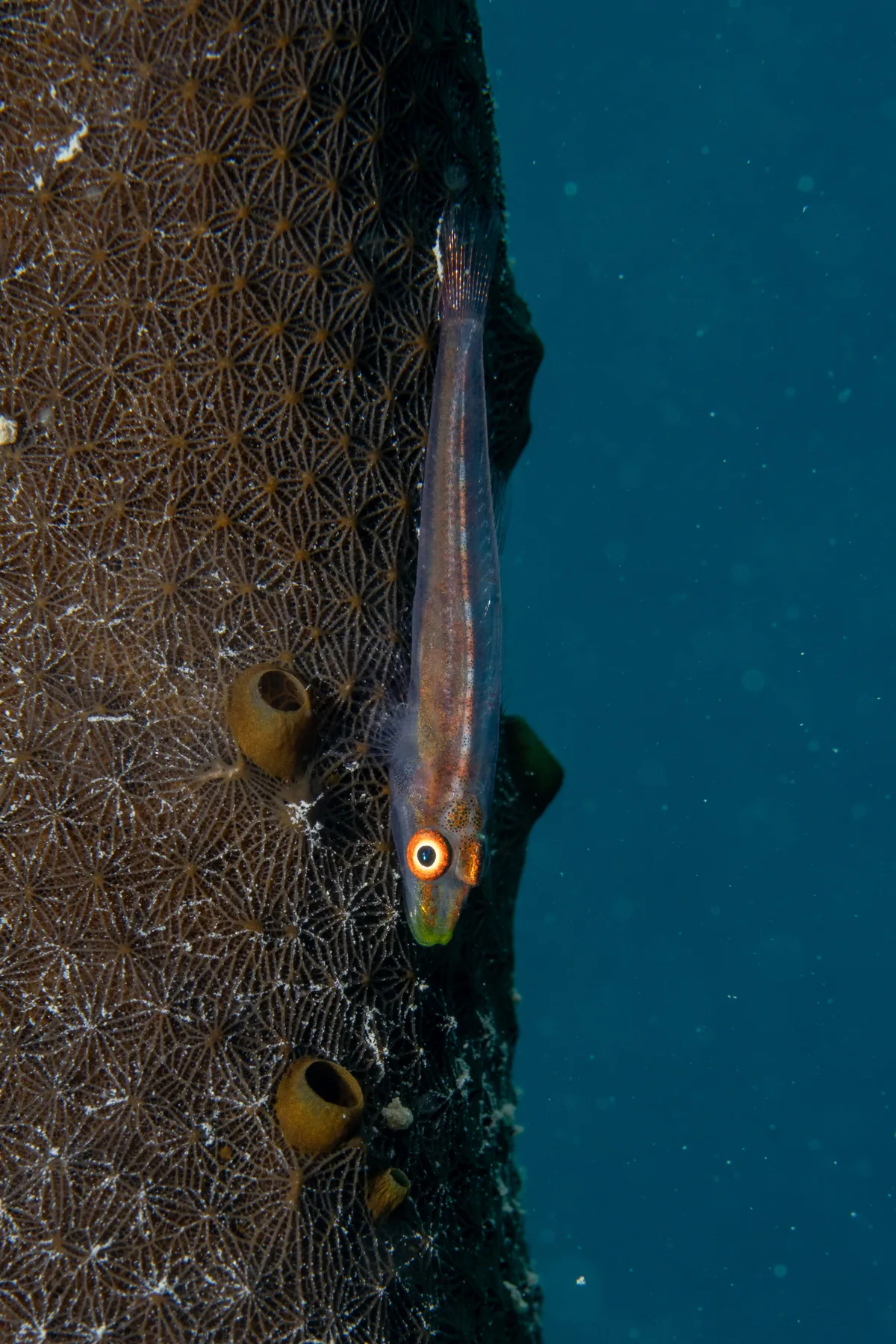
The head is the giveaway. The snout is long and flat, more than a third of the length of the head, which is unusual even in a genus of odd-looking gobies, and a blackish stripe runs from the eye forward to the front of the jaws. The body is translucent with a dusky yellow wash over the belly, the snout is yellowish, and there are scattered dark spots on the head behind the eyes. Two pairs of curved canine teeth sit in each side of the lower jaw, which is a serious set of hardware on a fish 25 millimeters long.
The species name means sponge dweller and it is literal. Look on red sponges - on walls, on overhangs, on anything artificial that a sponge has colonized - and look at the sponge itself rather than the water around it. The goby clings to the surface with its fused pelvic disc and moves in short shuffles.
Call it rare and mean it. A 2.5 centimeter translucent fish on a red sponge at 20-odd meters is not something you find by swimming past; you find it by stopping.
The genus. Bryaninops Smith 1959 - ṓps (eye or face). ETYFish
The species. Bryaninops spongicolus Suzuki, Bogorodsky & Randall 2012 - spongia (sponge) + -cola (dweller or inhabitant). ETYFish
- sits on red sponge, not on coral or sand
- long flat snout, over a third of the head length
- blackish stripe from the eye forward to the jaws
- translucent body, dusky yellow over the belly
- up to 2.5 cm
Why it's threatened
Major threats to this species are unknown.
Threat classification from the IUCN Red List.