
Ghost pipefishesSolenostomus
In this family it is the female who carries the eggs. That is the reverse of the arrangement everybody knows from seahorses and pipefish, and it is the fastest way to grasp that these animals are not pipefish at all but a small separate family standing beside them. Her pelvic fins, which in most fishes are two unremarkable paddles under the chest, are enlarged and joined edge to edge into a basket held against the belly, and the eggs are carried inside it on fine threads with water pumped through them. Where you find two, the larger is the female and the small one keeping station behind her is the male.
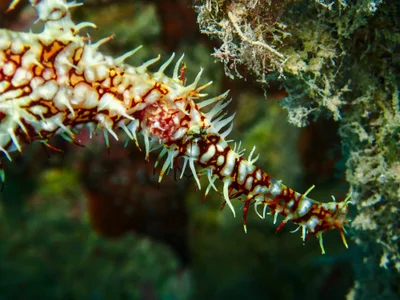
A ghost pipefish is a visitor to the bottom rather than a resident of it. The young drift for a long stretch in open water, glassy and almost unpigmented, and settle late. Once down, an individual takes on the color and the broken outline of whatever it settled into, crinoid arms or dead weed or a seagrass blade, grows skin flaps to match, then pairs, breeds and is gone. The adult life is thought to be measured in months rather than years, which is why they behave like weather rather than like residents.
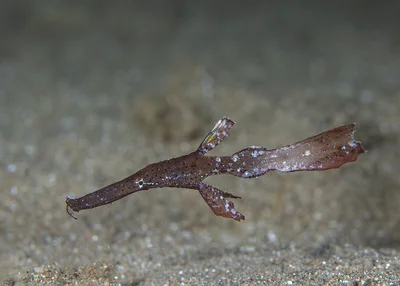
Head down is the working position. It hangs with the snout aimed at the bottom, tilted, riding the surge, and takes tiny crustaceans off the substrate and out of the water directly beneath it with a snout built for suction. It does not bolt when it is found. It tilts away and goes on hanging, and it will let a diver settle in close.
Two species are listed here. Both turn up seasonally and unpredictably, in ones and twos, and a site that held one last month usually holds nothing this month. Finding them is a matter of guides passing information along the coast rather than of knowing a reliable spot, and a ghost pipefish is the sighting that gets a phone call.
- highly compressed, elongated body
- upturned, pipette-like snout
- large, often fringed or tasseled fins
- hovers head-down or horizontally, swaying with currents
- mimicking floating debris, seagrass blades, or crinoid arms
2 species in Ghost pipefishes
Other odd-shaped groups
Similar silhouette underwater - worth a look if this was not your animal.


Last Update: August 23, 2026