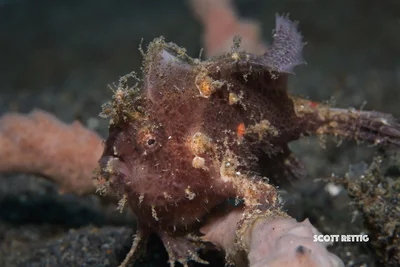
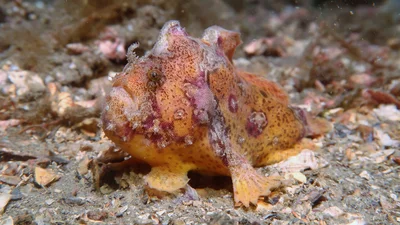
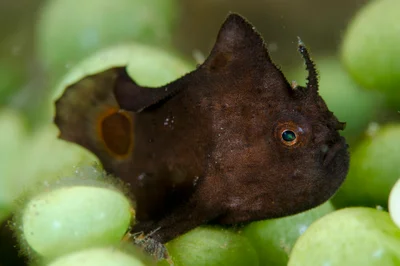
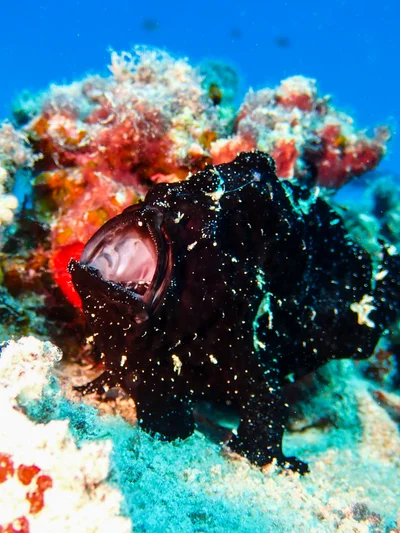
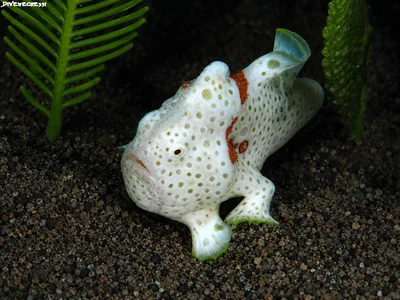
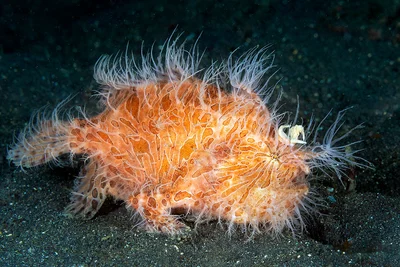
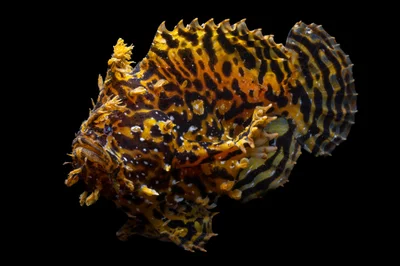
The lump on the sponge is an anglerfish. Not a lookalike and not a distant cousin: frogfishes sit inside Lophiiformes, the order that also holds the goosefish that comes up in trawls, the flattened batfishes that walk around on deep sand, the handfishes of Tasmania, and the black balloon with a lit lure that every documentary about the deep sea eventually reaches.
One bone holds that group together. In every anglerfish the first spine of the dorsal fin has migrated forward onto the snout, cut its connection to the fin behind it, and grown a bait on the tip. A frogfish waves a fleshy one; the deep-sea species light theirs with bacteria. What a frogfish does with that rod, and the strike that follows it, belongs to the species pages below.
The deep branch of the order does something no shallow one does, and it is worth knowing what your reef animal is related to. In many of those species the male is a fraction of the female's size, finds her in the dark, bites down and never lets go. The two bodies grow together, the blood systems join, and the male finishes as an attachment on her flank supplying sperm and nothing else. The genetics came out in 2020: the lineages that do this have dismantled much of their adaptive immune system, the machinery that would otherwise reject another animal's tissue on contact. They can fuse because they gave up the ability to tell self from other.
Frogfishes kept the immune system and stayed in the light, and they solved a different problem: how to move without being seen to move. The gill openings are reduced to two small tubes tucked in behind the pectoral fins, and a frogfish that wants distance takes a mouthful of water and blows it out of them, traveling on the jet with the body held still.
Seven are listed here, from a giant that fills two hands down to species a few centimeters long, plus the sargassum fish, which lives in drifting weed instead of on the bottom.
How to recognise frogfishes
IrregularNo standard fish outline - seahorses, frogfishes, ghost pipefishes.
- stocky, globular body, often with warty skin or flaps
- cryptic coloration, blending perfectly with surroundings
- modified limb-like pectoral fins used for 'walking'
- modified dorsal fin spine (lure) above mouth
- large, upward-pointing mouth