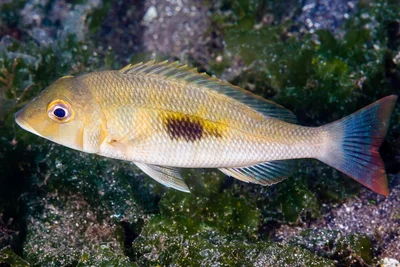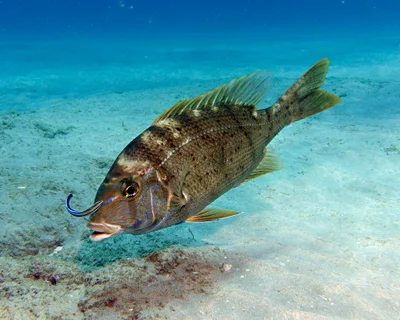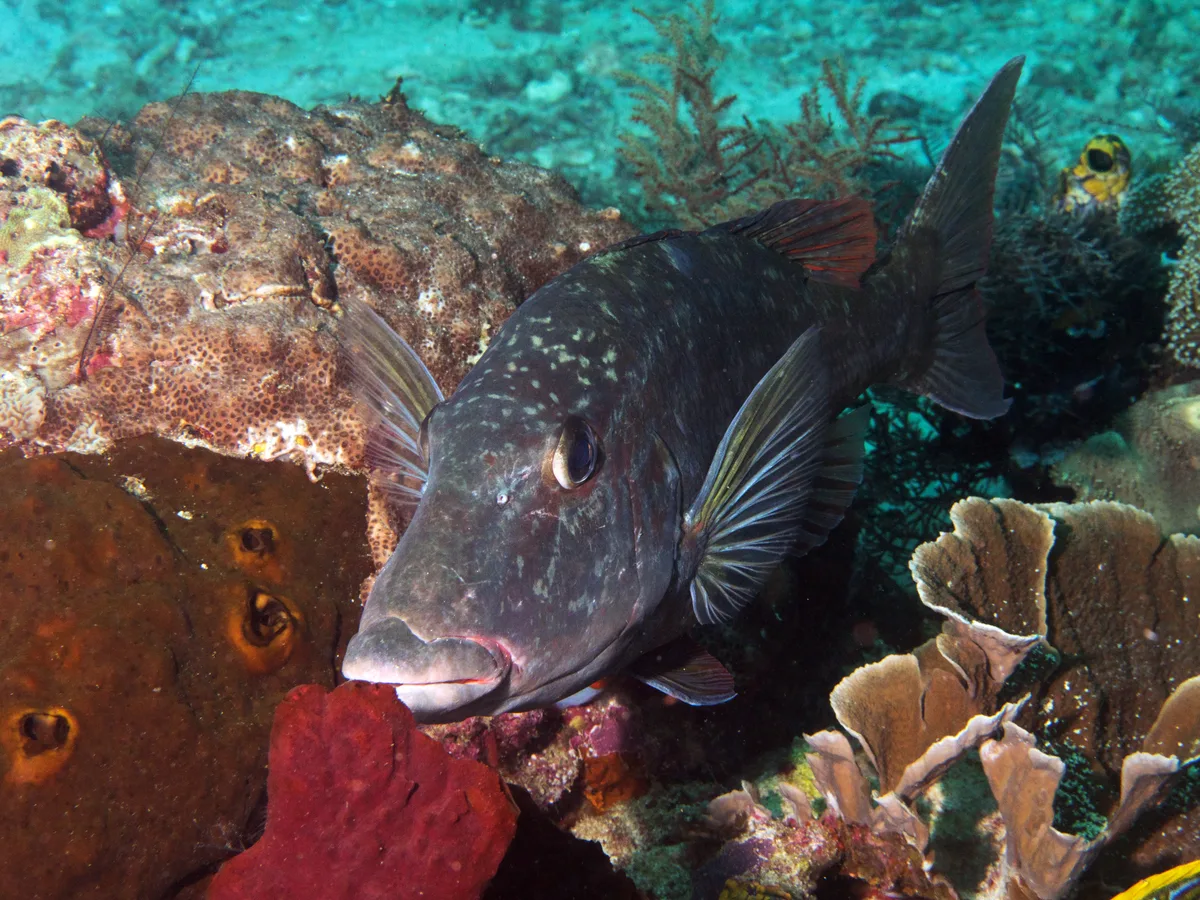
Lethrinus olivaceus, commonly known as the longface emperor or long-nosed emperor, is a marine ray-finned fish belonging to the family Lethrinidae, classified under the order Spariformes. It exhibits a widespread distribution across the Indo-Pacific, from the 🌊 Red Sea and East Africa to 🇼🇸 Samoa and the Ryukyu Islands (🇯🇵 Japan). The species was first described by French zoologist Achille Valenciennes in 1830, with Anyer in West Java, 🇮🇩 Indonesia identified as its type locality. Although Lethrinus longirostris was previously considered synonymous, it was confirmed as a distinct species in 2022 based on morphological and genetic differences.
The longface emperor has a body whose length is approximately 2.8 to 3.4 times its depth, characterized by an elongated snout, which may develop a hump in larger specimens. Its coloration is predominantly olive gray, highlighted by irregular dark blotches and sinuous dark lines on the snout. The dorsal fin comprises 10 spines and 9 soft rays, while the anal fin consists of 3 spines and 8 soft rays. Notably, the inner pectoral fin axilla lacks scales. Typically, individuals grow to about 70 cm, with a maximum documented length of 100 cm.
Lethrinus olivaceus is primarily associated with reefs and is found in habitats such as lagoons, sandy coastal areas, and reef slopes at depths ranging from 1 to 185 meters. These active and fast-swimming fish frequently form large schools, though adults are generally solitary. They occasionally associate with Lethrinus microdon in smaller groups. Their diet primarily consists of crustaceans, cephalopods, and fish.
The longface emperor is often targeted in fisheries using handlines, fish traps, trawling, and gillnetting. In regions like 🇳🇨 New Caledonia (🇫🇷 Overseas France) and possibly other areas of Oceania, it has been identified as a cause of Ciguatera fish poisoning.
The species. Lethrinus olivaceus Valenciennes 1830 - olive-colored. ETYFish
Why it's threatened
This species is susceptible to overexploitation.
Threat classification from the IUCN Red List.