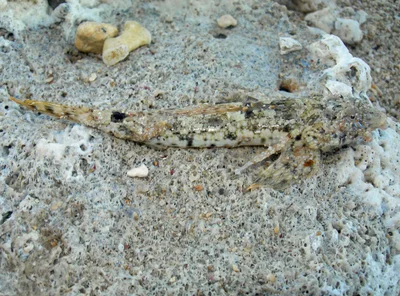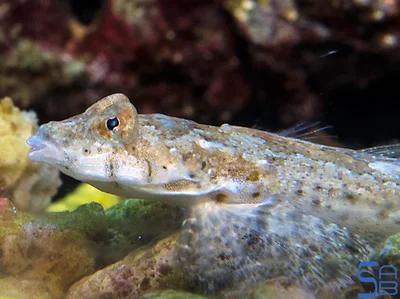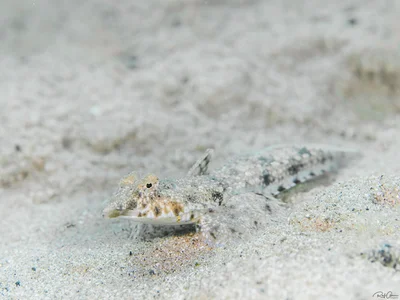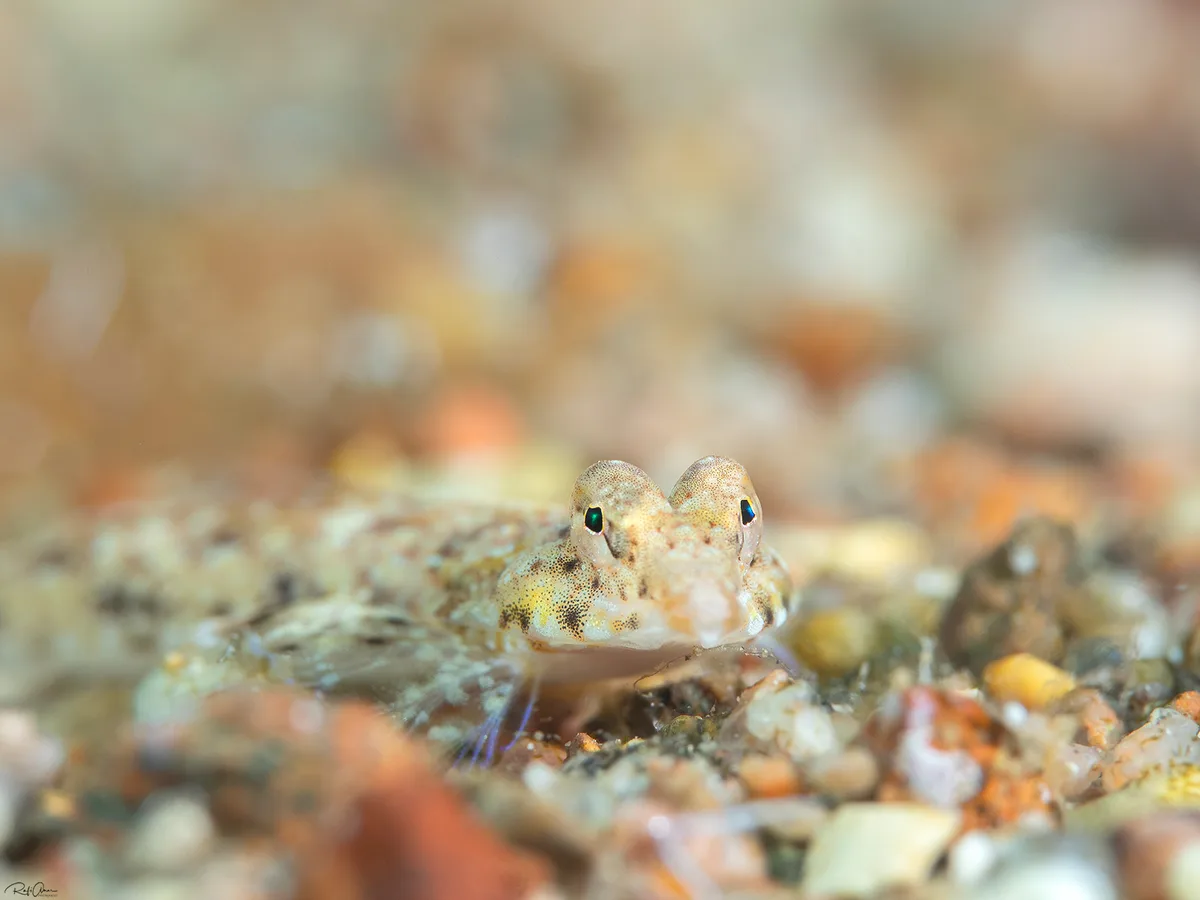
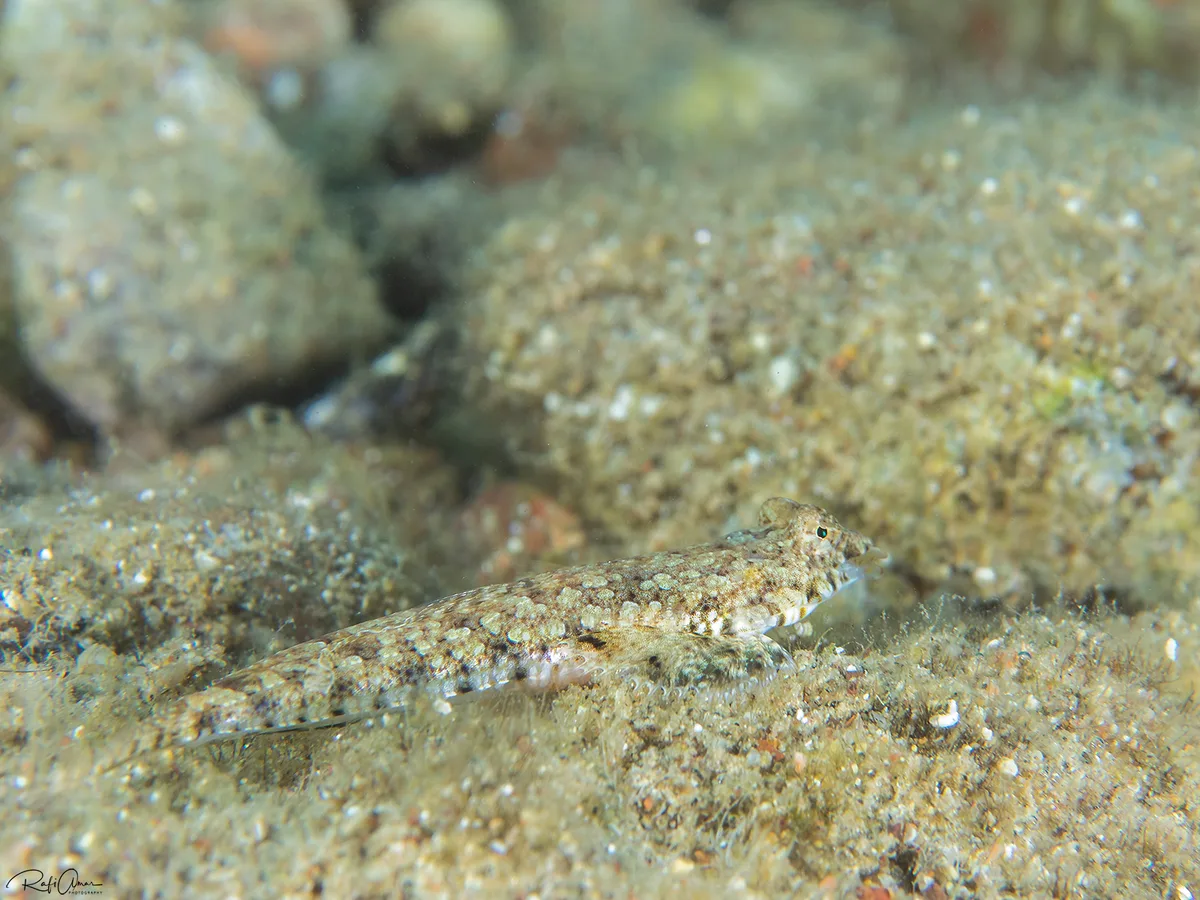
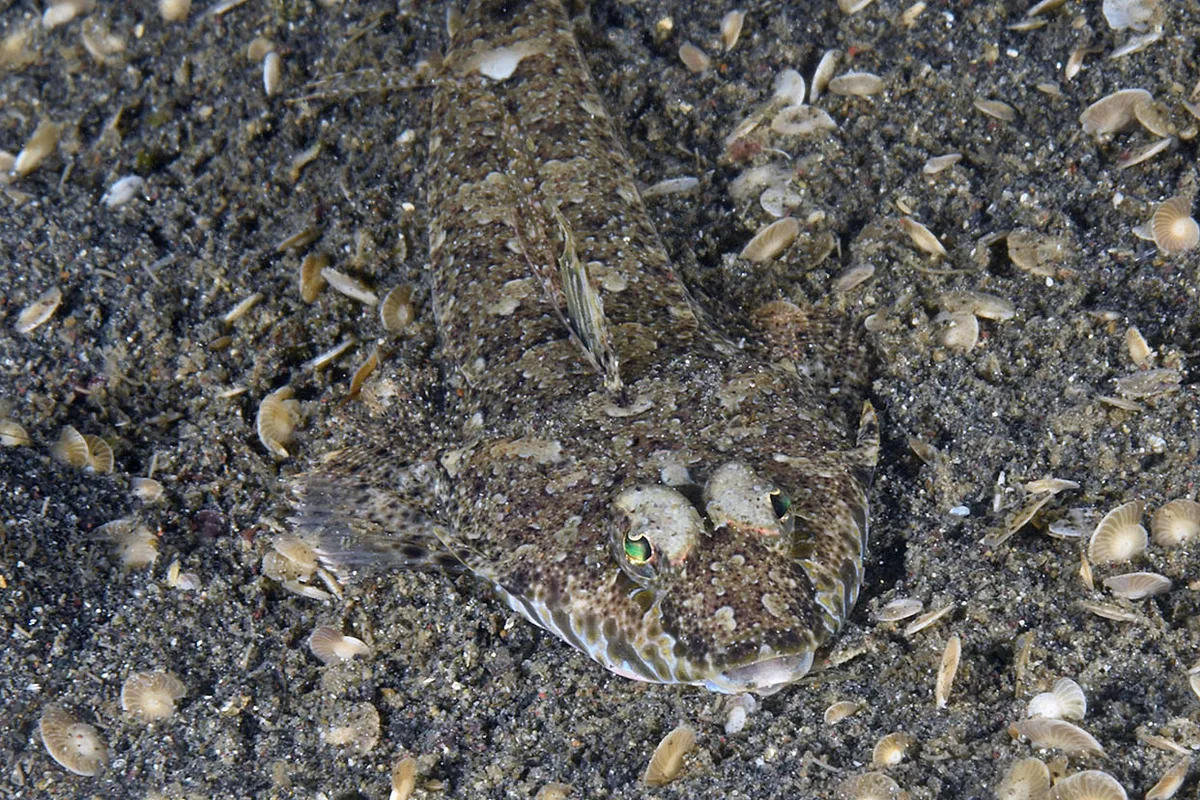
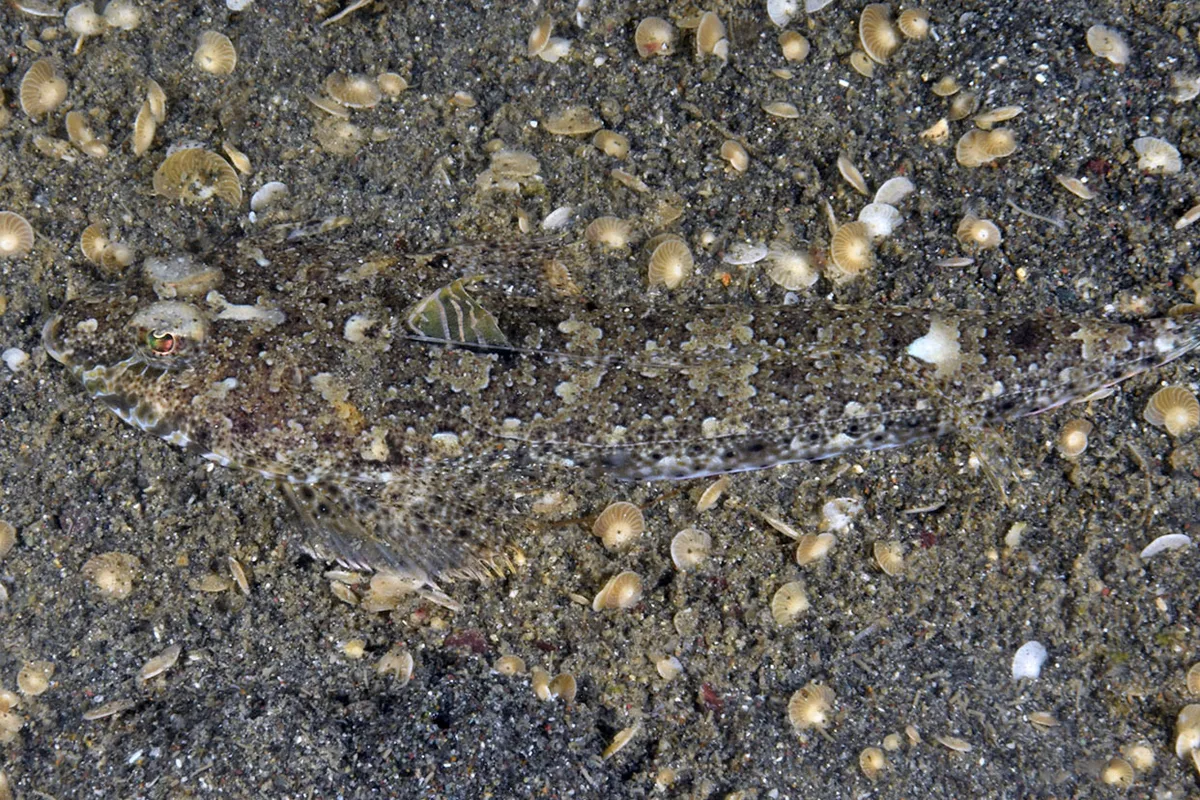
This is one of the fish that walked out of the 🌊 Red Sea and into Europe. It is native here. Since the Suez Canal (🇪🇬 Egypt) opened a corridor north it has settled into the eastern Mediterranean and become a resident of a sea it had no way of reaching before, one of the long list of 🌊 Red Sea species that made the same trip. The move shows in the pictures: most photographs of this fish in the public observation databases come from Cyprus, Greece and 🇹🇷 Turkey, and almost none from the sea it is native to.
It is also the biggest dragonet you are likely to meet on this coast, up to 20 cm against the 7 or 10 cm of the others, and the one with by far the widest depth range: recorded from 2 m down to 350 m, though most of them sit between 5 and 100 m. The body is light brown, speckled and blotched with blackish, and the fins are spotted dark brown. Males carry black markings on the first dorsal fin; females carry a single black blotch on its third membrane. The spine on the gill cover has a convex lower edge, which is what separates it from its relatives in the hand.
That gill-cover spine is the family badge. Dragonets have no scales anywhere on the body, and in place of them a heavy coat of bitter mucus that makes the fish unpleasant to swallow, so the barbed spine is the only hard thing on the animal.
On the bottom it walks rather than swims, propped on thick pelvic fins, working over open sand and mud and taking small crustaceans and worms out of the sediment.
It leaves that bottom to breed and for nothing else. A male displays with the first dorsal fin raised, the pair rises off the sand together, eggs and milt go into the water at the top of the climb, and both fish drop back down to the sediment they came from.
The species. Callionymus filamentosus Valenciennes 1837 - with filaments. ETYFish
- light brown body speckled and blotched with blackish
- dark brown spots across the fins
- black markings on the male's first dorsal fin; in females a single black blotch on the third membrane
- largest of the local dragonets, up to 20 cm
Why it's threatened
There are no known major threats to Callionymus filamentosus in the Persian Gulf.
Threat classification from the IUCN Red List.