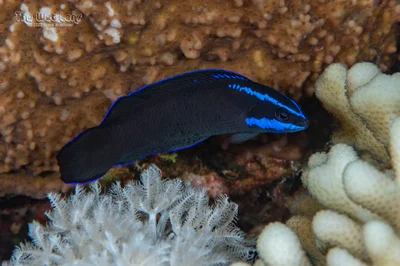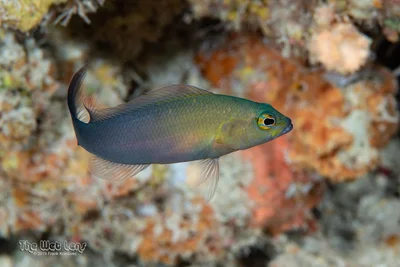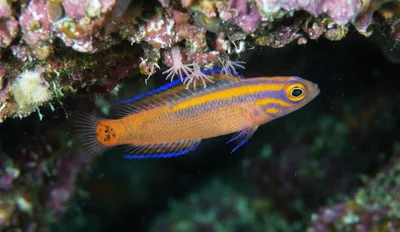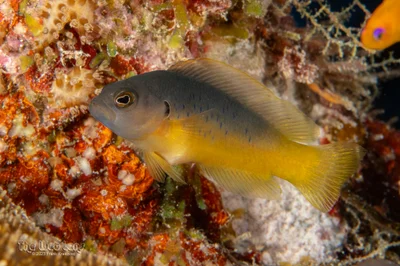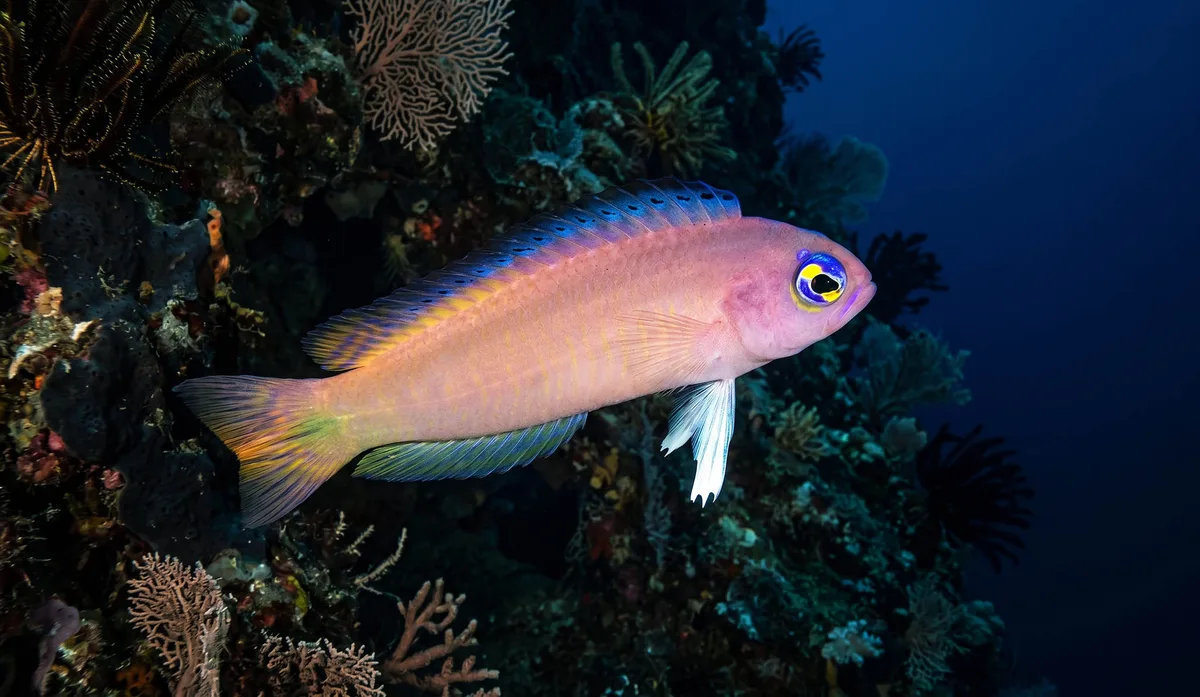
Almost nobody has seen this fish, and the reason is a line drawn by human physiology rather than by anything on the reef.
It lives on drop-offs below forty meters, in small caves in the wall. Forty meters is where recreational diving stops: past it the no-decompression time collapses to a few minutes, gas consumption roughly doubles, and nitrogen narcosis is doing real work on your judgment. So the fauna below that depth is documented by a small number of technical divers and by submersibles, and a three-centimeter fish in a crevice is not what either is usually looking for.
The result is a large gap in what is known. The 🌊 Red Sea's deep reef, between forty and about one hundred and fifty meters, holds its own community with its own species, many of them described only in the last twenty years and several found nowhere else. New fish are still being pulled out of it regularly.
This one is barely three centimeters, lives in the 🌊 Red Sea alone, and if you have seen it you were somewhere most divers never go.
The genus. Pectinochromis Gill & Edwards 1999 - pecten (comb or rake) + chromis (common suffix in the family). ETYFish
The species. Pectinochromis lubbocki (Edwards & Randall 1983) - Honours Hugh Roger Lubbock. ETYFish
- very small, under 4 cm
- only on drop-offs below about forty meters
- in small caves and crevices in the wall
- up to 3.4 cm
Why it's threatened
Threat classification from the IUCN Red List.