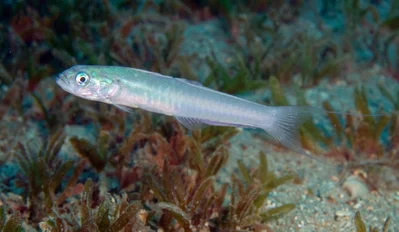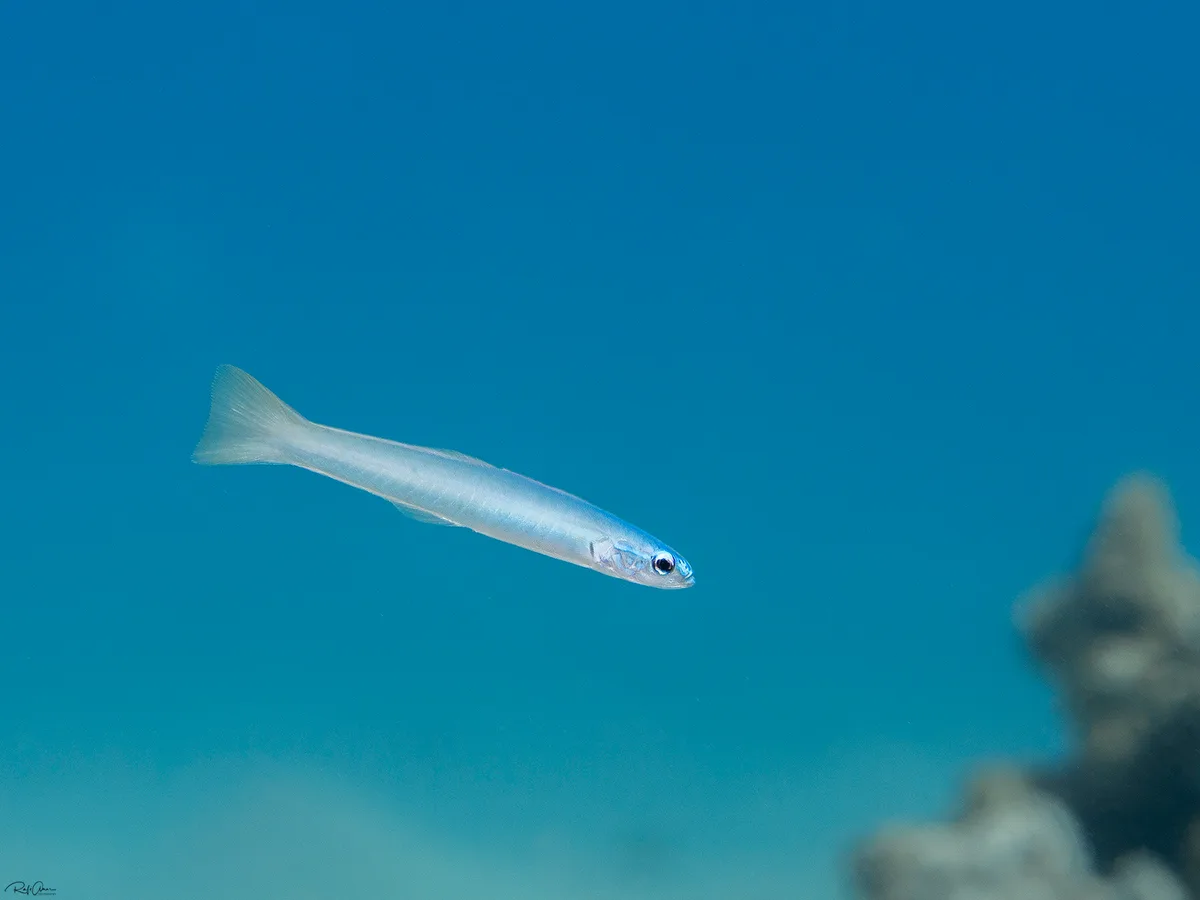
The Smallscale Dartfish, scientifically known as Ptereleotris microlepis, is a tropical marine fish commonly found in reef environments. This species is typically observed inhabiting lagoons and seaward reefs along rubble and sandy bottoms. It is predominantly found at depths ranging from 1 to 10 meters, though it can occasionally inhabit depths up to 50 meters. These fish are known to reside in shallow silty estuaries and outer reef lagoons or venture deeper along coastal slopes.
The Smallscale Dartfish grows to a maximum length of 13 centimeters (approximately 5 inches). It exhibits a pale to bluish-gray coloration with distinct narrow neon-blue bands and streaks on its head just behind its eyes. The base of its pectoral fin features a slender, pale blue-edged black band, and the postorbital area of its head is adorned with irregular, pale to iridescent blue bands and spots. A median fleshy protuberance that becomes a thin fold can be seen on its chin. The scales of the fish are embedded, closely-packed, and non-overlapping except on the posterior part. Its dorsal fins include 7 spines and 25-29 soft rays, while the anal fins consist of 1 spine and 24-27 soft rays. It has between 26 and 27 vertebrae. The first dorsal fin is lower compared to the second, with both the second dorsal and anal fins elevated at the front.
This species is observed living in pairs that often share the same burrow, although it is also common to see more than two individuals, particularly juveniles, seeking refuge together. The Smallscale Dartfish is known for its monogamous behavior, engaging in both obligatory and social partnering. These fish primarily feed on zooplanktons.
The distribution range of Ptereleotris microlepis spans the Indo-Pacific region, extending from the 🌊 Red Sea to the Line and Tuamotu (🇵🇫 French Polynesia) Islands, northward to the Ryukyu Islands (🇯🇵 Japan), and southward to the southern Great Barrier Reef.
The genus name Ptereleotris is derived from the Greek "pteron," meaning wing or fin, combined with "eleotris," the name of a Nile fish.
The species. Ptereleotris microlepis (Bleeker 1856) - micro- (small) + lepís (scale). ETYFish