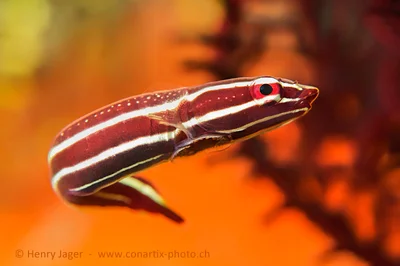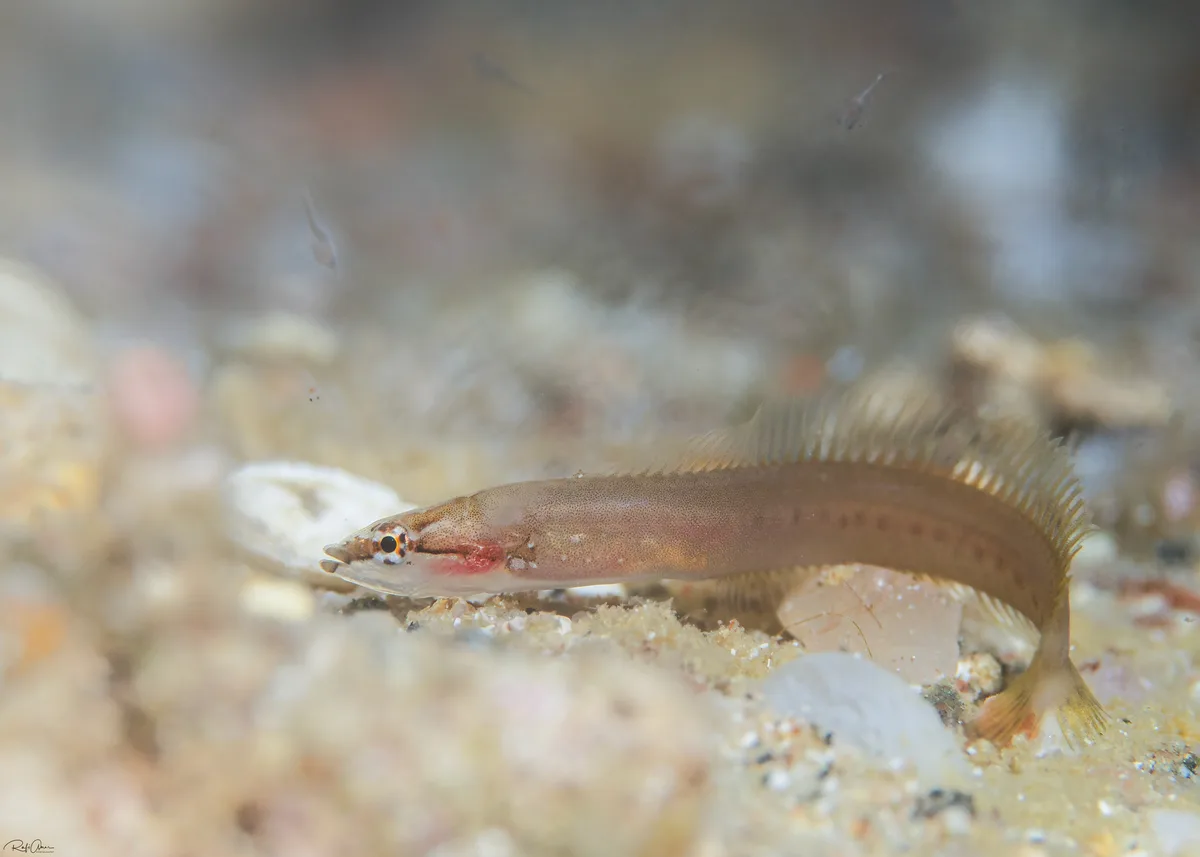
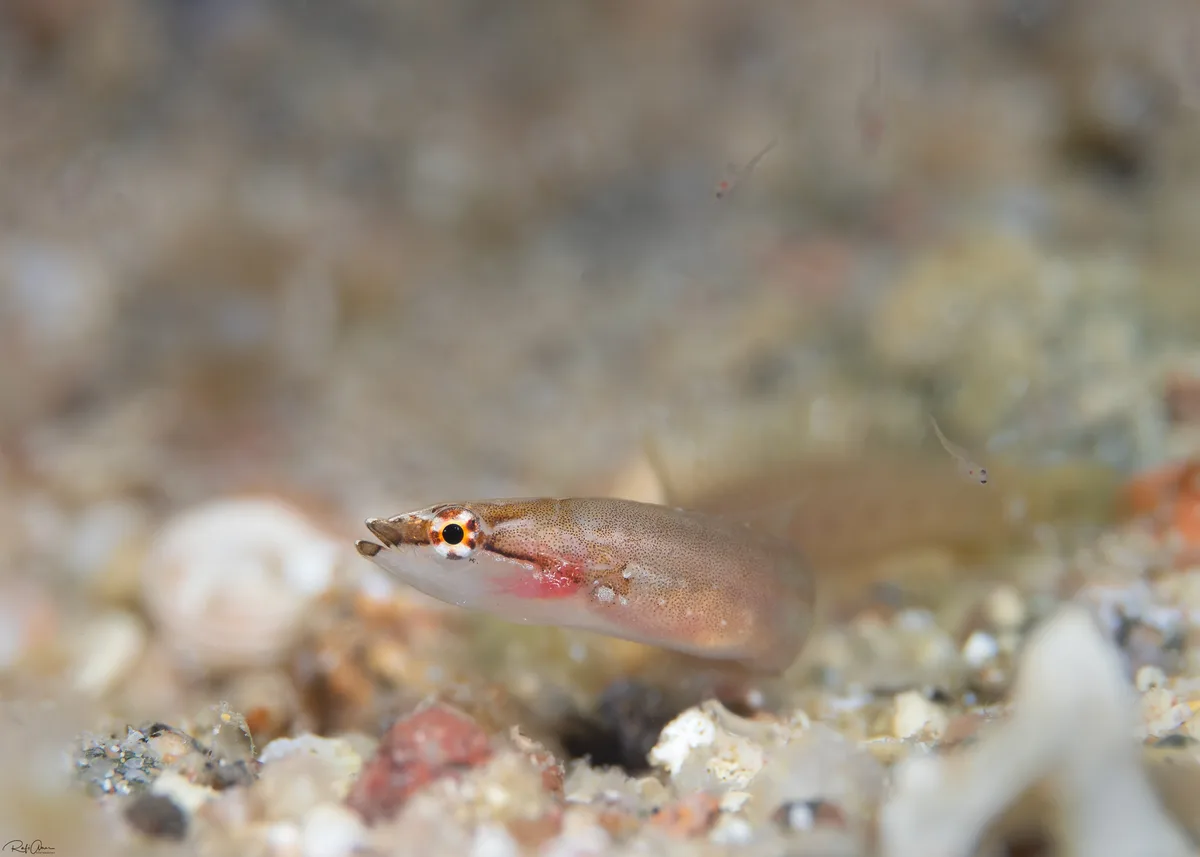
The pelvic fins of this fish have been rebuilt into a suction cup, and it works better than it has any right to.
The disc sits on the belly, formed from the fins and the tissue between them, with a rim that seals against the surface and a rough inner surface that grips. A clingfish can hold on hard enough to support many times its own weight, in surge that rolls boulders, and it does so without effort because the seal is passive: it takes muscle to let go, not to hold.
That is what buys the family its living. Clingfish occupy the places where nothing else can stay put, the surge zone, the undersides of stones, the wave-battered shallows, and they are not swept out because they are not, functionally, in the water column at all.
This one adds a second layer of protection. It lives among the spines of sea urchins in the top few meters, which means anything that wants it has to come through the spines first. Four centimeters, smooth, scaleless and slippery, tucked in near the base where the spines are thickest.
It lives in this sea and nowhere else, and its name says so.
The genus. Lepadichthys Waite 1904 - lepad- (apparently from Lepadogaster) + ichthys (fish). ETYFish
The species. Lepadichthys erythraeus Briggs & Link 1963 - red. ETYFish
- tiny, up to 4 cm, with no scales and a smooth slippery skin
- among the spines of a sea urchin, usually close to the base
- sucker disc on the belly, formed from the pelvic fins
- very shallow, in the top few meters
Why it's threatened
Threat classification from the IUCN Red List.