
ClingfishesGobiesocidae
A clingfish sinks. It has no swim bladder, the gas-filled bag every ordinary fish uses to hold depth without working for it, and no scales either. In open water it is in trouble. It belongs against a surface, and it holds itself there with a disc on its chest rebuilt out of its pelvic fins, which the species pages take apart properly.
What that buys is an address nothing else can hold. Most of this family is not tropical at all: the bulk of the species live on cold rocky coasts, in the narrow strip of sea where waves break, under boulders and in pools that empty at low tide. That is the most physically violent habitat in the ocean and the one with the fewest fish in it, and a clingfish sits through it pressed flat to the rock, some species out of the water altogether until the tide comes back.
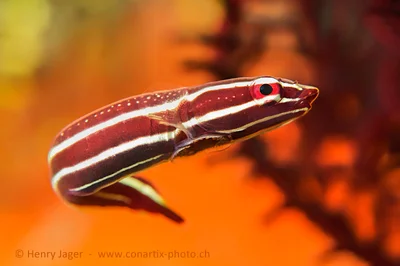
In warm water the same equipment was pointed at living surfaces instead. Tropical clingfishes turn up among the spines of urchins, in the arms of feather stars, on seagrass blades and under loose rubble, and several of them eat the animal they are sitting on. Both species listed here live that way, and both of their pages go into it.
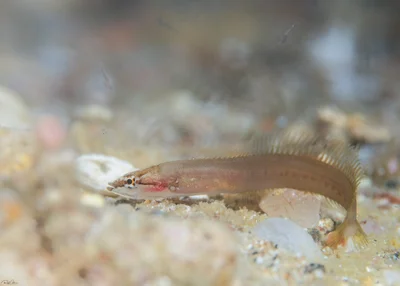
Everything about them is small and plain: no longer than a finger, scaleless, flattened at the front and tapering behind, slippery to hold and effectively invisible in place. The eggs are laid in a single layer stuck to the underside of a rock, and the male stays over them.
Two are listed for this sea, which is honest for a family that mostly lives in colder water than this. Neither is found by searching the reef. They are found by looking very closely at other animals.
- very small size, typically 2-7 cm
- large sucking disc on chest
- smooth, scaleless body
- clings motionless to substrate
- cryptic coloration, often browns, greens, or reds
2 species in Clingfishes
Other bottom-dwellers
Similar silhouette underwater - worth a look if this was not your animal.


Last Update: August 23, 2026