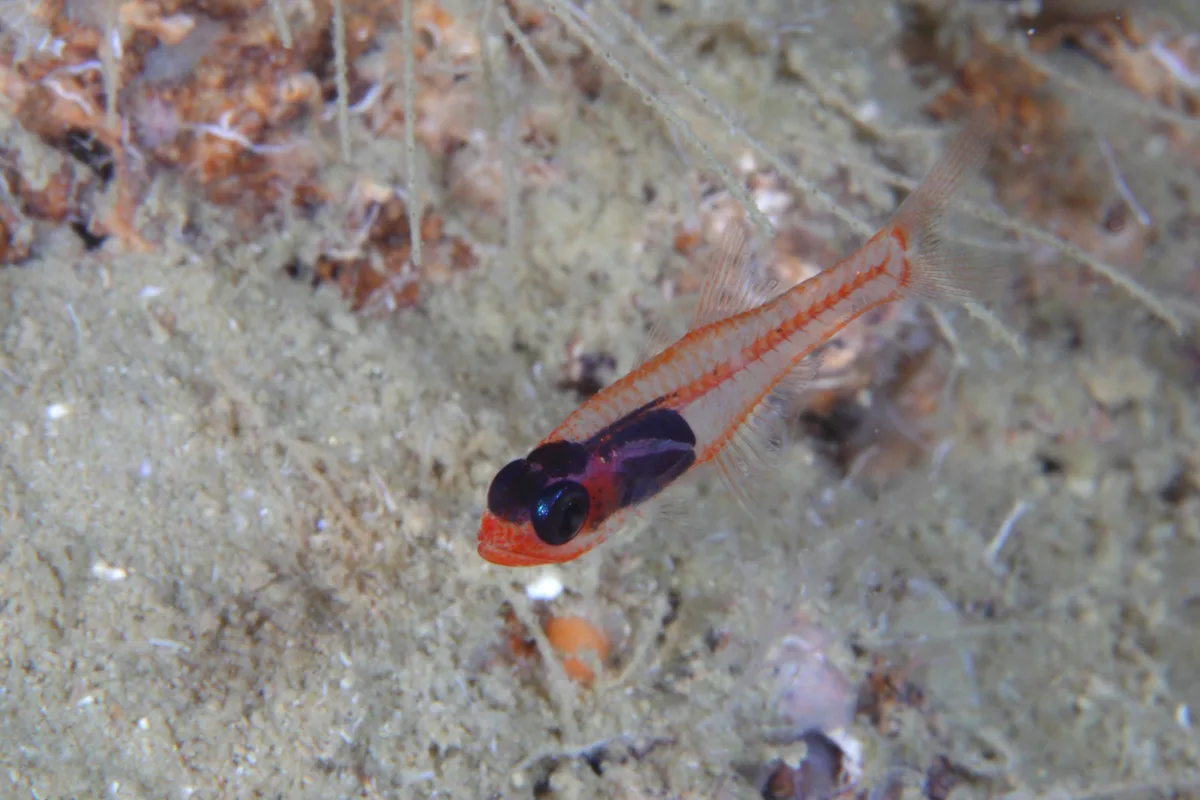
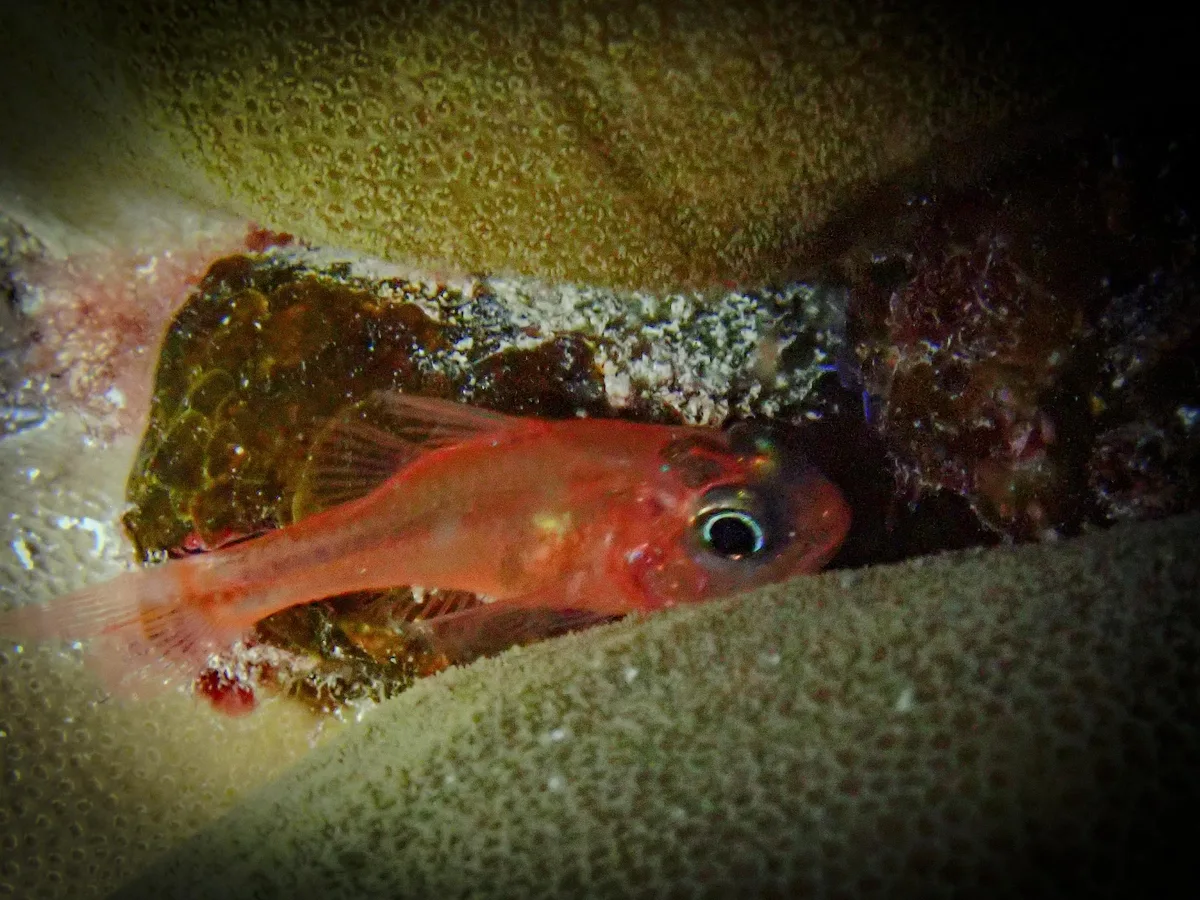
It goes back to the same hole. Not the same reef, not the same coral head: the same crevice, night after night.
Cardinalfish spread out over the reef in darkness to feed and reassemble at dawn, and where researchers have marked individuals and displaced them, the fish find their way back over distances of hundreds of meters, across ground they cross only at night. How they do it is not fully settled - some combination of remembered landmarks, the sound of the reef, and possibly the earth's magnetic field - but that they do it is well established.
That is more impressive than it sounds. The animal is six centimeters long, it is navigating in the dark, and the destination is one gap in a structure made of thousands of identical gaps.
This one is the small red cardinalfish of caves and rubble, uniformly ruby with no markings at all, and it stays so far inside cover during the day that most sightings are of an eye and a red shape in a crack. At night it comes out for small crustaceans, and before dawn it goes home.
The genus. Apogon Lacepède 1801 - ἀ- (privative) + pṓgōn (beard). ETYFish
- small, uniformly deep red with no markings
- large dark eye
- deep inside a crevice or under rubble by day
- up to 6 cm