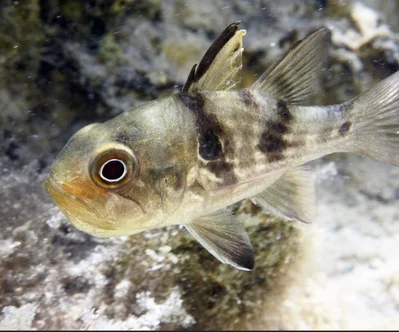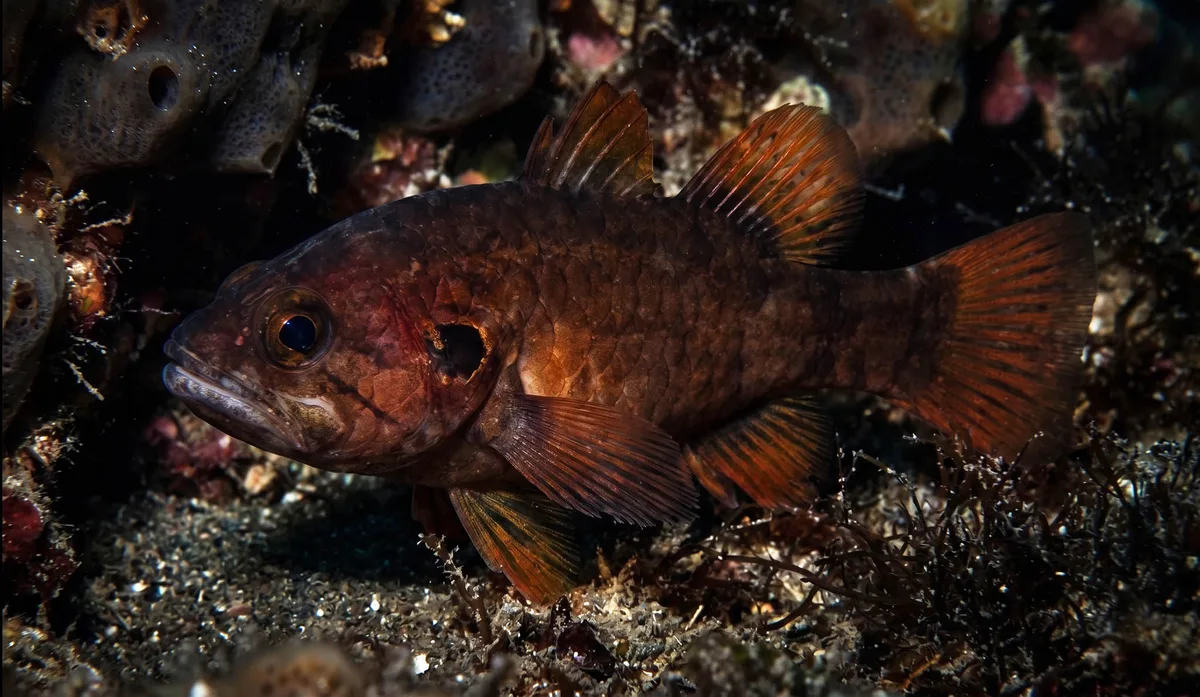
There is a second eye on the gill cover, and it is the mark of the whole genus.
A dark spot ringed in pale, set well behind the real eye near the rear edge of the gill plate, gives the fish a doubled, cross-eyed look that the common name refers to. Every Fowleria carries one, and its position and size are among the few reliable ways to separate species that are otherwise a set of mottled brown fish.
What it does is the usual work of a false eye. A predator deciding where the front of a fish is has two candidates instead of one, and if it picks the wrong one it commits its strike toward the tail. The real eye, meanwhile, is buried in mottling and a dark bar and is genuinely hard to pick out.
The rest of the genus follows the same plan: no stripes, no schooling, no hovering. These are bottom-sitting cardinalfish of rubble, dead coral and seagrass that rely on being hard to see rather than hard to catch, and they are among the least-photographed fish on the reef despite being common.
The male broods, like all cardinalfish, and at nine centimeters this is the largest of the group here.
- dark ocellus on the gill cover, ringed pale, sitting well behind the real eye
- mottled brown body with no stripes
- sits on the bottom in cover rather than hovering
- up to 9 cm
Why it's threatened
This species is a component of the marine ornamental trade, but the potential impact is unknown.
Threat classification from the IUCN Red List.