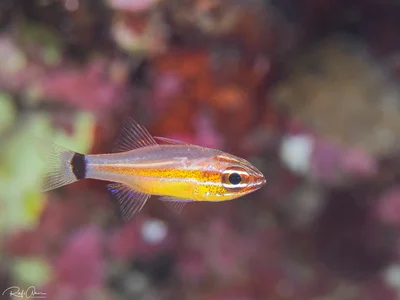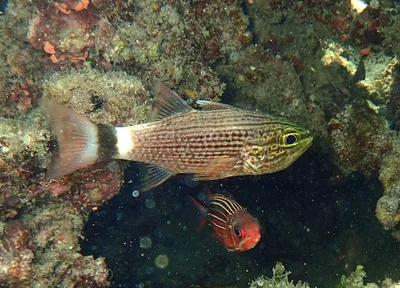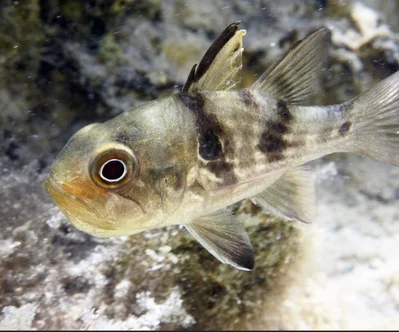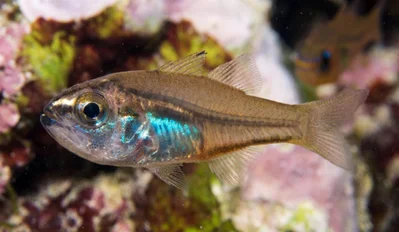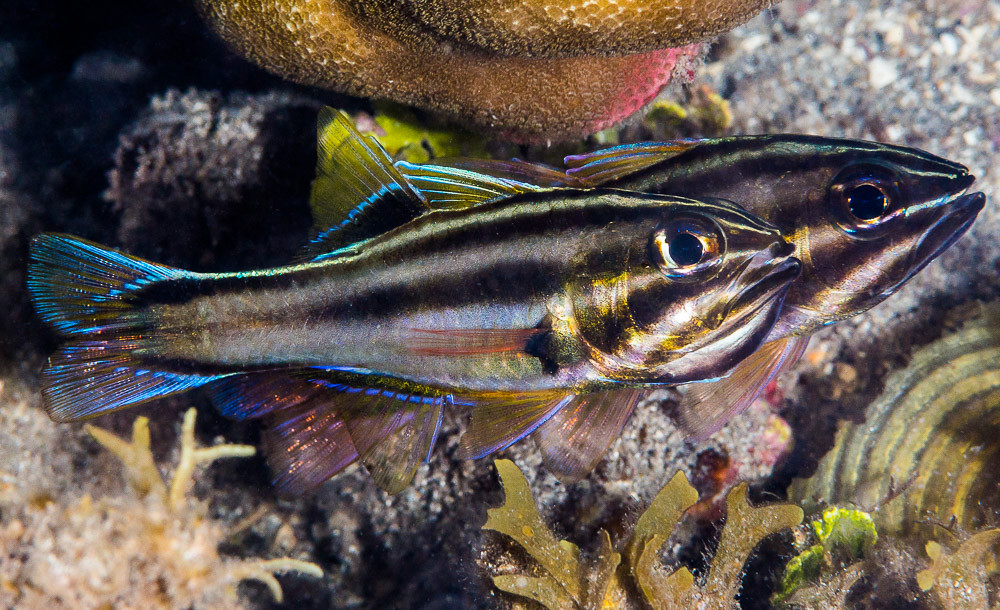
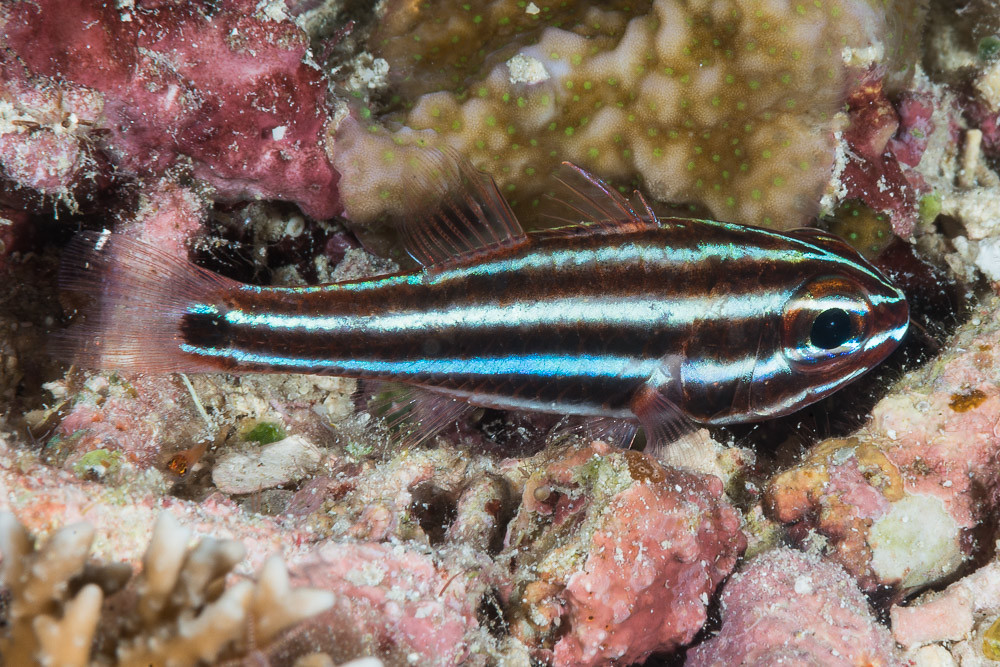
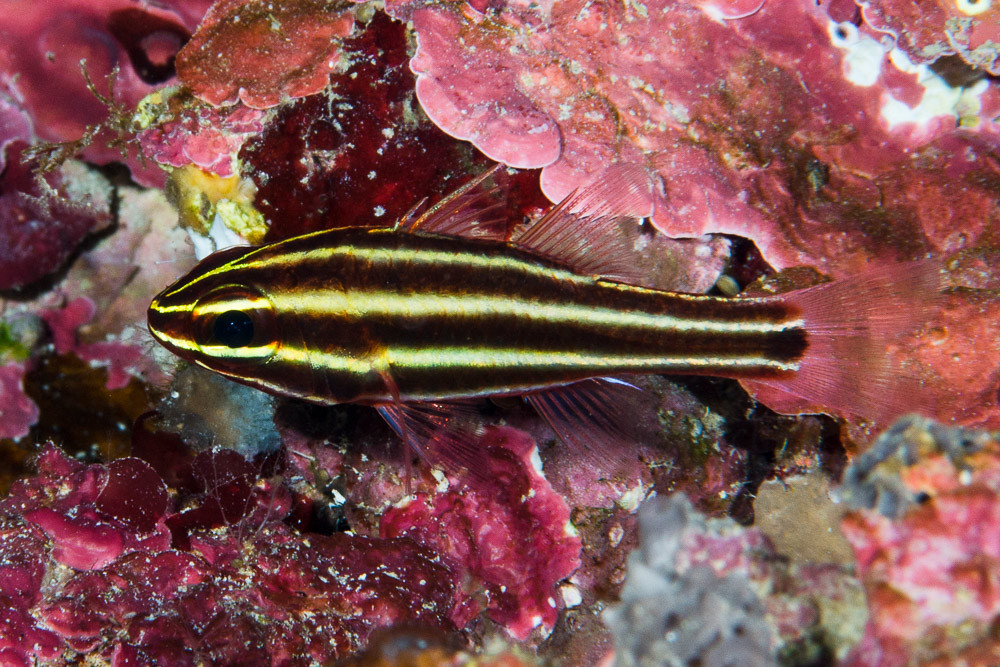
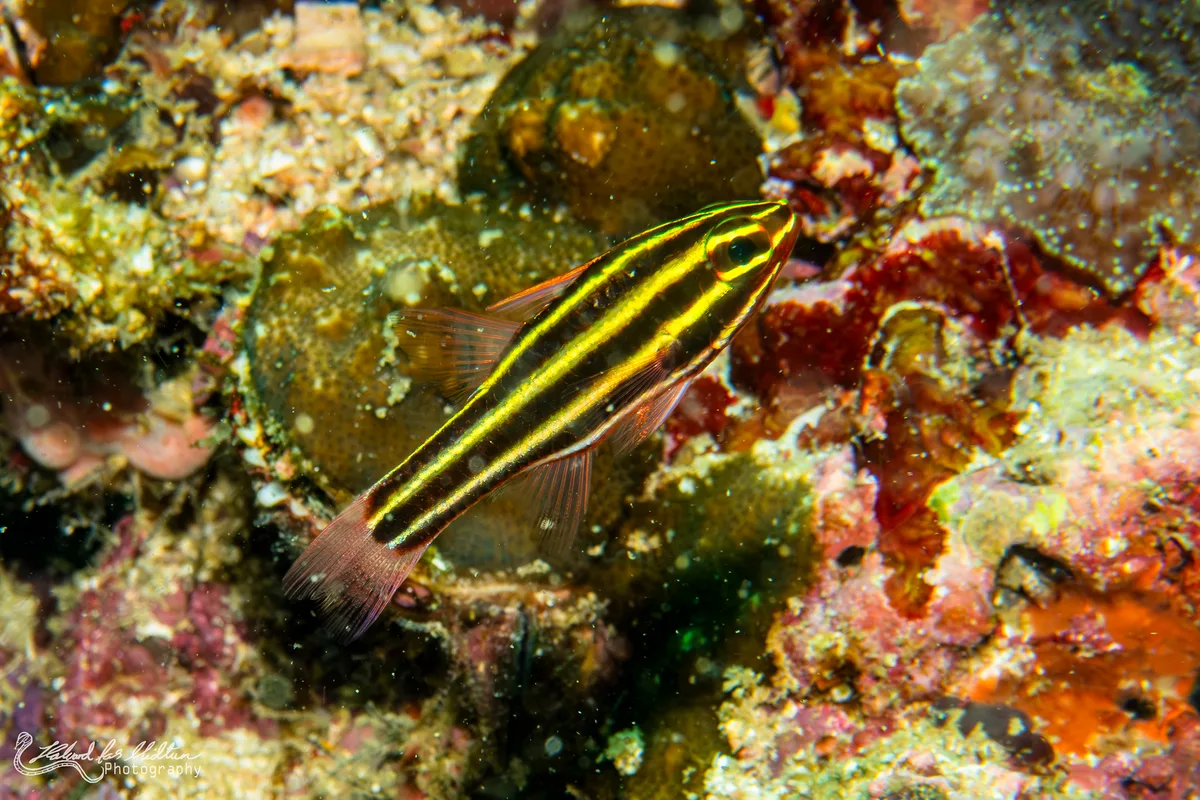
Hard black stripes on a pale fish, running from snout to tail and straight through the eye.
Stripes like that do two jobs at once and both matter to a shoaling fish. The first is the eye: a line drawn through it hides the one feature a predator can always find, which is why so many reef fish carry a bar or a stripe across the face. The second is the school. A fish trying to stay with its neighbors in poor light needs to read their position and heading fast, and a bold horizontal line does that better than any body shape - it shows which way the fish is pointing and how far away it is, at a glance, in conditions where color has already failed.
That second job is the one that matters here. Cardinalfish work at night and at dusk, and a shoal holding formation in near-darkness over a reef is doing it on lines rather than on shapes.
The rest is standard for the family: small, big-eyed, out at night for zooplankton, and the male carries the eggs in his mouth until they hatch.
The genus. Ostorhinchus Lacepède 1802 - osteo- (bone) + rhynchus (snout). ETYFish
The species. Ostorhinchus nigrofasciatus (Lachner 1953) - nigro- (dark or black) + fasciatus (banded). ETYFish
- pale body crossed lengthwise by two or three hard black stripes
- black spot on the tail base
- stripes continue straight through the eye
- up to 10 cm
Why it's threatened
This species is a component of the marine ornamental trade, but the potential impact is unknown.
Threat classification from the IUCN Red List.