Egypt to Host UNCCD COP18 in 2028: What a Desertification Summit Means for the Red Sea

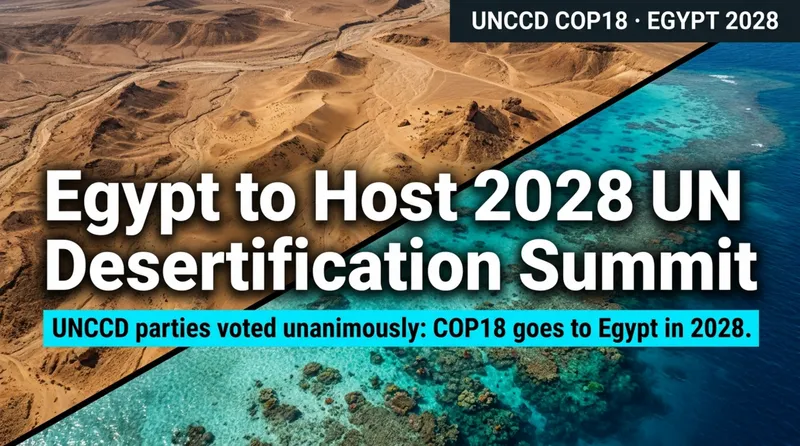
Parties to the United Nations Convention to Combat Desertification voted unanimously at the close of their seventeenth conference to hand the eighteenth to Egypt in 2028. Egypt's Foreign Ministry announced the result, which was adopted in Ulaanbaatar, Mongolia, on the final day of a session that ran from August 17 to 28, 2026.
The convention deals with land: desertification, soil degradation and drought. That looks like someone else's subject on a site about reefs. It is not, and the reason is measurable.
Which COP this is
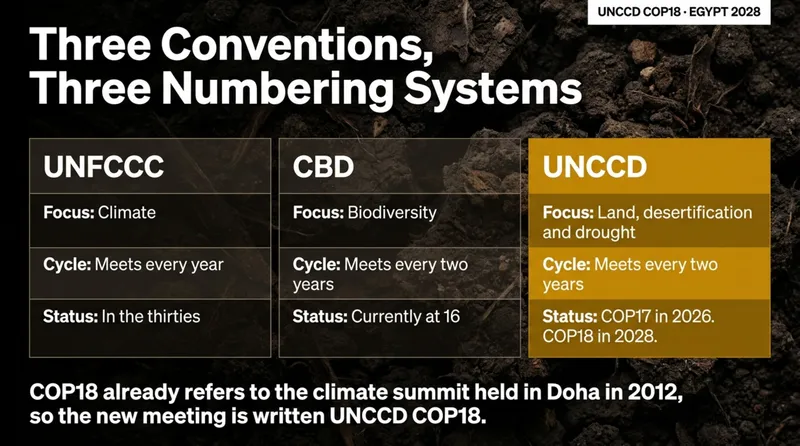
Three separate treaties came out of the 1992 Earth Summit in Rio de Janeiro, and each holds its own Conference of the Parties. Because they number their meetings independently, the same number belongs to more than one event.
The climate convention meets every year and has reached the thirties. The biodiversity and desertification conventions meet every two years and are still in the teens. So COP18 already means the climate summit held in Doha in 2012, and the new one is a different meeting of a different treaty. The unambiguous name is UNCCD COP18.
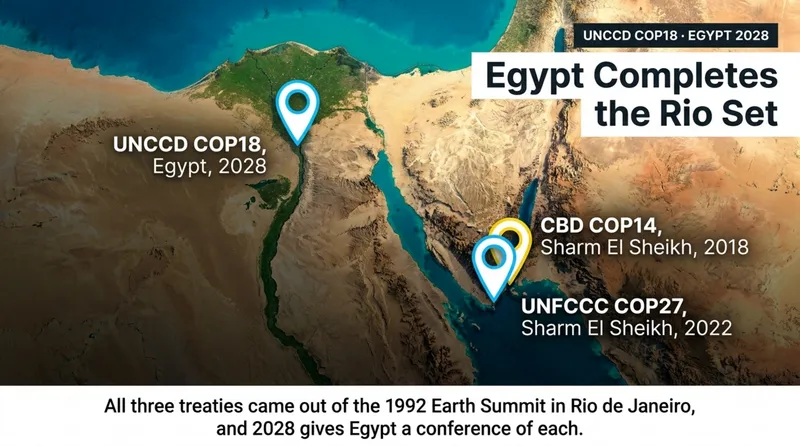
Egypt has hosted the other two. Sharm El Sheikh took the biodiversity conference, CBD COP14, in 2018, and the climate conference, UNFCCC COP27, in 2022. It has never hosted a desertification COP: the series has run through Rome, Dakar, Recife, Bonn, Geneva, Havana, Nairobi, Madrid, Buenos Aires, Changwon, Windhoek, Ankara, Ordos, New Delhi, Abidjan, Riyadh and Ulaanbaatar. The 2028 meeting will complete the set of all three Rio conventions for Egypt, and it will be the first UNCCD conference held in North Africa.
What COP17 failed to settle
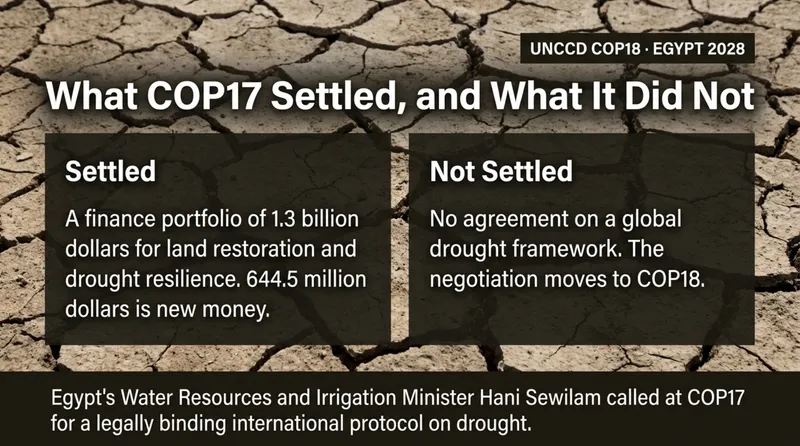
Egypt inherits an argument rather than a ceremony. COP17 closed with a finance portfolio of 1.3 billion dollars for land restoration and drought resilience, of which 644.5 million was identified as new money. It did not close with a global drought framework. Countries could not agree, and the negotiation was pushed to the next conference.
Egypt has already stated where it stands. During the ministerial segment in Ulaanbaatar, Water Resources and Irrigation Minister Hani Sewilam called for a legally binding international protocol on drought, arguing that the response has to shift from crisis management to prevention, and that countries facing acute water scarcity cannot wait for voluntary commitments.
That is an unusual position for a host to take before it holds the gavel. It means the 2028 conference arrives with its central fight already declared.
The convention is run by Egypt's former environment minister
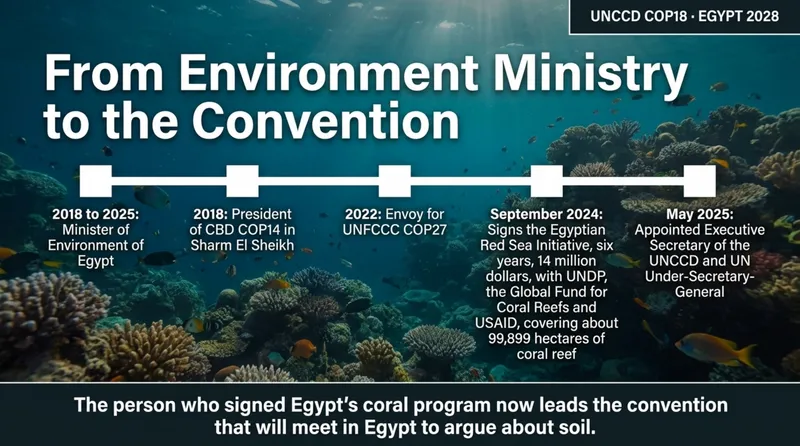
Yasmine Fouad served as Egypt's Minister of Environment from 2018 to 2025. In May 2025 the UN Secretary-General appointed her Executive Secretary of the UNCCD, a UN Under-Secretary-General post, succeeding Ibrahim Thiaw of Mauritania.
Her record is not a land record alone. She presided over CBD COP14 in Sharm El Sheikh, served as envoy for COP27, and was a lead author of the IPCC special report on climate change, desertification, land degradation and food security. In September 2024, as minister, she signed the Egyptian Red Sea Initiative, a six-year program funded at 14 million dollars with UNDP, the Global Fund for Coral Reefs and USAID, covering roughly 99,899 hectares of coral reef. Her tenure also covers the process that put the Great Fringing Reef under protection, the shark policy behind Egypt's valuation of a live shark at 200,000 dollars a year, and restrictions on single-use plastics in Red Sea resorts.
The person who signed Egypt's coral program now leads the convention that will meet in Egypt to argue about soil.
Why a land summit reaches the reef
Dust is the link, and it is the part of the UNCCD's work that crosses the shoreline. The convention hosts the UN Coalition on Combating Sand and Dust Storms, and the General Assembly has declared 2025 to 2034 a decade dedicated to the problem.
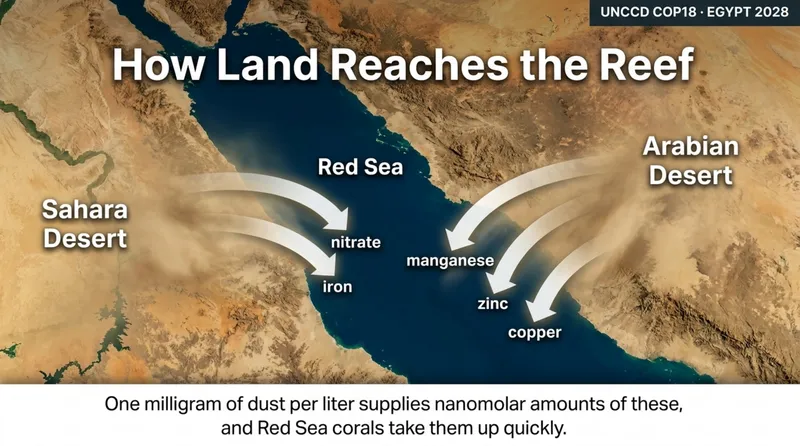
The Red Sea sits between the Sahara and the Arabian deserts, and its water is nutrient-poor. Dust falling on it is therefore not inert. Work published in Global Change Biology in 2022 found that one milligram of desert dust per liter delivered nanomolar amounts of nitrate along with iron, manganese, zinc and copper, and that the Hood Coral (Stylophora pistillata) took them up quickly.
A 2024 study in Scientific Reports went further and tested the Hood Coral and the Yellow Scroll Coral (Turbinaria reniformis) together under heat stress. Dust raised gross photosynthesis by up to twofold and net photosynthesis by up to tenfold, with chlorophyll up to 1.5 times higher and symbiont density up to 1.6 times higher. Iron on its own did nothing. It was the mixture of metals that mattered. The authors are careful about the limits: the work was done in tanks rather than on a reef, and the effect differed between the two species.
The choice of species is not incidental. The Hood Coral is a standard laboratory animal in coral biology, and the northern Red Sea is much of the reason. Colonies from the Gulf of Aqaba have been held several degrees above their summer maximum in tanks without bleaching, and through the marine heat wave of 2024 they sat at 32.6 degrees Celsius, about 3.4 degrees above the long-term average, still without bleaching. The explanation is a filter. After the last ice age the basin was recolonized from the south, and everything moving north had to cross the hot shallow strait at its mouth, so only heat-tolerant genotypes got through. Their descendants now live well below the temperature they can actually stand, which is why this sea is discussed as a refuge while reefs elsewhere die. The same research adds the reverse caution: these corals sit close to their cold-water bleaching threshold, so wider swings cut both ways.
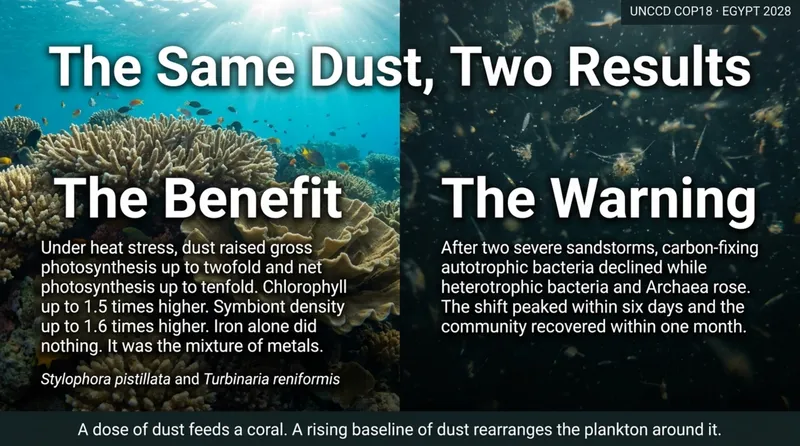
The opposite result exists as well, and it is also from the Red Sea. A 2022 paper in BMC Genomics tracked the water column through two severe sandstorms, one from the Nubian Desert in summer 2016 and one from the Libyan Desert in spring 2017. Both shifted the microbial community the same way: autotrophic bacteria, the ones that fix carbon, declined, while heterotrophic bacteria and Archaea increased. The shift peaked within six days and the community returned to its original composition within a month. The authors read that as a warning rather than a benefit, since expanding desertification means more dust, and a sea that receives more dust may run a more heterotrophic food web.
Both findings can hold at once. A dose of dust feeds a coral; a rising baseline of dust rearranges the plankton it lives among. What neither study supports is the comfortable version in which more dust is simply good for the reef.
Egypt's land problem stops at the waterline
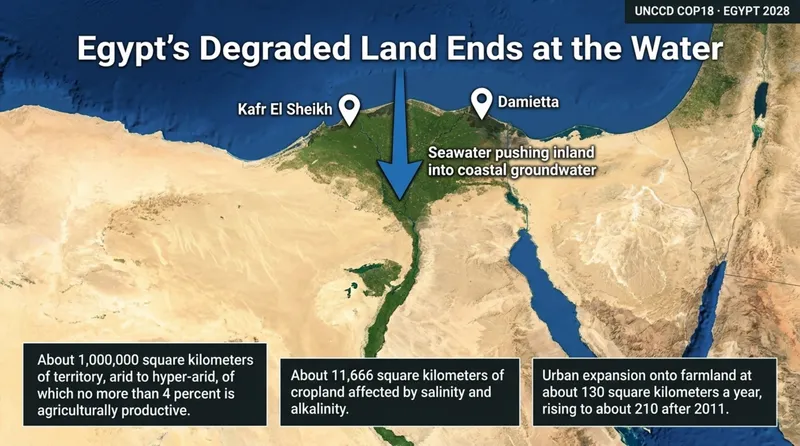
Egypt's own report to the convention describes a country of about one million square kilometers under arid to hyper-arid conditions, of which no more than 4 percent is agriculturally productive. Around 11,666 square kilometers of cropland, 2.8 million feddan in the local measure, suffer from salinity and alkalinity, and the report names that its top priority.
The cause of much of it is the sea itself. Groundwater extraction in coastal areas has drawn saline seawater into aquifers, and waterlogging and salinity in the northern Nile Delta pull seawater into the subsoil. Urban expansion onto farmland ran at about 130 square kilometers a year and rose to about 210 after 2011. Two of the degradation hotspots the report identifies, Kafr El Sheikh and Damietta, sit on the coast.
This is the part that makes a desertification conference in Egypt a coastal event whether or not it is billed as one. The boundary between degraded land and the sea is where both problems are worst, and Egypt has that boundary on two seas.
What has not been announced
The host country is settled. The city is not. Several outlets have named Sharm El Sheikh, which hosted both of Egypt's previous COPs, but no announcement from the UNCCD or from the Egyptian government confirms a venue, and the convention's own site does not yet carry COP18 details. Dates have not been published either.
Until they are, the useful thing to watch is the drought protocol. Egypt has asked for it to be binding, the parties could not agree on a weaker version, and the argument now has a two-year runway and a host with a declared position.
PADI Divemaster and underwater storyteller with over 7 years of hands-on Red Sea diving experience, documenting marine life, mapping dive sites, and promoting responsible ocean conservation.