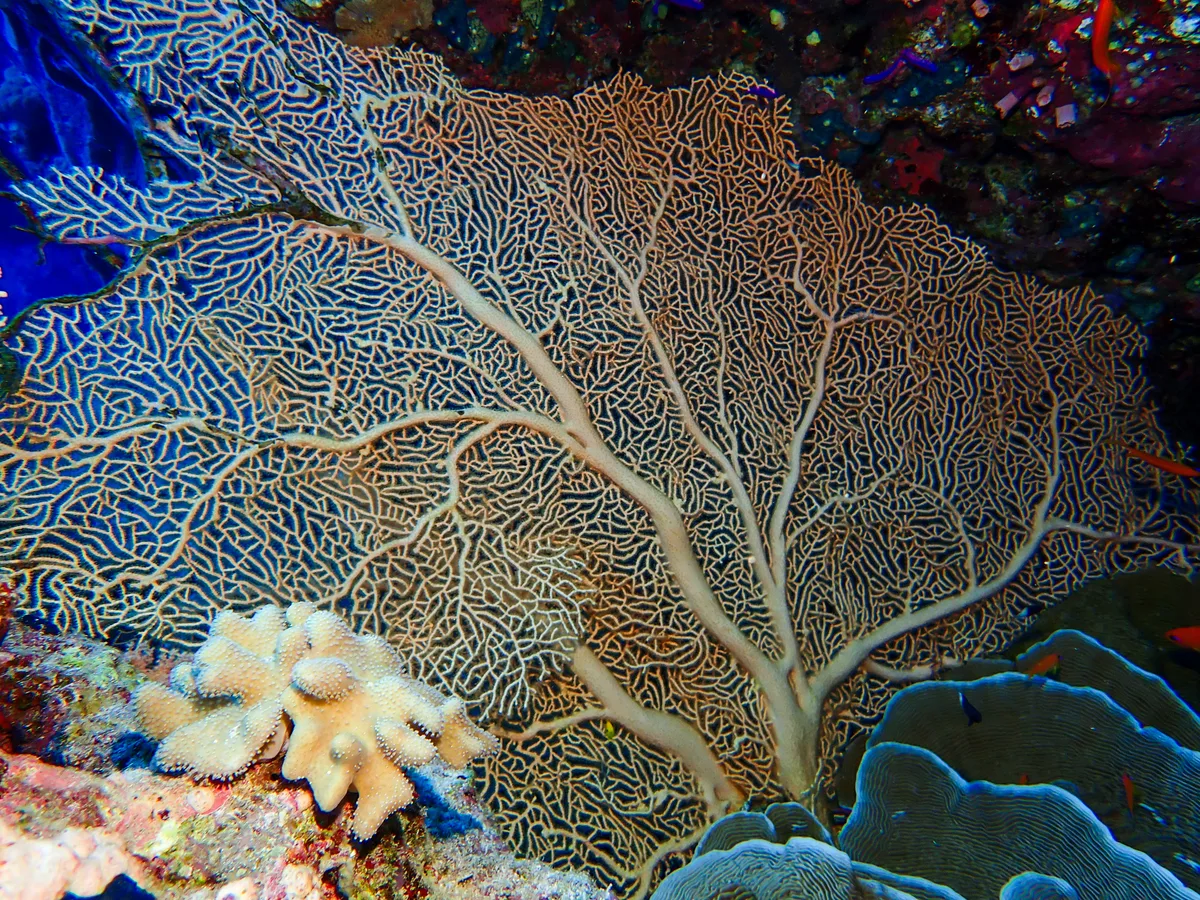
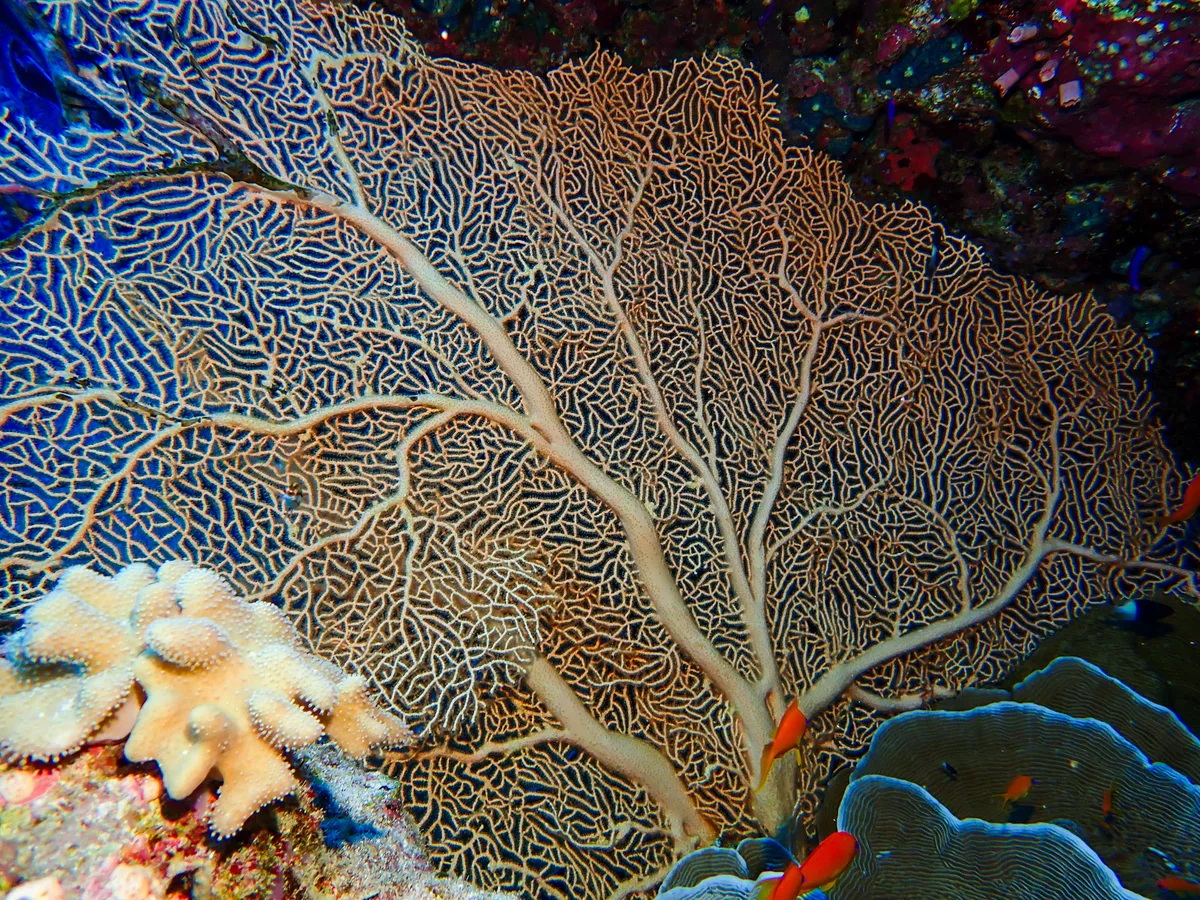
A flat fan of fine branches standing off a wall, up to a meter (3 ft) across, and always turned the same way - broadside to the current, edge-on to anyone swimming along the wall. That orientation is not chance. The colony grows into the flow so that every polyp on the fan is presented to moving water, and a fan facing the wrong way is a colony that starves.
The skeleton is not stone. Gorgonians build a flexible core of protein with tiny mineral spicules embedded in it, which is why the fan bends in surge instead of snapping - the same principle as a mast rather than a wall.
It feeds at night. Thousands of polyps open along the branches, each with eight feathery tentacles, and strain plankton from the current. By day the fan looks bare, which is why divers pass it as scenery rather than as an animal.
A fan this size is decades old. They are also where whip coral shrimps, gobies and clinging crabs live, so a slow pass over one with a torch usually finds something - and a fin kick through it costs years of growth.
- large flat fan of fine branches, fused into a net in places
- always oriented across the prevailing current, edge-on to a diver approaching along the wall
- yellow to orange-brown, with polyps out at night
- colonies to 1 m across