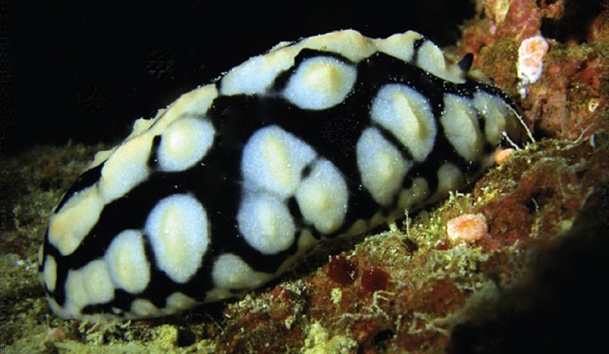
This is the least recorded animal in this entire section, and possibly in the catalogue.
It was described in 2020. The public occurrence databases hold exactly one record for it in the world, from 🇪🇬 Egypt, and the largest photographic community for sea slugs has not a single observation of it. What exists is the original description, a handful of images in the regional book, and that one logged sighting. An animal nearly three centimeters long, on a shallow reef, in one of the most heavily dived seas on the planet.
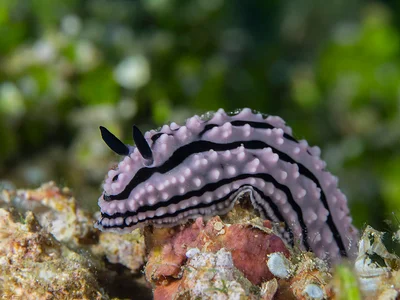
Which says something about the group rather than about this species. Wart slugs all wear versions of one black, white and yellow warning scheme, on purpose, because a shared signal is cheaper to teach a predator than six separate ones. The consequence for anyone with a camera is that they get photographed constantly and identified as whichever species is already familiar. A new one can sit inside that crowd for decades before somebody counts the bumps properly, which is what Nathalie Yonow did here.
Two characters separate it. The rhinophores are black with no paler tip, and the pustules are low and flat rather than raised into domes. Beyond that it is a Phyllidiella, meaning the tubercles run together into ridges along the back instead of standing apart, which is the genus mark.
The rest is family standard: no gill plume, breathing under the mantle rim, toxins through the whole body, and no reason to hurry.
- rhinophores black, with no paler tip
- pustules low and flat rather than standing up as domes
- tubercles fused into ridges, which is what separates Phyllidiella from Phyllidia
- under three centimeters, and almost never recorded