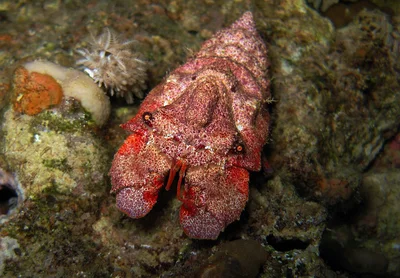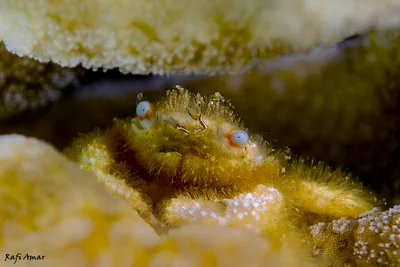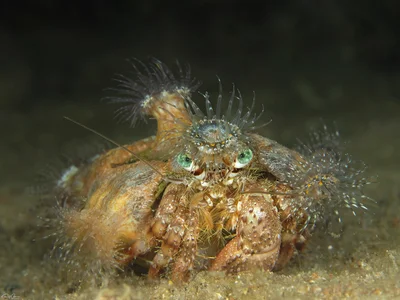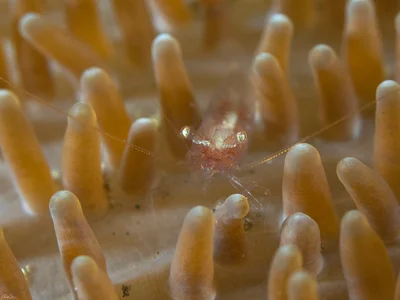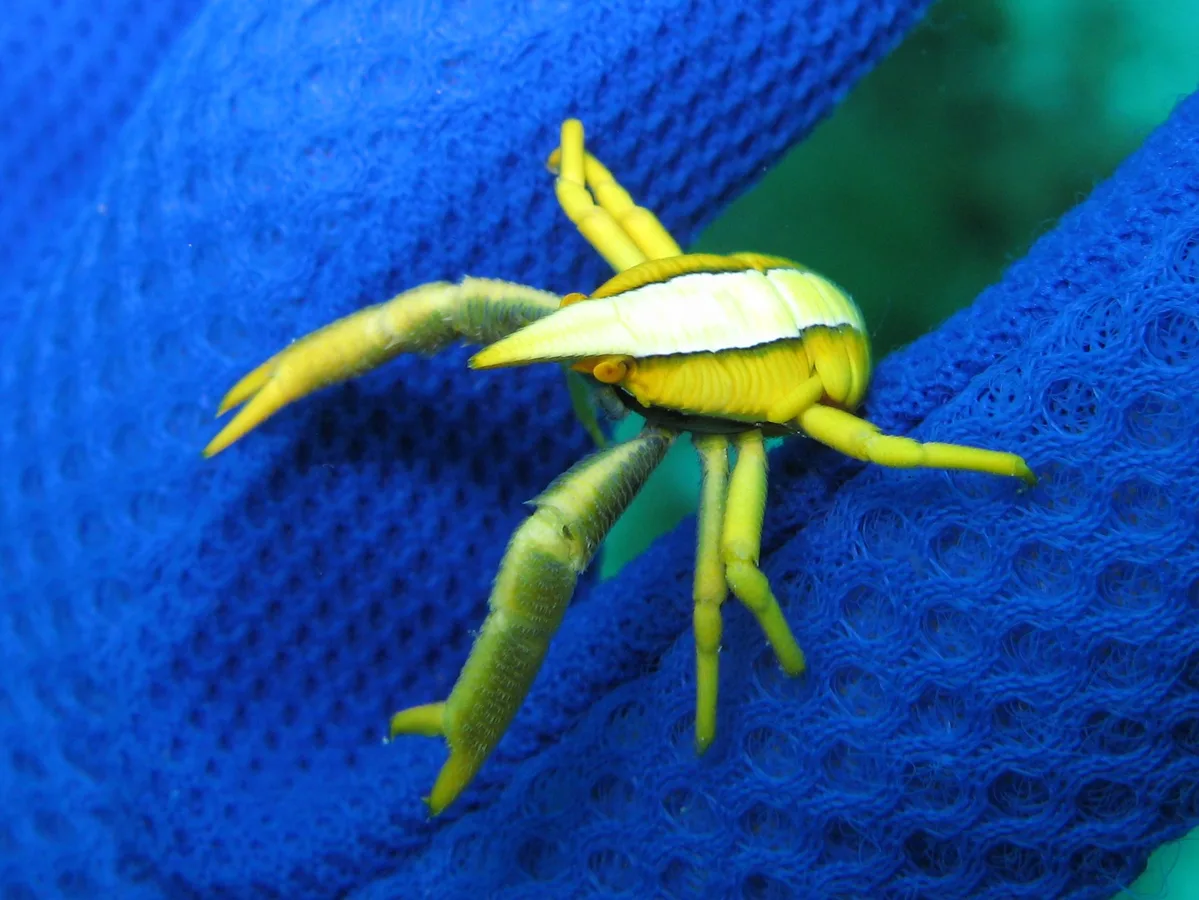

Allogalathea elegans, known as the feather star squat lobster, crinoid squat lobster, or elegant squat lobster, has a droplet-shaped cephalothorax and a dorsally flattened, elongated, triangular rostrum positioned on each side of its stalked eyes. Its first pair of legs, the chelipeds, bear pincers and extend longer than the body, while the last pair of legs is reduced. The body and legs are covered with small hairs. Females are typically larger, but individuals never exceed 2 cm (0.8 in) in total length. Coloration is highly variable, ranging from dark red, blackish-purple, orange, to brown, often marked with longitudinal stripes of differing thickness and tint. Despite its common name, this species is more closely related to hermit crabs than to true lobsters.
This squat lobster lives in commensal association with crinoids, particularly feather stars, from which it gains protection against predators such as fish and access to an ideal feeding substrate. While capable of living independently, individuals lacking a host typically experience a shorter lifespan due to increased predator exposure. It occurs from the surface to depths of 146 m (479 ft). Allogalathea elegans is a planktotrophic feeder, strategically benefiting from its crinoid host, which shares the same diet and positions itself to filter plankton optimally. Individuals may be found solitary or in large aggregations, always in close proximity to or directly on crinoids. It is widespread in the Indo-Pacific, with its range extending from eastern Africa to the 🇫🇯 Fiji Islands, and from 🇯🇵 Japan to southern 🇦🇺 Australia.
Reproduction involves precopulatory rituals that employ various sensory cues. Females are multiple spawners, typically undergoing three or four reproductive cycles during a breeding season, with synchronized gonadal development and breeding. Eggs hatch into larvae, which pass through four zoeal stages lasting a total of 13 to 16 days. The subsequent megalopal stage closely resembles a smaller adult before individuals mature.
- tiny, under 2 cm, living among the arms of a feather star
- color and striping match the host crinoid
- long slender claws held forward
- flattened body that slips between the arms