
Hammerhead sharksSphyrnidae
The head is not a hammer. It is a mounting bracket.
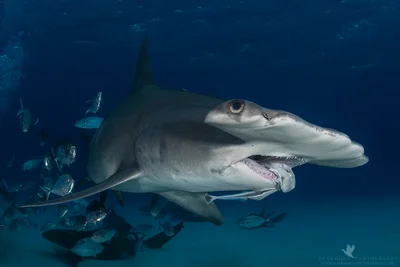
Everything a shark uses to find food sits on the front of its head, and a hammerhead has taken that front and pulled it sideways into a bar. The nostrils end up at opposite ends of it, sampling two points of water far apart, which lets the animal work up a scent trail the way you place a sound with two ears instead of one. The pores that read electrical fields are spread across the whole underside of the bar rather than crowded on a snout, so a hunting hammerhead sweeps it low over sand like a detector head, which is how a great hammerhead finds a stingray that is buried and completely out of sight. The eyes sit out on the tips, aimed outward but overlapping in front, so the animal has depth judgment ahead of it and, with one swing of the head, a view of very nearly everything around it. The bar is a wing as well: it gives lift at the front end and lets a heavy shark turn far tighter than its length suggests. And a great hammerhead will simply use it as a tool, pinning a ray flat to the bottom with the underside of its head before turning to bite.
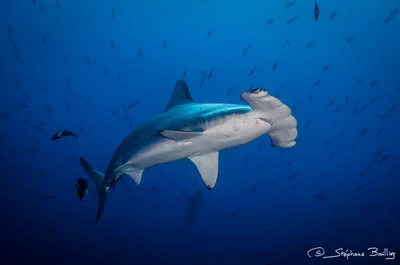
Then there is the thing they do that no other large shark does. Scalloped hammerheads gather in daylight, dozens or hundreds of animals turning slowly into the current above an offshore seamount, and break up at night to hunt alone, which is the reverse of the usual arrangement. In this sea that happens at Daedalus in high summer, and it is why people book a boat a year in advance for one week in July.
Two species are on the 🌊 Red Sea list, the scalloped and the great hammerhead. Both are listed as critically endangered worldwide, and the gathering is exactly what made them easy to take.
- distinctive wide, flattened head (cephalofoil)
- eyes positioned at either end of wide head
- streamlined, muscular body typical of sharks
- large size, typically over 1.5 meters long
2 species in Hammerhead sharks
Other groups in Sharks
Nearby in the catalogue.


Last Update: August 23, 2026