Clubnose Guitarfish
© Pierre de Chabannes
Fishes · Rays · Guitarfish

Clubnose Guitarfish

Glaucostegus thouin (Anonymous [Lacepède], 1798)
syn. Raja thouin, Rhinobatos thouin, Rhinobatos thouini, Rhinobatus thouini
3 m1-60 mCITES IICritically Endangered
727

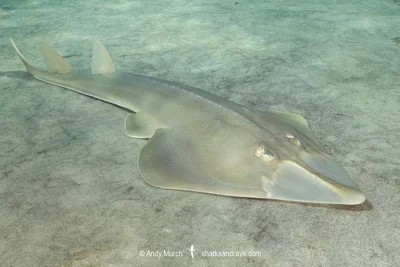
The clubnose guitarfish (Glaucostegus thouin) is a marine species classified as critically endangered within the Glaucostegidae family. This ray inhabits shallow coastal regions extending to depths of 60 meters (200 feet) in the Indo-Pacific, with a geographical distribution from 🇮🇳 India to Southeast Asia, and it is also present in the 🌊 Red Sea. Historical, though unverified, records suggest its presence in the Mediterranean and Suriname.

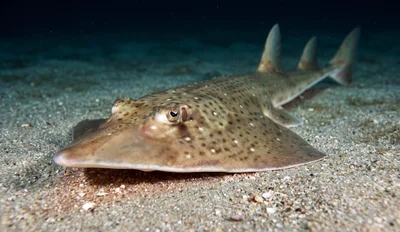
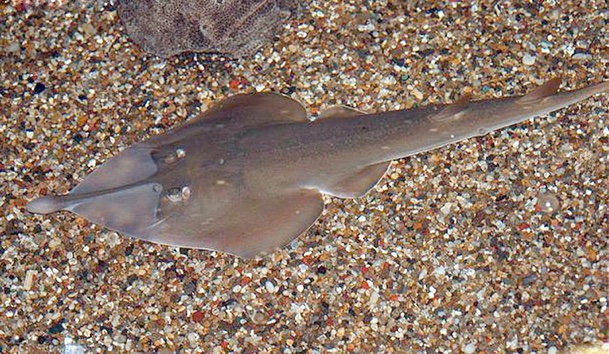
The clubnose guitarfish can attain a length of up to 3 meters (9.8 feet), though it more commonly measures less than 2.5 meters (8.2 feet). It is characterized by a pale yellowish or brownish coloration and a distinctive pale snout. A notable morphological feature is the unique club-like shape at the tip of its snout, distinguishing it from other species within the genus Glaucostegus.

Why it's threatened

Biological resource use
Intentional use: (subsistence/small scale) [harvest] · Intentional use: (large scale) [harvest] · Unintentional effects: (subsistence/small scale) [harvest] · Unintentional effects: (large scale) [harvest]

Globally, giant guitarfishes are subject to intense fishing pressure on their coastal and shelf habitats that is unregulated across the majority of their distributions. Giant guitarfishes are captured in industrial, artisanal, and subsistence fisheries with multiple fishing gears, including gillnet, trawl, hook and line, trap, and seine net and are generally retained for their meat and fins (Bonfil and Abdallah 2004, White and Sommerville 2010, Moore 2017, Jabado 2018). There is a high level of fisheries resource use and increasing fishing pressure across the range of the Clubnose Guitarfish, and demersal coastal fisheries resources have been severely depleted in significant areas of the Indo-West Pacific, including India and Southeast Asia (Stobutzki et al. 2006, Mohamed and Veena 2016).

In general, fishing effort and the number of fishers has increased in recent decades across the range of this species, with demand for shark and ray product increasing over the same period due to the shark fin trade (Chen 1996, Jabado et al. 2017). In the Indian state of Gujarat for example (just outside the range of the Clubnose Guitarfish), the number of trawlers increased from about 6,600 in the early 2000s to 11,582 in 2010 (Zynudheen et al. 2004, CMFRI 2010, Jabado et al. 2017). All Indian states have high numbers of trawlers (e.g., as reported in 2010: Maharashtra, 5,613 trawlers; Kerala, 3,678 trawlers, Tamil Nadu, 5,767 trawlers; total trawlers in India: 35,228) and a high number of gillnetters (total of 20,257 as reported in 2010), and most countries have significant fishing fleets operating in coastal waters e.g. Sri Lanka (24,600 gillnet vessels operating in 2004) and Indonesia (~600,000 fishing vessels in marine waters) (Dissanayake 2005, CMFRI 2010, KKP 2016, Jabado et al. 2017).

Sharks and rays, including giant guitarfishes, are often targeted and now heavily exploited across the region by net and trawl fisheries and increasing fishing effort has put significant pressure on all giant guitarfish species in the Indo-West Pacific. Furthermore, the high value of fins is driving retention and trade of giant guitarfishes globally (Moore 2017, Jabado 2018). The Clubnose Guitarfish is landed throughout its range (e.g., White and Dharmadi 2007, Last et al. 2010) and several countries within the distribution of this species rank among the top 20 shark fishing nations globally, specifically Indonesia, India, Malaysia, Thailand, and Sri Lanka (Lack and Sant 2011).

The shallow, inshore soft-bottom habitat preferred by the species is threatened by habitat loss and environmental degradation (Stobutzki et al. 2006, White and Sommerville 2010, Moore 2017). Southeast Asia for example, has seen an estimated 30% reduction in mangrove area since 1980 (FAO 2007, Polidoro et al. 2010).

Threat classification from the IUCN Red List.

Comments

Please, sign in to leave a comment

Continue with a social account — yours will be created automatically.

No comments yet — be the first.

Last Update: June 28, 2026