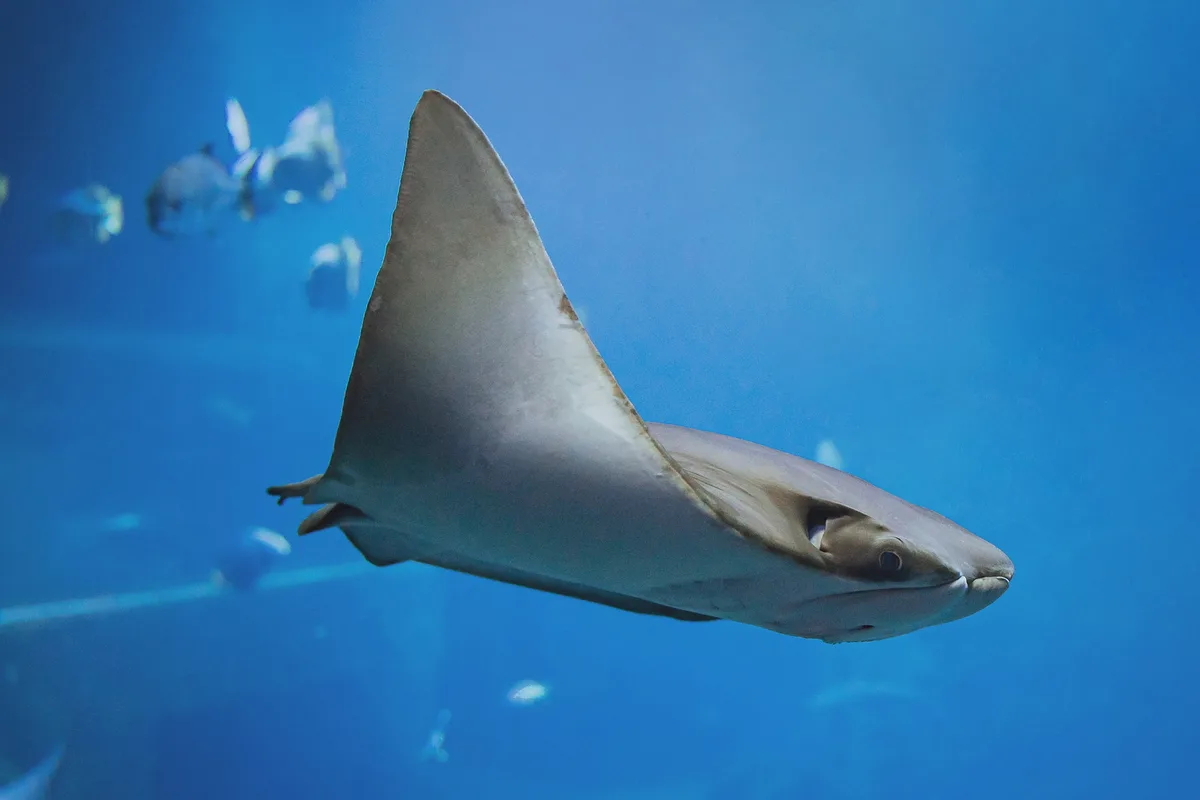
The Shorttail Cownose Ray (Rhinoptera jayakari) is a marine species classified under the genus Rhinoptera, derived from Greek, with "rhinos" meaning nose and "pteron" meaning fin or wing. This species is benthopelagic and inhabits tropical regions, reaching a maximum length of approximately 90 cm (1.2 m disc width).
Notably, these rays are found in the open ocean, frequently forming sizable shoals. They exhibit ovoviviparous reproduction (aplacental viviparity), with embryos initially deriving nourishment from their yolk sacs. Subsequently, they receive additional sustenance from the mother through the indirect absorption of uterine fluid, which is enriched with mucus, fat, or protein, facilitated by specialized structures.
Geographically, the Shorttail Cownose Ray is distributed across the Indo-West Pacific region, from 🇿🇦 South Africa to the 🇵🇭 Philippines, extending northward to the Ryukyu Islands (🇯🇵 Japan) and southward to eastern 🇮🇩 Indonesia. However, recent genetic studies suggest the existence of two closely related species within this range, potentially distinguished by variations in the shape of their heads and tails, as well as the robustness of their bodies.
The genus. Rhinoptera Cuvier 1829 - ptera (fin). ETYFish
The species. Rhinoptera jayakari Boulenger 1895 - Honours Atmaram Sadashiva Grandin Jayakar. ETYFish
Why it's threatened
The Oman Cownose Ray in taken as target and bycatch in coastal industrial and artisanal fisheries fisheries throughout its range by a range of gears including demersal trawl, purse seines, tangle nets, set nets, gill nets, droplines, longlines, and Danish seine (White et al. 2006, Blaber et al. 2009). It is retained for human consumption or for fish meal. The northern South China Sea has been heavily over-exploited, with fish stocks having declined by over 70% in the inshore, offshore, and outer shelf areas between the 1960s and 1990s (Wang and Yuan 2008). In China, the number of powered fishing vessels increased from ~10,000 in the late 1960s to ~200,000 in the mid-1990s, along with an increase in vessel size and more modern fishing gear. Since 1989, the catch-per-unit-effort (CPUE) of fish stocks has steadily decreased and large, highly valued species have been replaced by small, less valuable species, with most of the catch now used as feed in aquaculture (MacKinnon et al. 2012). The demand for seafood in China is high and increasing, with China one of the the largest consumers of seafood products globally; a 6% annual increase per capita fish consumption was evident from 1990–2010 (Fabinyi and Liu 2014).
Taiwan ranks among the top 20 shark fishing nations globally and is a major global shark fin and shark meat trading nation (Oakes and Sant 2019). However, since the 1970s, most of the Taiwan global shark catch is from Taiwan fishing vessels operating in distant waters outside Taiwan Exclusive Economic Zone (EEZ) (H. Hsu, Taiwan National Fisheries Statistics pers. comm. 28 August 2019). By the 1950s, the Taiwan coastal fisheries were considered overfished, and fisheries expanded into offshore waters. The fisheries catch within the Taiwan EEZ continued to rise from the 1950s until 1980, after which it steadily declined (Kuo and Booth 2011). The number of powered vessels operating in Taiwan’s EEZ significantly increased from the 1950s (3,215 vessels) to the late 1980s (peaked in 1989s at 15,900), and then slowly decreased to 11,200 vessels in 2017 (Huang and Chuang 2010, Liao et al. 2019, H. Hsu Taiwan National Fisheries Statistics pers. comm. 28 August 2019). In Taiwan, the demand for seafood has always been high with per capita fish consumption at 31.2 kg per capita in 2013 (Fabinyi and Liu 2014, Helgil 2019).
The Oman Cownose Ray is subject to intense fishing pressure within Viet Nam and Cambodia, if it is still extant in the two countries. There is a high level of fisheries resource use throughout Viet Nam. Most marine stocks have been declining since the 1990s and are now considered fully or over-exploited with a lack of adequate enforcement leading to essentially unregulated fisheries (Teh et al. 2014, FAO 2020a). The motorized fishing fleet has been increasing since the 1950s and rapidly expanded in the mid-1980s to 2000s (Teh et al. 2014). The fleet is dominated by small-scale artisanal and subsistence fisheries that tripled from 1950 (~24,280 vessels) to 2014 (~78,000 vessels) but also substantially increased in effort in terms of engine power, particularly over the last two decades (Pauly et al. 2020). This fleet tends to operate in inshore waters at depths less than 50 m and within 4–5 nautical miles from shore (Teh et al. 2014, FAO 2020a). The demand for seafood is also high in Viet Nam, with per capita fish consumption steeply increasing over the last two decades to 36.3 kg per capita in 2017 (FAO 2020a, Helgil 2020a).
In the Philippines, the Oman Cownose Ray is taken as bycatch in commercial and small-scale municipal fisheries and all incidental catch appears to be retained as discards are virtually non-existent (Palomares and Pauly 2014). The demand for seafood has always been high with per capita fish consumption increasing over the last two decades to 34.1 kg per capita in 2013 (Helgil 2020b). The fishing fleet in the Philippines rapidly expanded in the 1960s and 1970s and by the 1980s, overfishing was apparent throughout the Philippines (Palomares et al. 2014). The commercial fleet tripled from the 1960s (2,100 vessels) to 2014 (6,400 vessels) (Palomares et al. 2014). Fishing shifted from mainly inshore demersal to offshore pelagic species during the late 1980s (Palomares and Pauly 2014).
In Indonesia, small-scale fisheries comprise most (~90%) of fisheries production (Tull 2014). In some regions, effort by these small-scale fisheries has tripled when taking population growth into account (Ramenzoni 2017). Sharks and rays are an important resource in Indonesia and are the main livelihood for some communities (Sadili et al. 2015). Indonesia catches the highest number of chondrichthyans in the world with the catch of rays rising as shark fisheries collapse. In 2003, rays comprise over 50% of chondrichthyan landings, up from 32% in 1981 (White et al. 2006). In Malaysia, this species is now considered very rare and only juveniles are observed at landing sites, indicating a likely decline in recent years (A. Bin Ali unpubl. data 2020). In Malaysia, fishing effort has been increasing since 1950 across subsistence, artisanal, and industrial fisheries (Pauly et al. 2020). The number of vessels across all sectors has more than doubled from 22,800 vessels in 1950 to 50,150 vessels in 2014 (Pauly et al. 2020). However, the substantial increase over this period has been in engine power which has dramatically increased by ~30 fold (Pauly et al. 2020). Consequently, fisheries were fully exploited by the late 1970s (Teh and Teh 2014). Nevertheless, fish consumption continues to rise and most (~85%) comes from the Malaysian EEZ (Fowler et al. 2002, A. Bin Ali unpubl. data 2020). Small-scale inshore fisheries provide the main supply for local consumption. In Thailand, the gulf coast is considered one of the most overfished regions of the world due to the rapid industrialization of their fishing fleet (Sylwester 2014). The number of Thai trawlers peaked in 1989 at ~13,100 boats (Poonnachit-Korsieporn 2000), which was reflected in the catch per unit effort (CPUE) which declined from >300 kg per hour in 1963 to 20–30 kg per hour in the 1990s (Poonnachit-Korsieporn 2000).
In Myanmar, Rhinoptera spp. are caught in large abundances in purse seines, up to 10,000 kg/year (A. Maung unpubl. data 2020). Inshore fisheries are relatively small-scale and include many subsistence level fishers. At times since 1950, significant numbers of foreign vessels have operated in Myanmar waters targeting fish and shrimp. International Labour Organisation (2015) estimated the number of vessels participating in the small-scale inshore fishery to be about 26,000 in 2013, with about 50% of them unpowered. Foreign fishing vessels numbered 153 in 2013, but had historically been much higher; foreign vessels were banned in 2014. In Bangladesh, this species is among one of the most abundant rays landed frequently in longlines and setbag nets amongst other modified gill nets (A.B. Haque unpubl. data 2020). Bangladesh has a substantial artisanal fishing fleet that operates throughout the coastal regions. In 2017–2018 there were 67,669 vessels reported to be operating (DoF 2018). All benthic rays in Bangladesh are targeted with non-baited demersal longlines (1–10 km) with 10,000–30,000 hooks that operate in 5–40 m depth (A.B. Haque unpubl. data 2020). There has been an increase in fishing vessels over the past 10 years. It is believed that there may be a number of nursery areas around coastal Bangladesh. Sharks and rays landed in the pre-monsoon season are often pregnant and near term. This period overlaps with significant fishing pressure (A.B. Haque unpubl. data 2020).
In Sri Lanka, this species is caught mostly in gillnets and demeral set gillnets in artisanal coastal fisheries (D. Fernando unpubl. data 2020). Coastal fisheries account for about 67% of the marine fishes caught, but there are some uncertainties regarding further expansion of coastal fishing activities (Wijayaratne 2001). Approximately 28,000 fishing crafts operate and of this, 87% of crafts operate in the coastal fishery which consists of traditional non-motorised crafts and fiberglass reinforced plastic boats with inboard engines (Wijayaratne 2001, NARA 2003). In India, Rhinoptera spp. have been caught regularly in the mixed species fishery by a large suite of gears. Mohanraj et al. (2009) reported Rhinoptera spp. formed 8% of rays landed at Chennai, Bay of Bengal during the 2002–2006 period, in which trawls were the major gear used and the annual catch ranged between 33–120 t. Juveniles are found in estuaries and high fishing effort, particularly with stake and doll nets, occurs in this habitat. There are approximately 24,554 trawl vessels operating in the Indian part of the species' range (CMFRI 2010). Furthermore, there are over 13,400 gill netters operating along the west coast, with many other types of net gear also deployed in coastal areas (CMFRI 2010). The shallow depth distribution means this species is unlikely to have a depth refuge. There has been a significant increase in coastal fishing effort and power over the past 30 years (just over two generation lengths) (CMFRI 2010). A ray fishery has recently began (two years ago) in the Andaman and Nicobar islands and uses demersal set gillnets to catch up to 6 t of rays/ trip (3–5 days). There are currently 20–40 boats operating in this fishery (K.K. Bineesh unpubl. data 2020). In Pakistan, about 2,000 trawlers operate in shelf areas, targeting shrimp in shallow waters and fish in outer shelf waters (M. Khan pers. comm. 6 February 2017). In Iran, there is increasing fishing effort with the number of fishermen increasing from 70,729 in 1993 to 109,601 in 2002 (Valinassab et al. 2006).
This species comprised 3% of all elasmobranch landings (by number) along the eastern coast of the Red Sea (Saudi Arabia) where only juveniles were caught (Spaet and Berumen 2015). In the United Arab Emirates (UAE), the species comprised 59.4% of examined batoid landings (R.W. Jabado unpubl. data 2019). The species was not observed during landing surveys in Bahrain, while small numbers were observed in Kuwait (Moore et al. 2012; although larger numbers of unidentified Rhinoptera spp. where also reported). It is caught in trawl fisheries off Somalia (M. Ali unpubl. data 2019), and likely elsewhere that is undocumented.
In the Western Indian Ocean, overall catches reported to FAO have increased over the past 30 years but have levelled off since 1999 suggesting stocks are fully fished. There is concern for serial depletion with the number species landed near-doubling from only 85 in 1971 to 152 reported in 2000 (van der Elst et al. 2005). Artisanal catches are underreported and most small scale/artisanal/subsistence coastal fisheries within the Western Indian Ocean are considered to be fully- or overexploited, especially where they are found close to population centres. Over the last ten years, the number of underexploited fisheries in the coastal zone has tended to decline and such fisheries are now an exception (FAO 2006, Pierce et al. 2008).
There is a large amount of illegali, unreported and unregulated (IUU) fishing in the Indo-Pacific region with reported catch estimated to represent only 0.9–19.4% of the true catch (Tull 2014). In some areas, including near marine protected areas (MPAs), IUU catch of sharks was estimated to equal 77% of the reported catch, indicating much higher levels of depletion (Varkey et al. 2010). This species’ preference for coastal waters means it is also threatened by extensive habitat degradation, including pollution and clearing, and destructive fishing practices. Large coastal areas, in particular mangroves, have been lost in Indonesia and Malaysia through land conversion for urban development, shrimp farms, and agriculture. Across Indonesia and Malaysia from 1980 to 2005, the area of mangroves was reduced by >30% (FAO 2007, Polidoro et al. 2010). In Viet Nam, dynamite and cyanide fishing, and sedimentation have caused widespread destruction of coral reefs (Jameson et al. 1995, FAO 2020a). Large areas of the coast are used for brackish-water aquaculture, which may have contributed to the dramatic loss of 45% of mangroves in Viet Nam from 1945–1995 (Jameson et al. 1995). Marine habitats in the Arabian Gulf are experiencing high levels of disturbance due to major impacts from development activities (including dredging and reclamation), desalination plants, industrial activities, habitat destruction through the removal of shallow productive areas and major shipping lanes (Sheppard et al. 2010).
Threat classification from the IUCN Red List.


