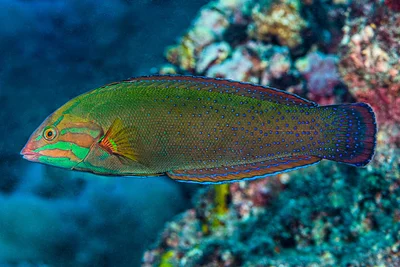
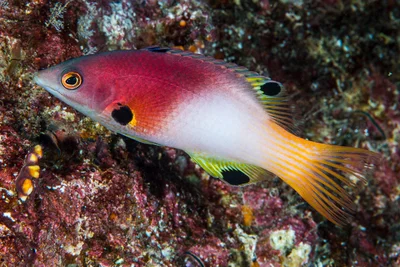
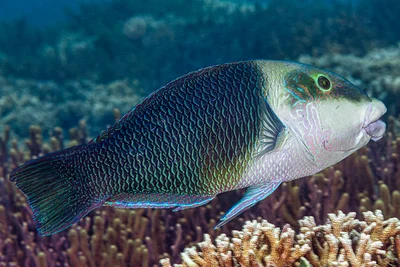
The mouth is the thing. Two teeth in each jaw project straight forward like a pair of forceps, and the fish uses them to pick single small animals off rock and rubble - a copepod, a worm, the arm of a brittle star - one at a time.
That is precision feeding, and it is unusual at this size. Most wrasses of twenty centimeters are crushers that take whole shelled animals and break them in the throat. This genus went the other way and built a pair of tweezers, which lets it work over ground the crushers have already been across and take what they could not pick up.
The sexes look nothing alike. The female is dark brown covered in white spots with a bright yellow tail, and that is the fish people photograph; the male is green-blue with orange lines and no spots at all.
Twenty-two centimeters (9 in), always moving over mixed bottom, and buried in sand at night.
- females dark brown covered in fine white spots, with a yellow tail
- males green-blue with fine orange lines and no spots
- two forward-projecting teeth in each jaw, visible up close
- length up to 22 cm
Why it's threatened
Threat classification from the IUCN Red List.