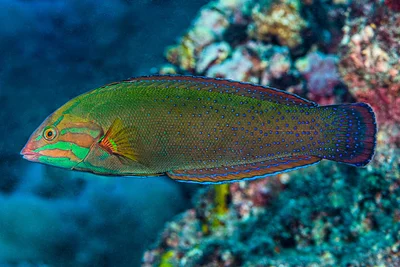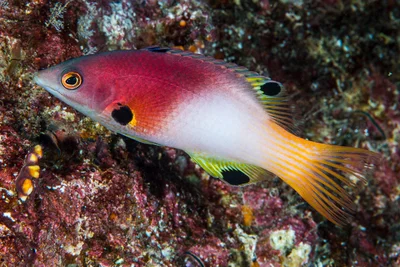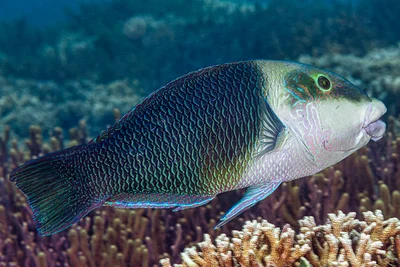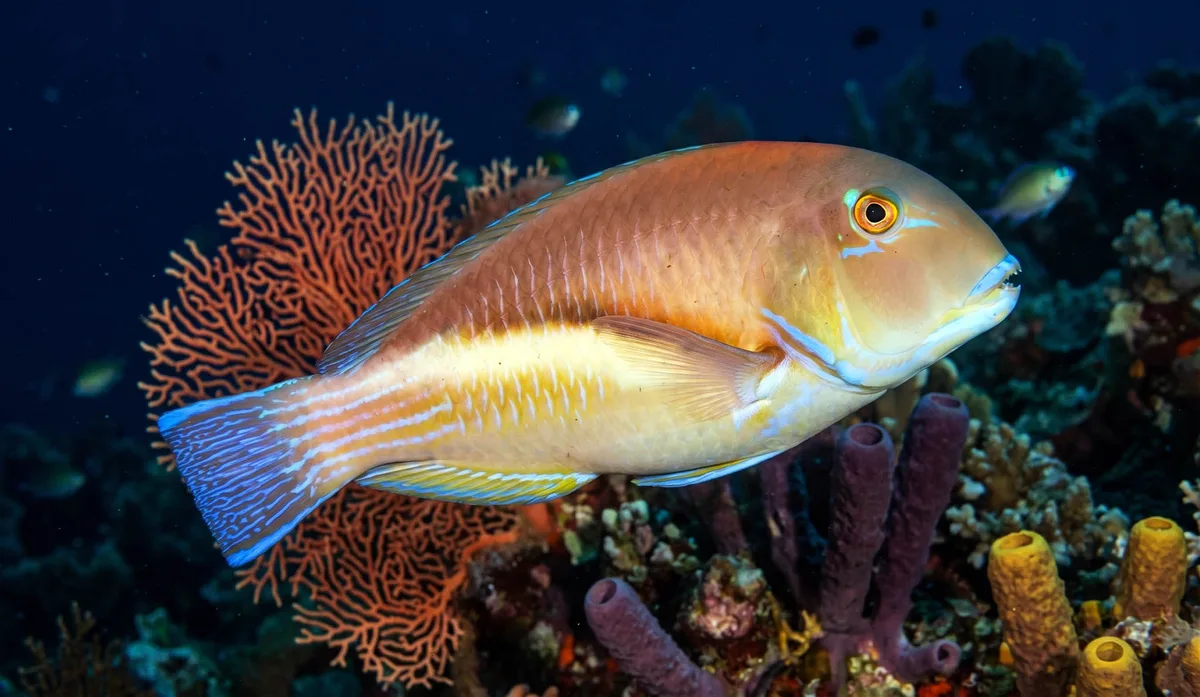
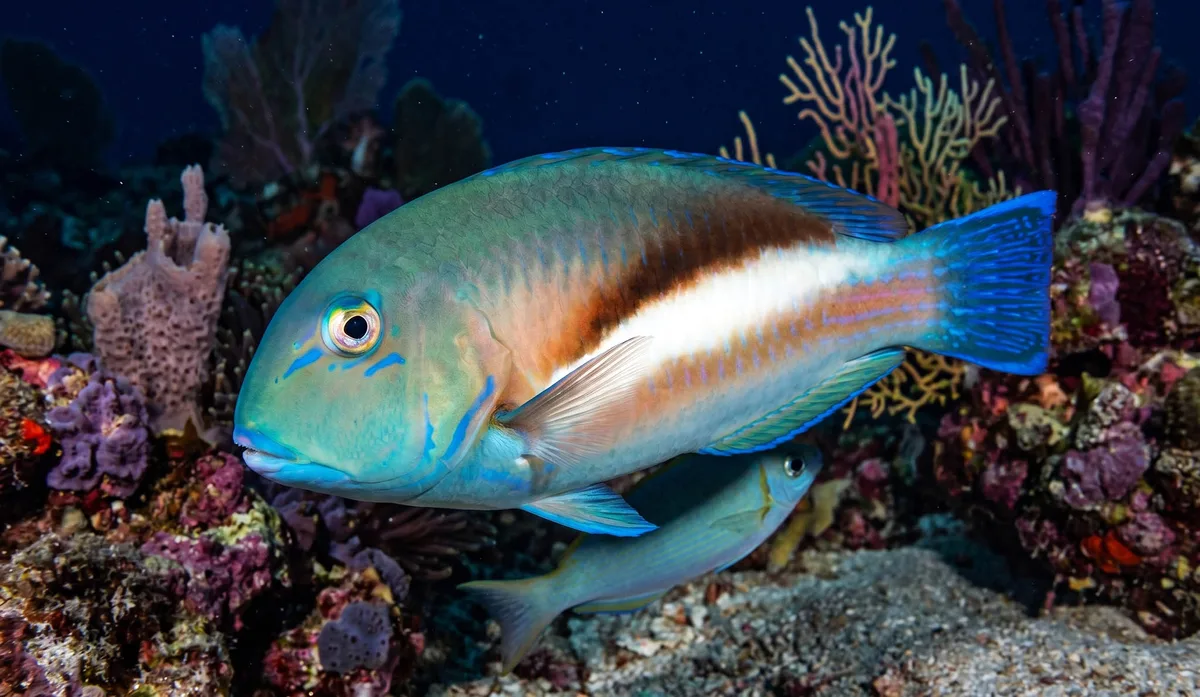
Tuskfish use tools, which is a sentence that took a long time to be allowed.
A tuskfish that finds a clam it cannot open carries it - sometimes a considerable distance - to a particular piece of hard coral it uses repeatedly, and smashes the shell against it with sideways flicks of the head until it breaks. The same fish returns to the same anvil. It has been filmed repeatedly, and it satisfies the definition of tool use that was for decades assumed to be beyond fish entirely, on the grounds that tool use requires a hand and fish do not have one. It turns out you can use the whole animal as the hand if the anvil stays still.
The teeth are the other half. The genus is named for them: heavy protruding canines, blue in some species, used to lever and grip shelled animals off the bottom.
This one lives deep, between about forty and eighty meters, which is why almost nobody here has seen it. It is a fish of the rubble slopes below the reef rather than of the reef itself.
The genus. Choerodon Bleeker 1847 - choiros (pig) + odon (tooth). ETYFish
The species. Choerodon robustus (Günther 1862) - full-bodied or stout. ETYFish
- heavy-bodied wrasse with a steep forehead and protruding canines
- reddish to pinkish body, plainer than the shallow wrasses
- well below normal diving depth, on rubble and sand
- up to 35 cm
Why it's threatened
There are no major threats known for this species.
Threat classification from the IUCN Red List.