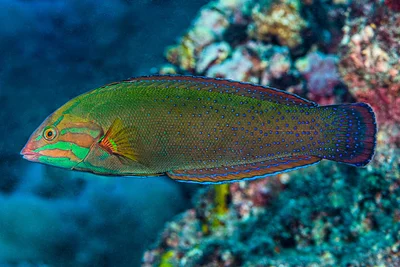
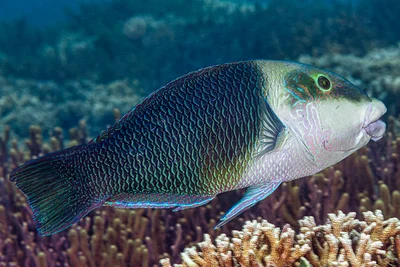
Fairy wrasses have a divided eye. The cornea in this genus is split into two parts with different optical properties, effectively giving the fish two lenses in one eye - one for the close, sharp work of picking individual plankton out of the water, and one for the wider view.
No other reef fish family is built that way, and it fits what these animals do. A fairy wrasse feeds by taking single copepods from moving water while a group of them hangs above a rubble slope, and it does this at depths where the light is poor. Picking one moving speck out of a current in dim blue light is an optical problem, and this genus solved it in the eye rather than in the brain.
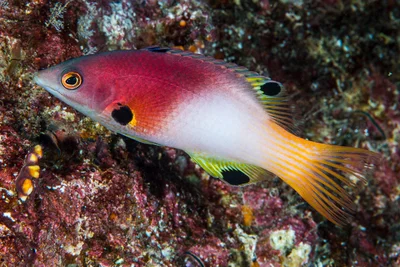
This species is one of the deep ones, living below forty meters, and it belongs to this sea and nowhere else. It is purple and magenta with a yellow-orange back, which under a torch is one of the more spectacular fish on the coast and which almost nobody sees, because forty-five meters is past where most people turn around.
The species. Cirrhilabrus blatteus Springer & Randall 1974 - purple. ETYFish
- purple to magenta body with a yellow-orange back
- long trailing pelvic fins in males
- below forty meters, in loose groups above rubble
- up to 16 cm
Why it's threatened
There are no known major threats to this species.
Threat classification from the IUCN Red List.