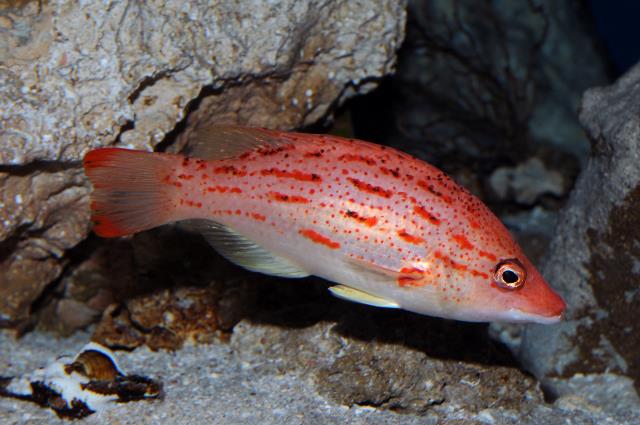
Its common name is morse hogfish, and the pattern is why: the red bands along the body are broken into long and short pieces, dashes and dots, running the length of the fish like a line of code.
It lives deeper than anything else in this group, recorded from fifty meters down past a hundred, and that is not a place where color means what it means on the reef. At a hundred meters there is no red light left at all, so the red and white pattern that looks so striking under a torch is, in the animal's own world, a set of dark bands on pale - which is exactly what disruptive camouflage needs. The showiness is entirely an artifact of how we look at it.
Which is a good reminder for the whole catalogue. Most of the spectacular color on this site is being described under artificial light at close range, and the animal wearing it has never seen itself that way.
It was described relatively recently and is known from a small number of specimens and photographs, all from depth.
The species. Bodianus rubrisos Gomon 2006 - ruber. ETYFish
- white body with red bands broken into long and short segments
- yellow wash on the upper body in some individuals
- very deep, mostly below fifty meters
- up to 20 cm
Why it's threatened
There are no major threats known for this species.
Threat classification from the IUCN Red List.