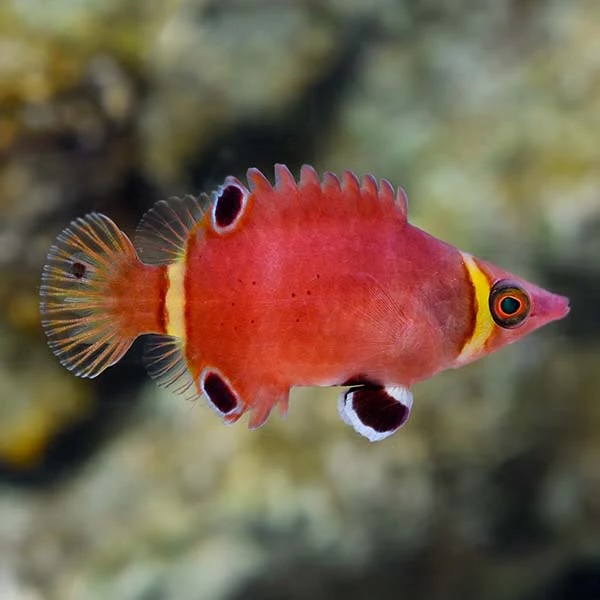
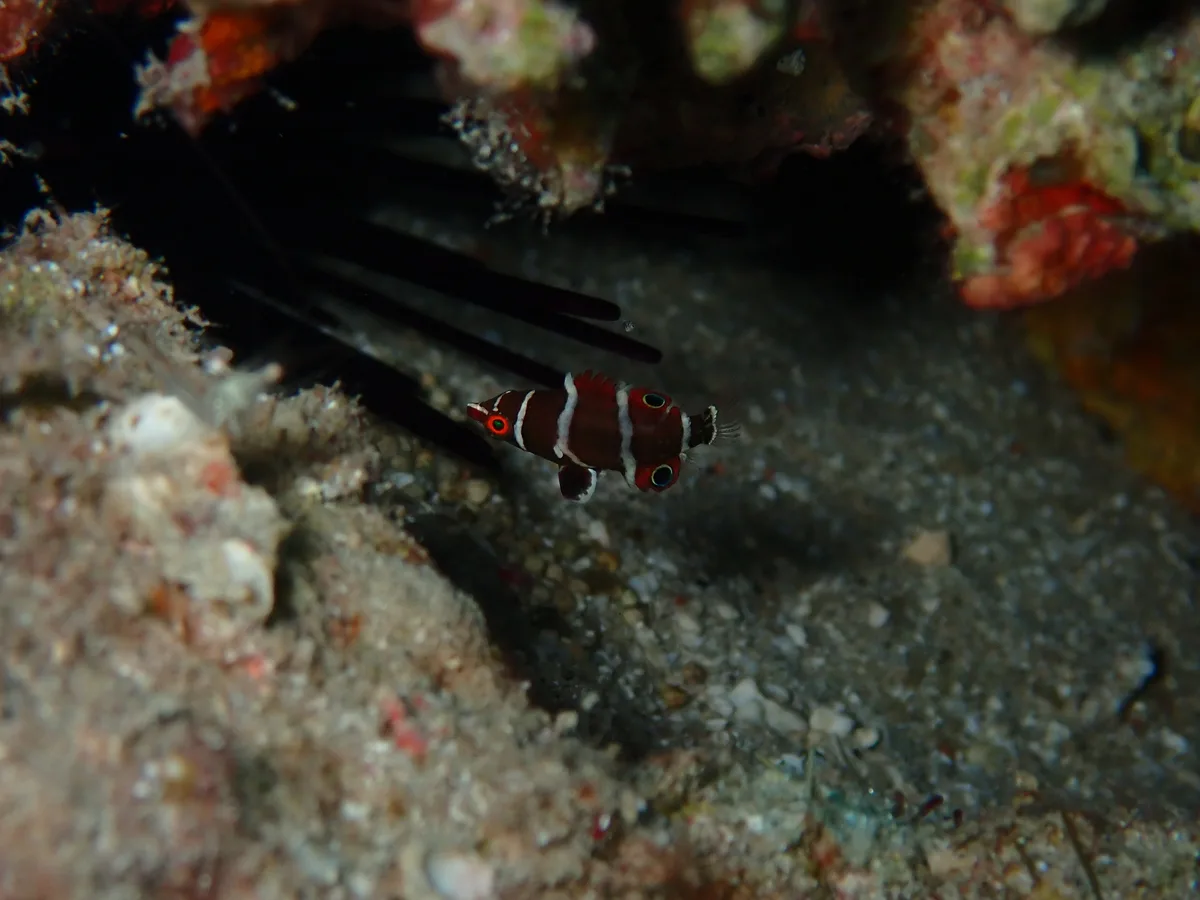
This may be the hardest wrasse on the coast to see. It is seven centimeters long, dark, and it does not come out: it lives deep in caves and under overhangs, hangs at odd angles including upside down, and retreats further in when a light arrives.
The fins are the giveaway when you do find one. The dorsal and anal fins are drawn out into long trailing filaments that catch the torch beam before the body does, and the two pale bars across a dark red-brown body are the marks the name refers to.
It also sits in an odd place in the records. The regional guide to this sea carries it - 🌊 Red Sea and 🌊 Gulf of Aden, seven centimeters, in caves and overhangs - and the global databases do not have the name at all. That happens with fish that are described in regional works and rarely collected: the animal is well known to the people who dive here and effectively invisible to a database compiled from the primary literature of a whole ocean.
So the practical answer is to trust the people who have looked, and to note that the paperwork has not caught up.
The species. Wetmorella bifasciata Schultz & Marshall 1954 - bi- (two) + fasciata (banded). ETYFish
- seven centimeters, dark red-brown with two pale bars across the body
- long trailing filaments on the dorsal and anal fins
- hangs in caves and under overhangs, often upside down
- up to 7 cm