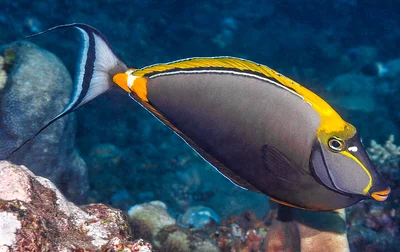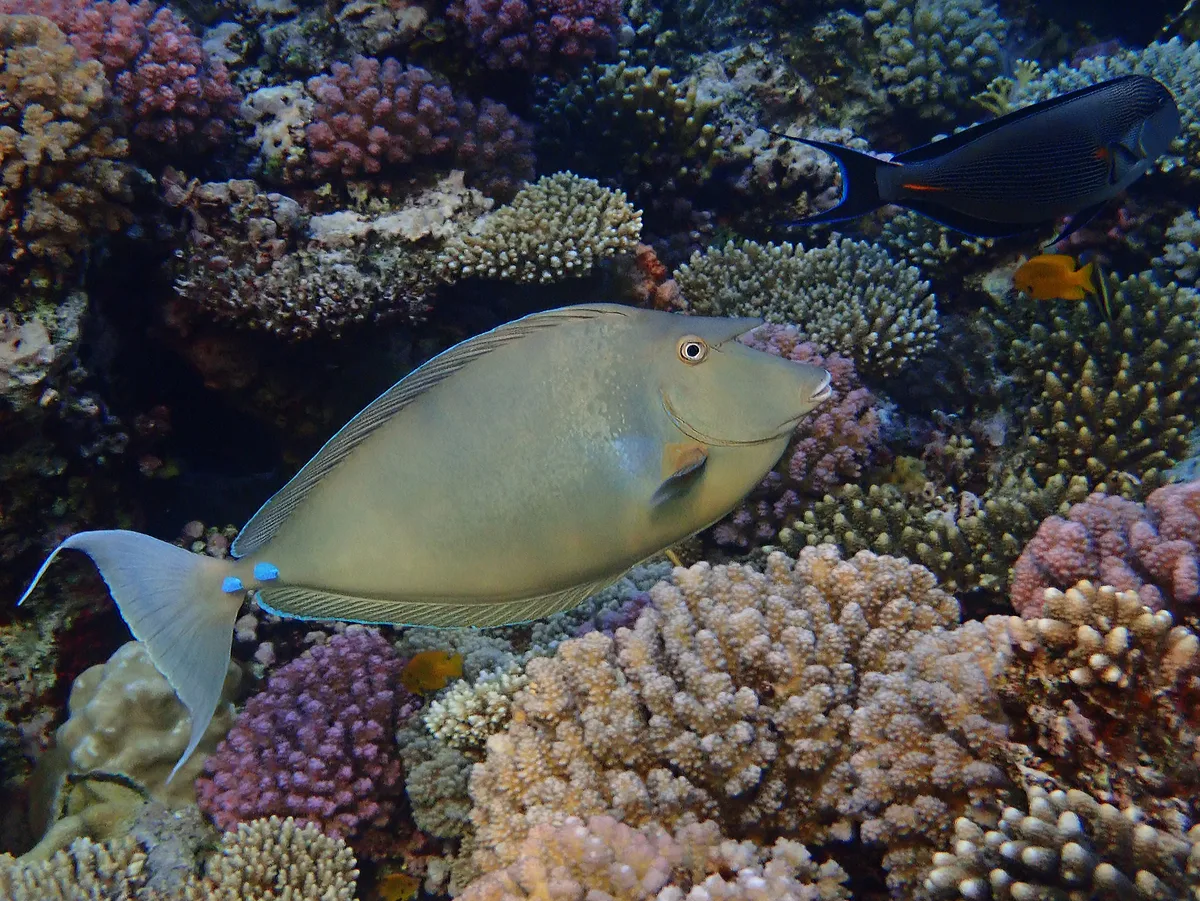
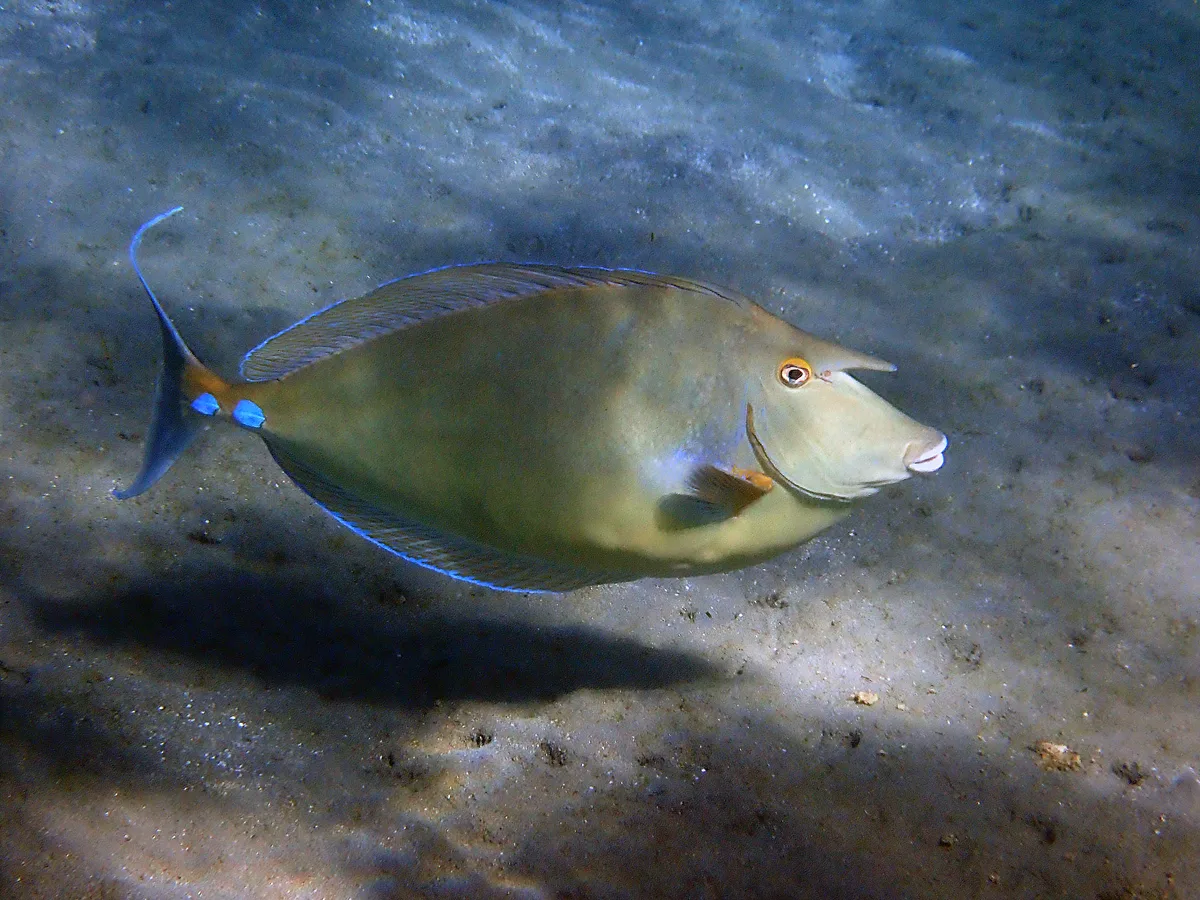
The Sleek Unicornfish (Naso hexacanthus) is a marine species commonly found in tropical and brackish waters, usually inhabiting clear lagoons and slopes of seaward reefs. Found at depths ranging from 1 to 150 meters (3 to 492 feet), it typically prefers 10 to 137 meters (33 to 449 feet). This fish can grow up to 75 cm (30 inches) in length, with a more common size being around 50 cm (20 inches).
These fish primarily feed on zooplankton, including crab larvae, arrow worms, and pelagic tunicates, occasionally consuming filamentous red algae. They are diurnal and usually seen schooling in large numbers and sometimes forming small aggregations for feeding. The Sleek Unicornfish is notable for never being poisonous, and they reproduce by spawning in pairs.
The fish's body is moderately deep and compressed, with a uniformly convex dorsal profile. It lacks any bony horn or projection on its head. It is equipped with six dorsal spines and up to 29 soft rays, while its anal fins have two spines and up to 30 soft rays. The pectoral fins usually have 17 rays, and its distinctive pelvic fins have a single spine and three rays. As Sleek Unicornfish mature, their caudal fin transitions from slightly notched to flat, and the slender caudal peduncle develops sharp keels. Their color ranges from dark brownish-gray to yellowish on the underside, with vivid colors on their fins and a black tongue in fish over 25 cm (10 inches).
The Sleek Unicornfish is distributed across the Indo-Pacific region, from the 🌊 Red Sea and East Africa to Hawaii (🇺🇸 United States), Marquesas, and Ducie islands, extending north to Southern 🇯🇵 Japan and south to Lord Howe Island.
The name "Naso" originates from the Latin word "nasus," meaning nose, referencing the fish's profile.
The species. Naso hexacanthus (Bleeker 1855) - hexa- (six) + acanthus (thorn or spine). ETYFish
Why it's threatened
Threat classification from the IUCN Red List.