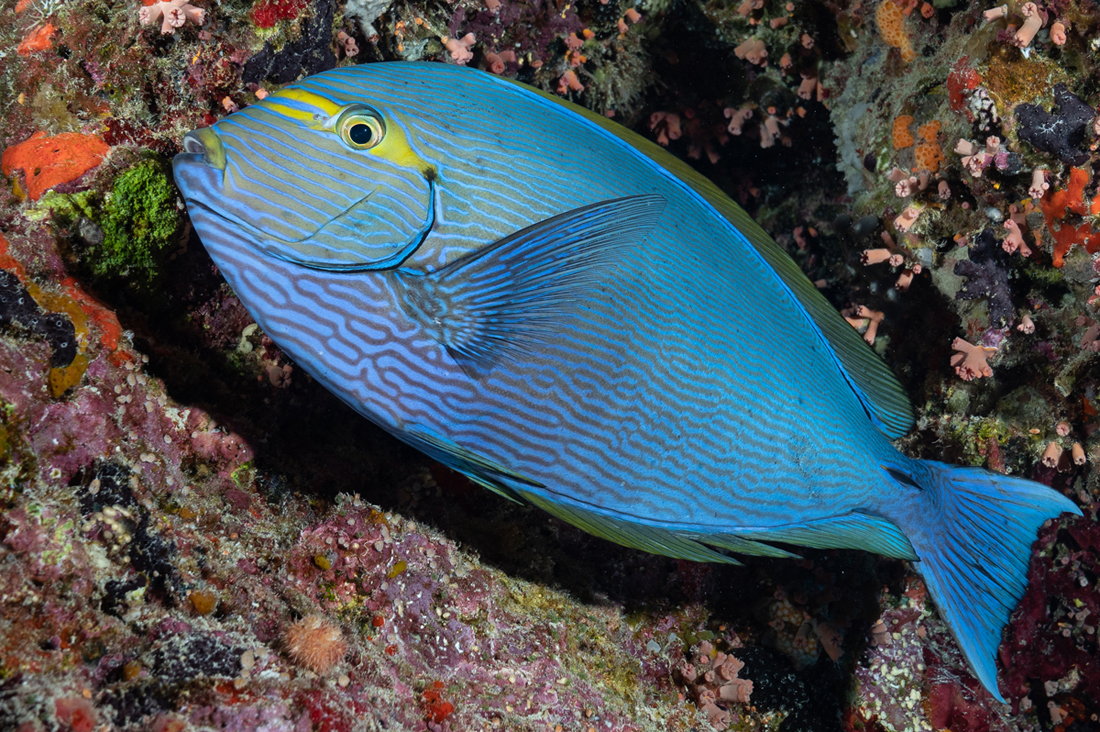
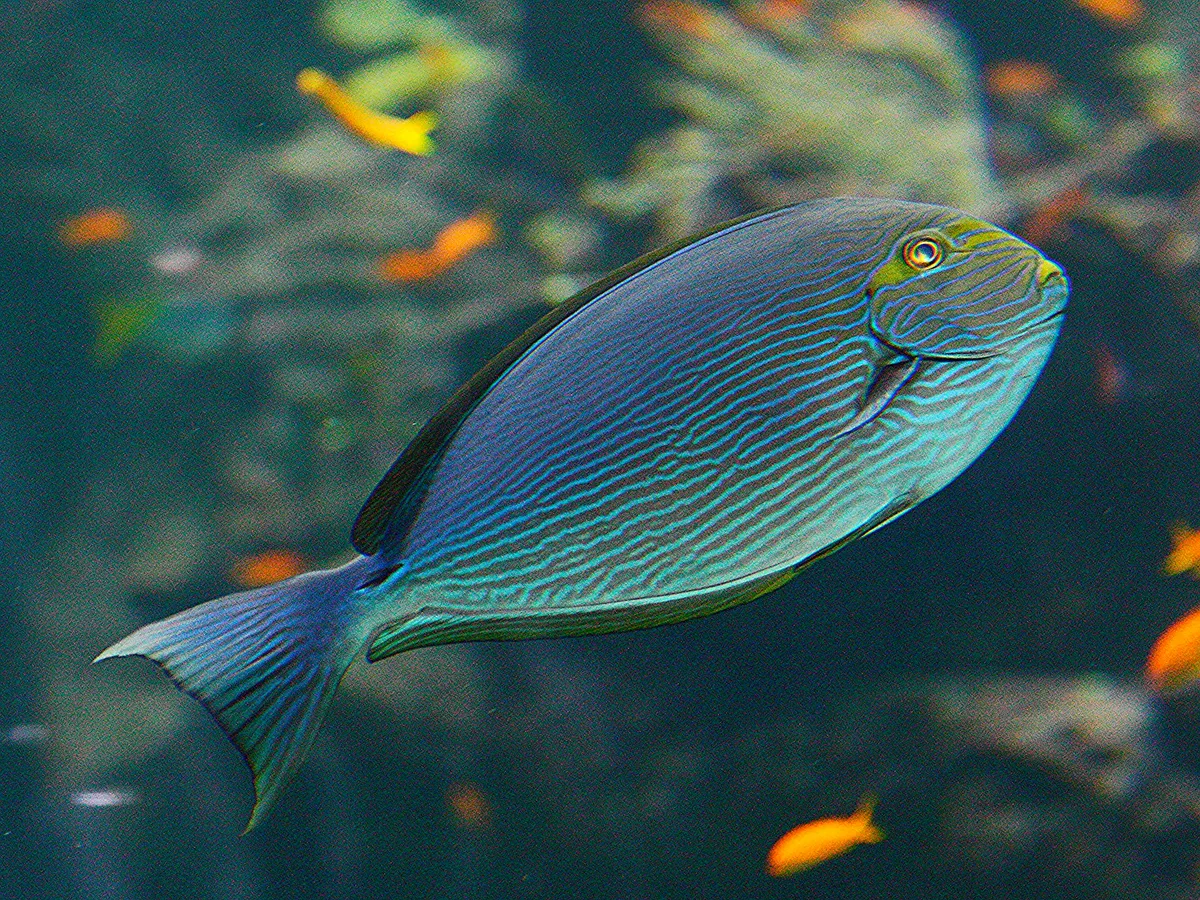
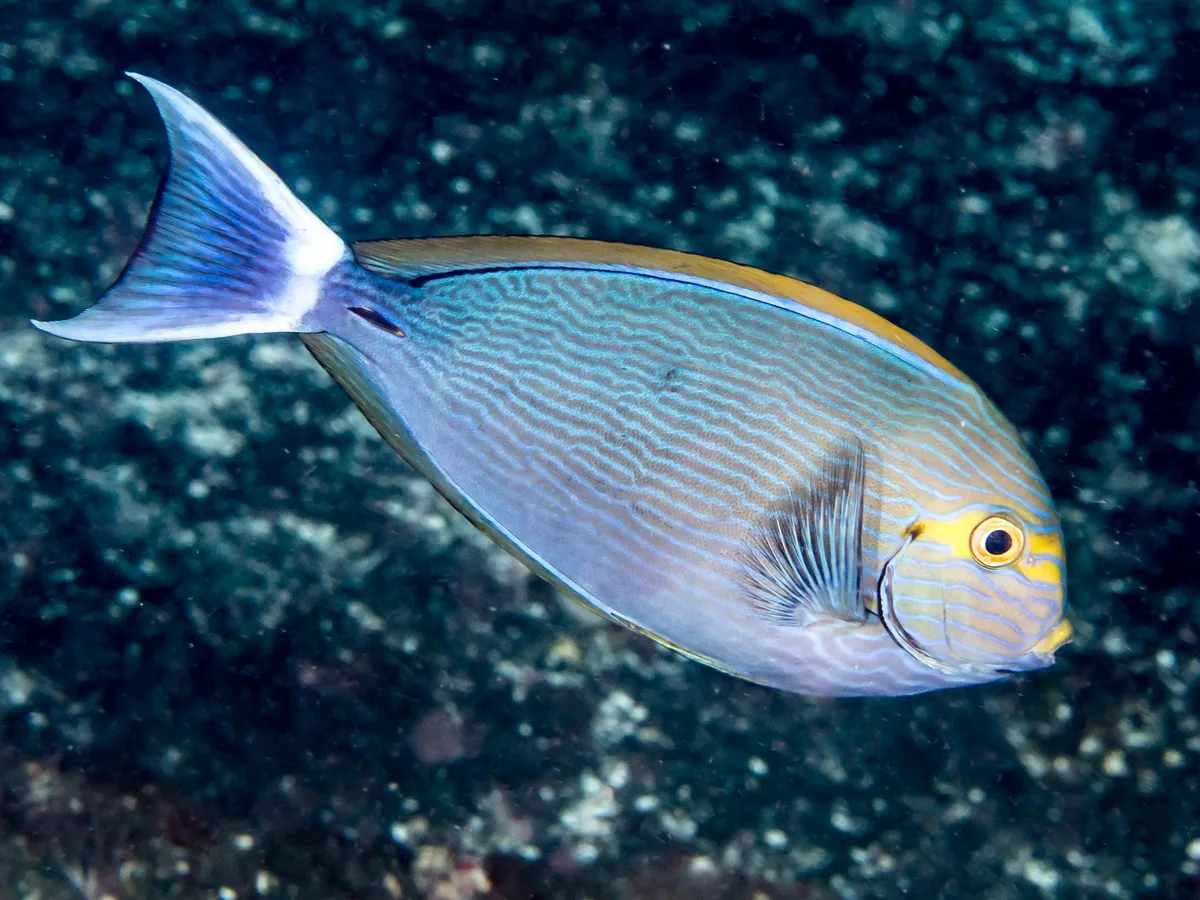
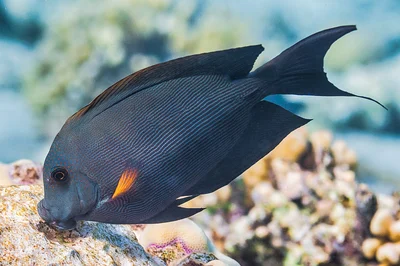
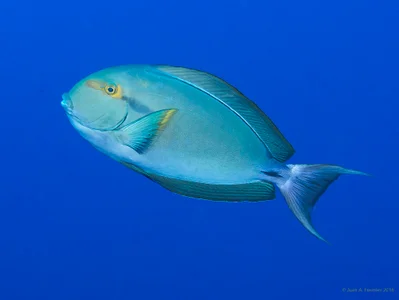
A large blue-gray surgeonfish with fine wavy lines, hanging in open water off a slope rather than grazing on it. Fifty centimeters (20 in), and the one surgeonfish here that mostly eats animals - it takes zooplankton from midwater, which is why the groups are always up off the bottom and facing into the flow.
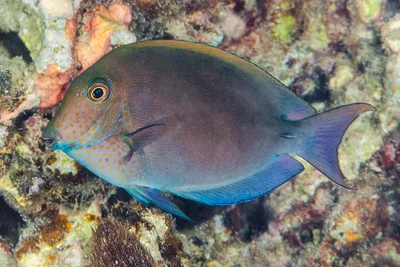
It changes shade in seconds. A fish that has been feeding calmly in pale blue-gray goes almost black when it is chased or when it moves down onto the reef, and back again - a genuine, rapid switch rather than a trick of the light.
Like every surgeonfish it carries a folding scalpel on each side of the tail base, lying in a socket and swung out by flexing the tail. Divers do not get cut. People handling fish do, and the wounds are deep and slow to heal.
It is a schooling fish that thins out where it is speared, and on unfished reefs the groups can be large.
The genus.Acanthurus Forsskål 1775 - acanthus (thorn or spine) + oura (tail). ETYFish
The species.Acanthurus mata (Cuvier 1829) - A local name for this fish. ETYFish
How to recognise it
blue-gray body with fine wavy blue lines along the flank
yellow patch behind the eye
single folding blade in a socket on each side of the tail base
Acanthurus mata is targeted in areas where illegal fishing practices are known to occur (i.e., Coral Triangle Region).
Surgeonfishes show varying degrees of habitat preference and utilization of coral reef habitats, with some species spending the majority of their life stages on coral reef while others primarily utilize seagrass beds, mangroves, algal beds, and /or rocky reefs. The majority of surgeonfishes are exclusively found on coral reef habitat, and of these, approximately 80% are experiencing a greater than 30% loss of coral reef area and degradation of coral reef habitat quality across their distributions. However, more research is needed to understand the long-term effects of coral reef habitat loss and degradation on these species' populations. Widespread coral reef loss and declining habitat conditions are particularly worrying for species that recruit into areas with live coral cover, especially as studies have shown that protection of pristine habitats facilitate the persistence of adult populations in species that have spatially separated adult and juvenile habitats (Comeros-Raynal et al. 2012).
Threat classification from the IUCN Red List.
Comments
Please, sign in to leave a comment
Continue with a social account - yours will be created automatically.