
Sea breamsSparidae
This is the family most people have already eaten.
Sparidae are the sea breams and porgies, and one of them is on nearly every fish counter in the Mediterranean world, sold as dorade or orata: the gilt-head, which is also one of the most farmed marine fish anywhere. That is the honest introduction to this heading, because on the 🌊 Red Sea coast these are not reef animals and divers hardly meet them. They belong to the water that reefs do not explain: shallow rocky shore, surf and wash, seagrass, the mouths of estuaries, brackish shallows, the sheltered water inside a harbor. Eight are listed here, and most people who see one see it on a line or on ice.
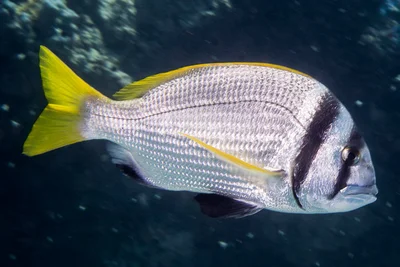
Inside a single body outline, a deep silver oval with a steep face and a small mouth set low on it, the family runs an unusually wide set of diets. Some have jaws paved for crushing shells. Others carry a row of small cutting teeth at the front: the karanteen listed here works seagrass and weed, which makes it something rare in a family of shell breakers. Emperors solve the crushing problem in their own way and their page takes that up. What sparids do with it is spread across the whole range of coastal food at once, which is a large part of why the family is everywhere.
Sex is a stage of life rather than a fixed property here, and this is the family where the textbook examples come from. Some species begin as males and become females later; others run it the other direction; in others still an individual carries both kinds of tissue and never switches at all. The wrasse page has the female-first version, which is the one the reef runs on. The gilt-head is the opposite case, a fish that spawns as a male in its first seasons and as a female afterward.
Identification is a matter of marks rather than shape, since the shape is shared: dark bars across the head, fine gold lines along the scale rows, a blotch at the shoulder, yellow in the lower fins. This is a coastal 🌊 Indian Ocean handful rather than a rich local fauna, and the interesting thing about the list is how much of it belongs to fishermen rather than to the reef.
- oval to oblong body, deeper than thick
- silvery, grey, or reddish overall colouration
- single dorsal fin with prominent spines
- small mouth, set well away from eye
8 species in Sea breams



Other oval-bodied groups
Similar silhouette underwater - worth a look if this was not your animal.


Last Update: August 23, 2026