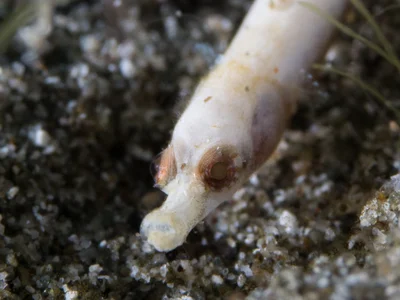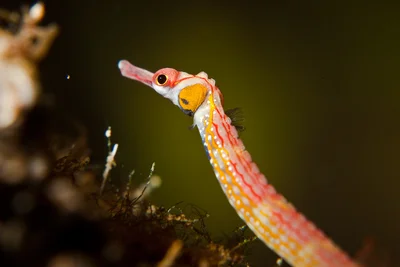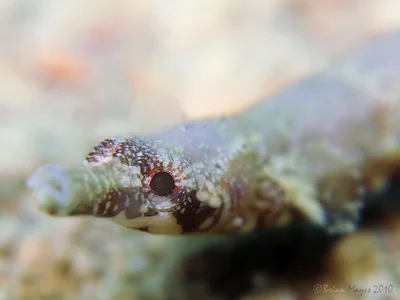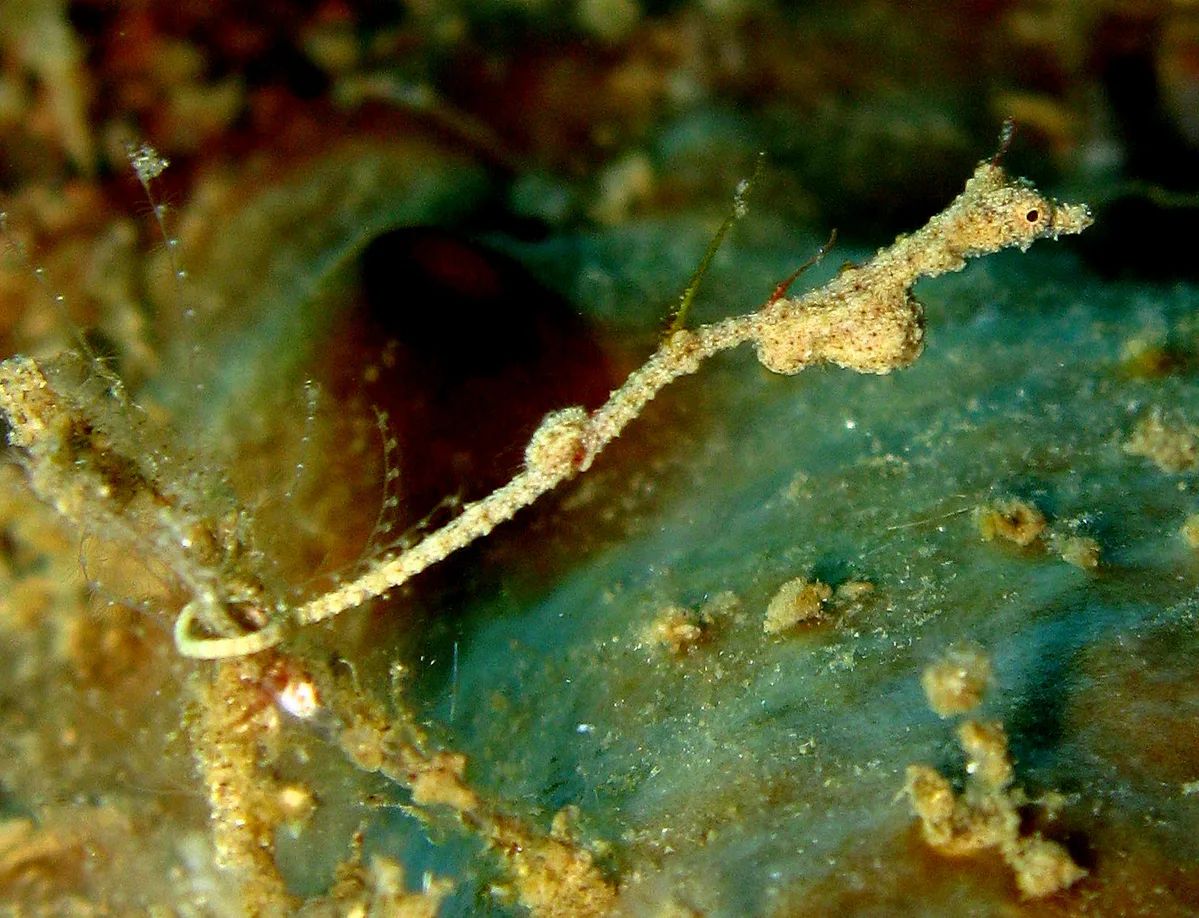
The thread pipefish (Kyonemichthys rumengani), known in 🇯🇵 Japan as Hari-youji, is a species indigenous to the 🌊 Pacific Ocean, particularly around 🇮🇩 Indonesia, inhabiting depths ranging from 15 to 20 meters (49 to 66 feet). This species, reaching a length of 2.68 centimeters (1.06 inches), is the sole representative of its genus.
Initially described in 2007 following the examination of an adult female specimen from the Lembeh Strait in Sulawesi, Kyonemichthys rumengani was originally thought to be closely related to the pygmy pipehorse genera, Acentronura and Idiotropiscis, due to morphological similarities. However, mitochondrial genetic analyses have positioned Kyonemichthys as a sister taxon to Urocampus, forming a clade that excludes the more phylogenetically distant Acentronura, Idiotropiscis, and Siokunichthys.
Originally identified in 🇮🇩 Indonesia, Kyonemichthys rumengani demonstrates a widespread distribution throughout the Indo-Pacific region. It has been documented in diverse locations, including the 🌊 Red Sea near 🇪🇬 Egypt, the Ryukyu Islands (🇯🇵 Japan), the 🇵🇭 Philippines, 🇫🇯 Fiji, the Mariana Islands, and Papua 🇵🇬 New Guinea. This species is typically found in mixed habitats on shallow coastal reefs and is noted for utilizing bryozoans, hydroids, and debris as holdfasts for orientation.
The genus. Kyonemichthys Gomon 2007 - kyo (swollen and nema) + ichthys (fish). ETYFish
The species. Kyonemichthys rumengani Gomon 2007 - Honours Noldy Rumengan. ETYFish
Why it's threatened
There are no known direct threats to this species. It may be susceptible to coral reef habitat loss, but is able to utilize other habitat types.
Threat classification from the IUCN Red List.