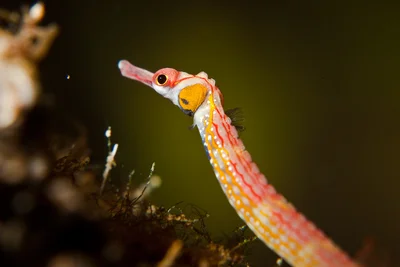
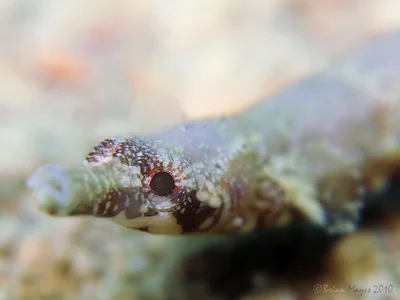
Shortnose Pipefish
© Arne Kuilman
Fishes · Bony fishes · Pipefishes

Shortnose Pipefish

Micrognathus andersonii (Bleeker, 1858)
syn. Corythroichthys tanakae, Syngnathus andersonii
9 cm1-10 mLeast Concern
661

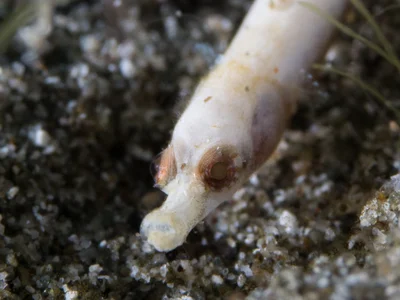
The Shortnose Pipefish, scientifically classified as Micrognathus andersonii, derives its name from the Greek words "mikros," meaning small, and "gnathos," meaning jaw. This species exhibits a coloration that ranges from pale to dark brown, often displaying 2-3 distinctive blotches on the sides of its trunk.

Habitat and Range: The Shortnose Pipefish is typically associated with reef environments, inhabiting depths ranging from 1 to 10 meters. The species reaches a maximum length of 8.5 centimeters. Notably, male Shortnose Pipefish are responsible for carrying eggs in a specialized brood pouch.

Geographic Distribution: This species is found within the Indo-Pacific region, extending from East Africa and the 🌊 Red Sea to 🇼🇸 Samoa. Its distribution includes northern areas up to southern 🇯🇵 Japan and southern regions down to 🇹🇴 Tonga. Additionally, it is present in Belau, the eastern Caroline Islands, and the Mariana Islands in 🇫🇲 Micronesia.

Why it's threatened

Residential & commercial development
Housing & urban areas · Commercial & industrial areas · Tourism & recreation areas
Biological resource use
Unintentional effects: (subsistence/small scale) [harvest] · Unintentional effects: (large scale) [harvest]
Pollution
Sewage · Run-off · Nutrient loads · Soil erosion, sedimentation
Climate change & severe weather
Habitat shifting & alteration · Temperature extremes

This species may be caught as bycatch in trawls and/or targeted for use in traditional medicine and aquarium trade (Vincent et al. 2011). It is also threatened by the ongoing degradation and loss of seagrass and coral reef habitats that is occurring as a result of coastal development and pollution, destructive fishing practices such as trawling and dynamite fishing, and the effects of climate change including increasing sea surface temperatures and ocean acidification (Bruno and Selig 2007, Carpenter et al. 2008, Short et al. 2011, De'Ath et al. 2012). It is however able to utilize other habitat types, and declines in coral and seagrass are occurring over longer time frames than three generations for this species.

Threat classification from the IUCN Red List.

Comments

Please, sign in to leave a comment

Continue with a social account — yours will be created automatically.

No comments yet — be the first.

Last Update: June 28, 2026