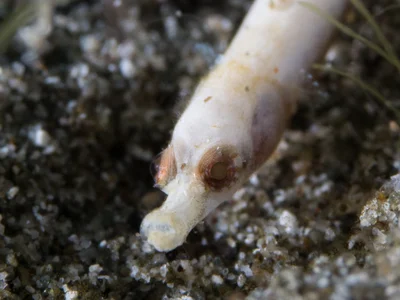
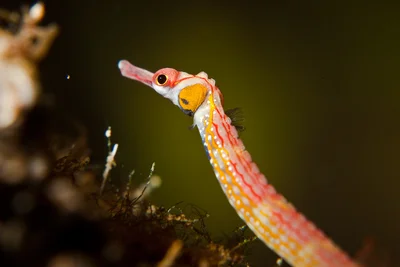
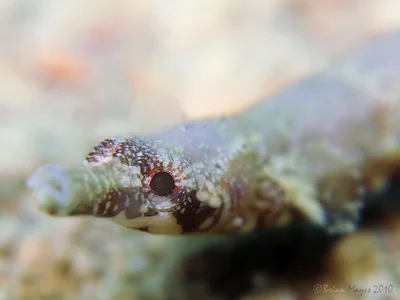
Herre’s Pipefish
© Shohei Shigeta
Fishes · Bony fishes · Pipefishes

Herre’s Pipefish

Siokunichthys herrei Herald, 1953
syn. Siokunichthys elongatus
7.6 cm1-37 m
632

The genus name "Siokunichthys" is derived from Siokun Bay, located on the Zamboanga peninsula in the 🇵🇭 Philippines, combined with the Greek word "ichthys," meaning fish.

Siokunichthys herrei is typically captured using dip-net methods or gathered in surface plankton samples. This species is ovoviviparous, with the male responsible for carrying the eggs in a specialized brood pouch located under the tail.

This demersal species inhabits depths ranging from 1 to 37 meters. It is also commonly found among Xenia soft corals at depths of 1 to 10 meters. Herre’s Pipefish can reach a maximum length of 7.6 centimeters.

The species is distributed across the Indo-West Pacific region, from the northern 🌊 Red Sea extending to 🇮🇩 Indonesia, the 🇵🇭 Philippines, the 🇸🇧 Solomon Islands, and 🇫🇯 Fiji.

Why it's threatened

Residential & commercial development
Housing & urban areas · Commercial & industrial areas · Tourism & recreation areas
Biological resource use
Unintentional effects: (subsistence/small scale) [harvest] · Unintentional effects: (large scale) [harvest]
Pollution
Sewage · Run-off · Nutrient loads · Soil erosion, sedimentation
Climate change & severe weather
Habitat shifting & alteration · Temperature extremes

This species is associated with Xenia soft corals as habitat and loss of this habitat could be a threat. However, the conservation status of these corals is not well understood. Corals are threatened in the region by coastal development and pollution, destriuctive fishing practices such as trawling and the use of dynamite, increased sea surface temperatures as a result of climate change, and ocean acidification (though the latter threat is not likely applicable to soft corals) (Bruno and Selig 2007, Carpenter et al. 2008). Syngnathids are also globally threatened by bycatch and habitat destruction as a result of low densities, low mobility and high habitat faithfulness (Vincent et al. 2011). It is not yet known if these are relevant threats to the status of this species.

Threat classification from the IUCN Red List.

Comments

Please, sign in to leave a comment

Continue with a social account — yours will be created automatically.

No comments yet — be the first.

Last Update: June 28, 2026