
Pinecone fishesMonocentridae
The dorsal spines point alternately left and right. Not upward: the row of stout spines along the back of a pineconefish leans one to this side, the next to that, so the top of the animal is a zigzag of hard points with no clean line for a mouth to close on. Underneath, each pelvic fin is a single spine about as long as the fish's head, hinged so it can be thrown out sideways and locked there, the same mechanism a stickleback uses. Fully deployed, the fish is a rigid object with pegs sticking out of it in four directions.
That is the whole strategy, and it accounts for the rest of the animal. It is cased in plate scales, which the species page deals with, and a body in a case cannot bend, and a body that cannot bend cannot swim the way most fish swim. So it does not. A pineconefish hovers and paddles, slowly, and never needed speed, because its answer to being attacked is to be impossible to swallow rather than to be somewhere else.
It comes from an old lineage of night fish, the one that also produced the squirrelfishes and soldierfishes of the reef and the roughies of deep water: big eyes, red and orange coloring, a working day that begins at dusk. The pineconefish is that group's armored extreme and it keeps the group's habits, spending daylight wedged into a cave or under a ledge on a deep slope and coming out after dark for small crustaceans, lit by the organs in its own lower jaw.
One species is listed here and it lives mostly below recreational diving. Encounters are rare, and they usually happen on the roof of a cave, at the far end of a dive light.
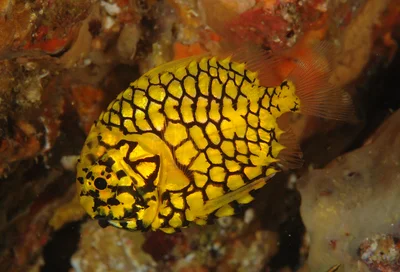
- compact, oval body with a rigid appearance
- body covered in large, stiff, spiny scales
- scales forming a distinctive pinecone-like pattern
- pair of glowing light organs on lower jaw
1 species in Pinecone fishes
Other oval-bodied groups
Similar silhouette underwater - worth a look if this was not your animal.


Last Update: August 23, 2026