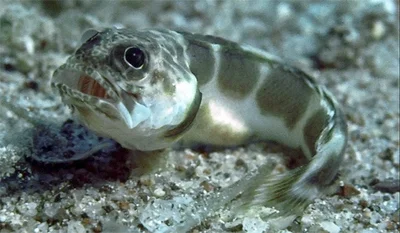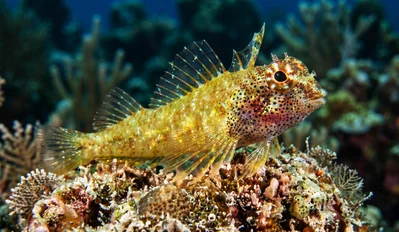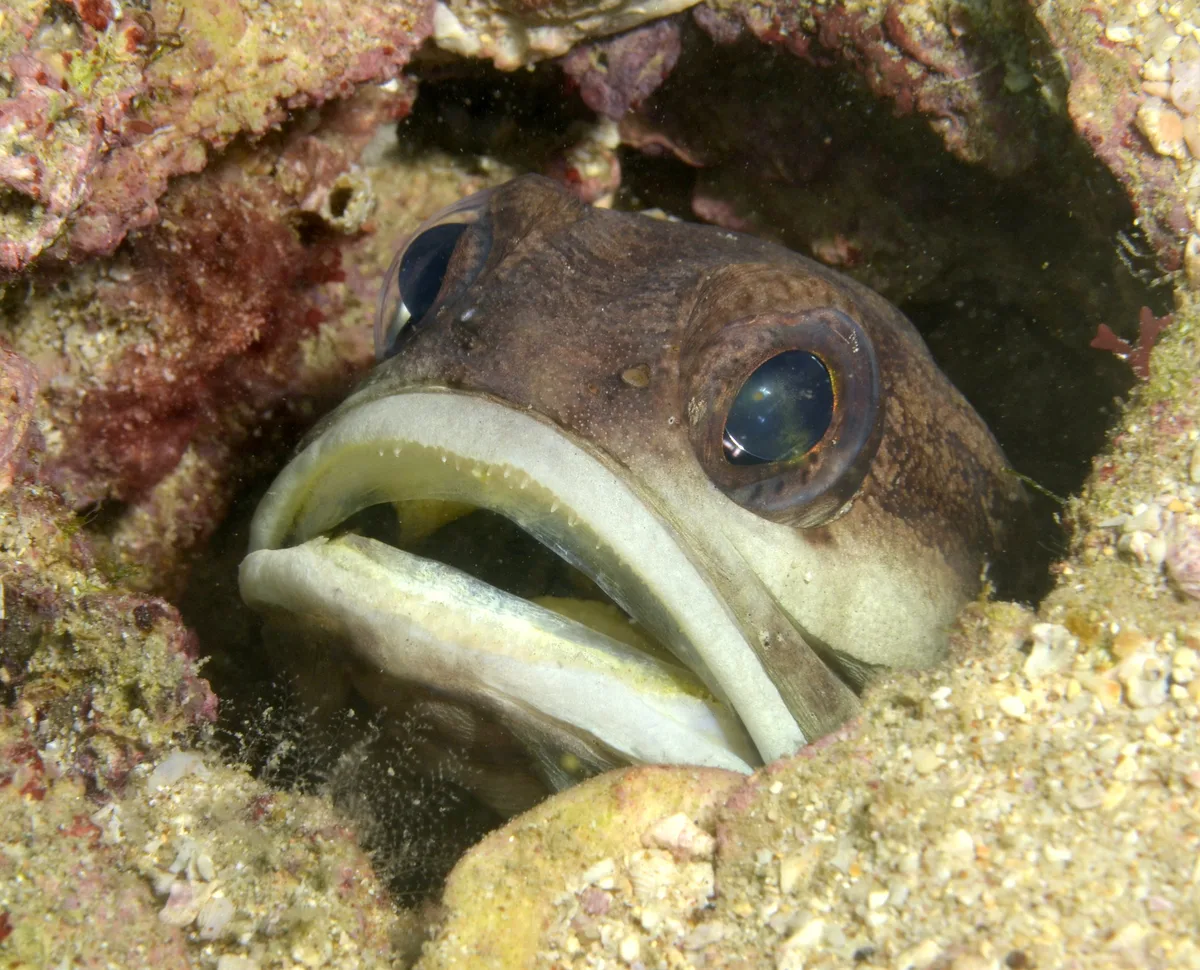
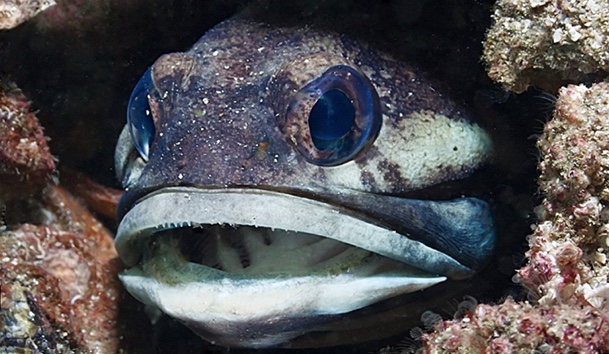
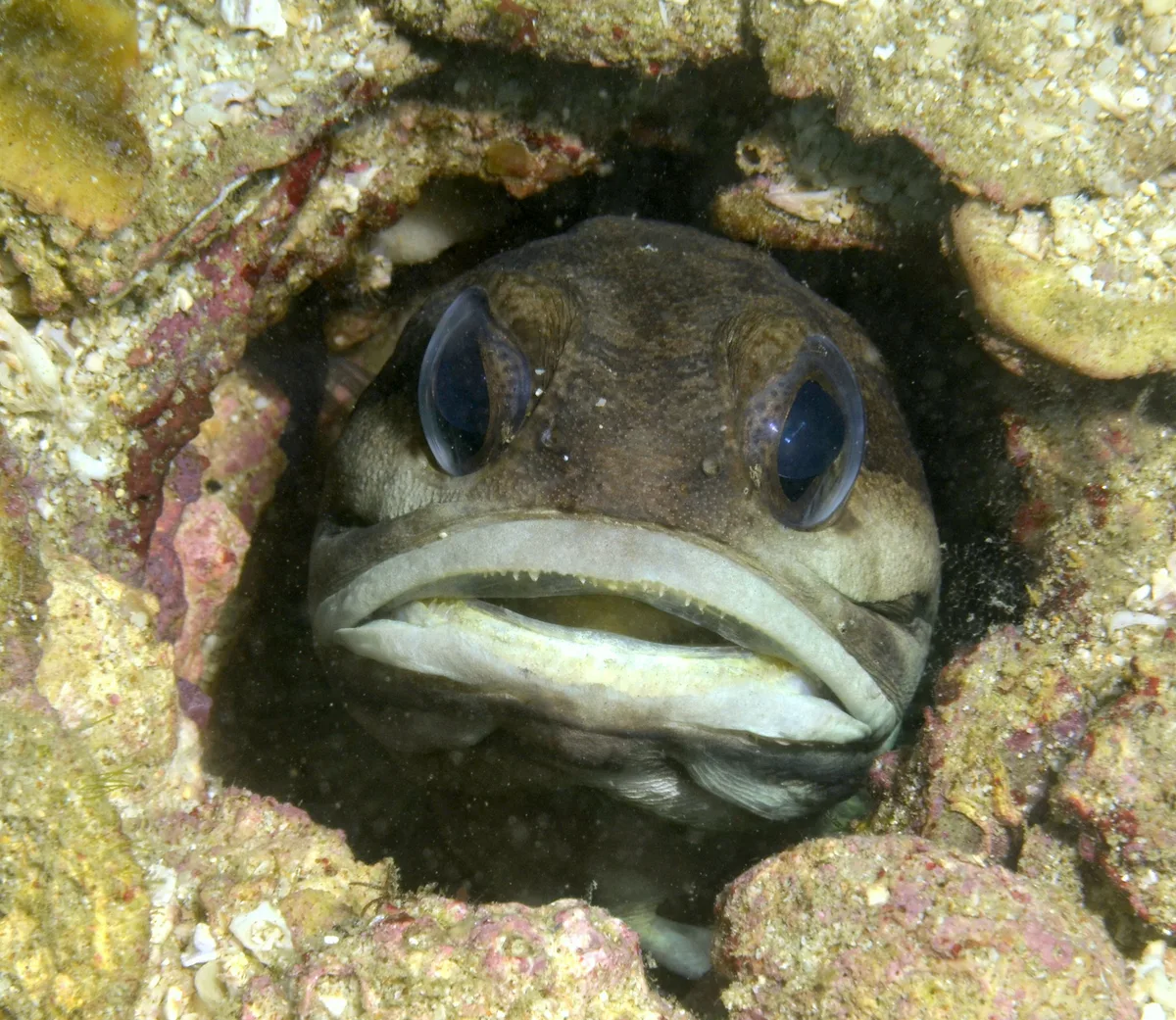
The whole animal is arranged around looking out of a hole.
The eyes sit high on the head, close together and near the top, so that a fish holding station at the mouth of a vertical shaft can see the entire hemisphere above it while showing almost nothing of itself. They also move independently, which means it can watch a threat on one side and a passing meal on the other at the same time without turning. On most fish the eyes are set on the sides of a body that has to be aimed; on a jawfish they are set on a periscope.
That is what the rest of the shape follows from. The head is broad and blunt, the body tapers away behind it into something that fits down a shaft, and the fish reverses into the hole tail-first rather than turning around, so that it is facing out at all times. It rarely crosses open sand, and when it does it is nervous and fast.
This is the largest of the local jawfishes, up to eighteen centimeters with a dark margin along the dorsal fin, on sand and rubble slopes where there is enough loose material to build with.
The genus. Opistognathus Cuvier 1816 - opisthen (behind) + gnathus (jaw). ETYFish
The species. Opistognathus nigromarginatus Rüppell 1830 - nigro (black) + marginatus (enclosed with a border). ETYFish
- dark margin along the dorsal fin
- large head and a huge mouth on a body that tapers away behind it
- large eyes set high and close to the top of the head
- up to 18 cm, the largest jawfish here