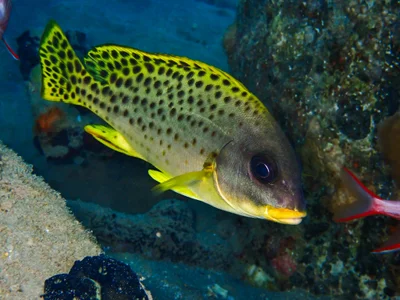
The young ones dance, and it is the strangest thing this family does.
A juvenile sweetlips is not a small version of the adult. It is boldly patterned in brown and white, sometimes in stripes and sometimes in large blotches, and it swims a few centimeters above the bottom with a lurching, fluttering, exaggerated motion that no other fish on the reef uses. Nothing about it reads as a fish trying to be inconspicuous. The usual explanation is that the pattern and the movement together imitate the toxic flatworms and sea slugs that patrol the same ground, animals that predators learn once and then leave alone. That reading is not proven, and this page will not pretend it is. What is not in question is that a small fish in the open, advertising itself and moving badly on purpose, is doing something that only pays if it is not worth eating.
Then it grows up and becomes a different animal. The pattern fades into fine spots or plain flanks, the dance stops, and the fish turns into a large, deep-bodied, unhurried gray or spotted thing hanging under a ledge. The two stages look so unlike each other that guidebooks print both pictures and readers still get it wrong.
The better name for the family is sweetlips, and it is descriptive: the lips are thick, fleshy and rubbery, and they get thicker with age until an old fish looks like it is pouting. Behind them the mouth is small and works as a tube for picking invertebrates off sand and rubble, mostly after dark. The name grunt records the noise they make by grinding the tooth plates at the back of the throat, with the swim bladder behind acting as the sounding box, and the species pages take that apart.
Seven are listed here, nearly all of them thicklips of the genus Plectorhinchus, and they are among the easiest large fish on a 🌊 Red Sea reef to approach: a resting sweetlips will usually let you settle a couple of meters away and stay put. One of them lives in this sea and around Socotra (🇾🇪 Yemen) and essentially nowhere else.