
FusiliersCaesionidae
A fusilier is a snapper that gave up hunting.
The family sits directly alongside the snappers, close enough that a fusilier is essentially one of them with the specification changed, and every change follows from a decision about food. A snapper takes one crab or one fish in a night off the bottom. A fusilier eats objects a millimeter across, out in the water, and needs thousands of them a day. Nothing about a heavy head with canines in it helps with that.
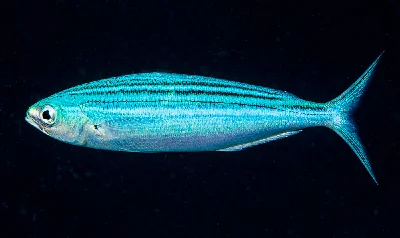
So the head was made light and the mouth small, and it shoots forward as a fine tube when it opens, with extra bone at the top of the jaw to support the movement. The body was narrowed into a spindle, the tail cut deep into two thin lobes, the scales made small and smooth. What comes out is a fish built for a whole day of cruising rather than for one strike, which is the opposite of the animal it came from and the reason the two families no longer look related.
That diet also sets the schedule. A fish living on plankton cannot stop and cannot lie up, so a fusilier school is in motion from first light to dusk, streaming along a wall or over a slope with the whole group turning together, feeding continuously the entire time. At dark they go into the reef, wedge into holes and cracks, and many come up blotched and reddened for the night before turning silver and blue again by morning.
The other thing they are is food. A fusilier school is what everything fast on the reef is looking for, and a wall that suddenly empties of them has usually just been visited. Elsewhere in the 🌊 Indian Ocean they are netted by the ton as live bait for pole-and-line tuna boats, which is a rough measure of how much of the reef's energy passes up through this one family. Seven are listed here, separated by where the stripe sits, whether the back is yellow and what the tail lobes are doing, and one of them, the 🌊 Red Sea fusilier, is found here and barely anywhere outside.
- silvery body, often with yellow or blue stripes
- yellow markings on fins or tail base
- forming large, fast-moving schools in mid-water
7 species in Fusiliers




Other torpedo-shaped groups
Similar silhouette underwater - worth a look if this was not your animal.




Last Update: August 23, 2026