
Flying gurnardsDactylopteridae
It does not fly. Nothing in this family has ever been recorded leaving the water, and the fins that earned it the name are fans rather than wings, too broad, too soft and too slow to do anything at all in air. The name came from the surface, from people who saw a wide-finned fish shoot out from under a boat and filed it alongside the flying fishes, which are a different group entirely and really do glide.
It is not a gurnard either. The true gurnards, the sea robins, sit in a separate family, and they also walk the bottom on separated fin rays, which is the interesting part: two unrelated lineages arrived at the same solution. Modern work puts this fish nowhere near them, out among the seahorses and the pipefishes instead.
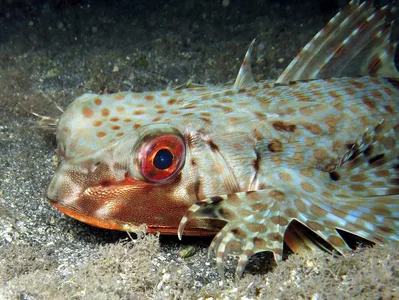
What it actually has is one fin doing two jobs. Each pectoral is divided. The front section is short, its rays free and stiffened, and the fish walks on them, testing sand and turning rubble for crustaceans, worms and small molluscs. The rear section is the enormous spotted fan, carried folded flat against the flank while all that work goes on, and thrown open at anything that comes too close. The species page has that moment.
The rest of the animal is a box. The head is enclosed in heavy bony plates with a long spine running back from behind the gill cover, and the body behind it is armored and keeled. Nothing in the design suggests speed and the fish has none, which is the whole point of carrying a helmet and a bluff.
One species is listed for this sea. It lives out on sand and rubble below the reef proper, usually alone, and it is found by noticing that a lump of the bottom is walking.
- robust body with large head, blunt snout, prominent eyes
- greatly enlarged, wing-like pectoral fins
- pectoral fins often with vibrant blue spots or bands
- fins spread for short glides just above substrate when disturbed
- modified pelvic fin rays used to 'walk' on seafloor
1 species in Flying gurnards
Other bottom-dwellers
Similar silhouette underwater - worth a look if this was not your animal.


Last Update: August 23, 2026