The Octopus Countdown: One Brilliant Life, One Ultimate Chance

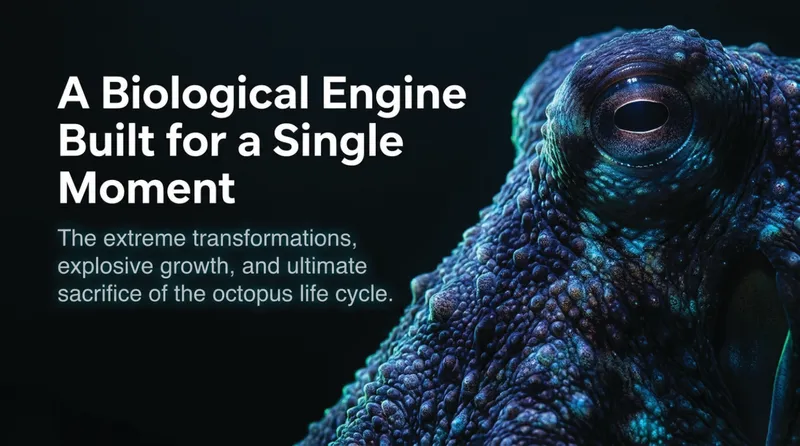
There's a creature down in the reef that can crack open shells, squeeze through gaps smaller than its own eyeball, and recognize the face of a diver who's visited it before. And yet, from the moment it hatches to the moment it dies, its whole life fits into less time than most of us spend picking a Netflix show. The octopus isn't just smart - it's smart on a deadline. Everything it does, from its first days drifting in open water to its final weeks on the reef, is aimed at one single, unrepeatable moment. This is the story of that countdown.
One Chance, No Do-Overs
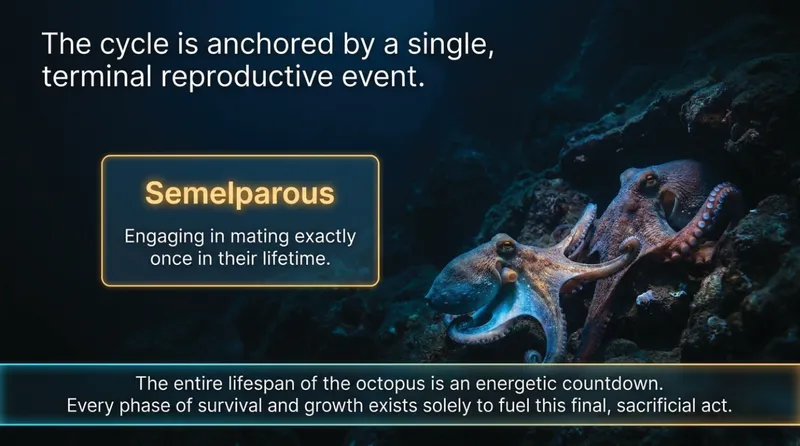
Octopuses are what biologists call semelparous - they mate exactly once in their entire life. Not once a season, not once a year. Once, full stop. After mating, the female retreats into a den, lays her eggs, and spends the rest of her life guarding them. She doesn't hunt. She doesn't feed. She simply protects, until her body gives out entirely.
It sounds bleak, but it's actually a brutally efficient strategy. Every scrap of energy she has left goes straight into giving her eggs the best possible shot at survival, rather than being spent keeping herself alive. It's a trade she makes without ever seeing the payoff.
A Journey Through Every Layer of the Sea
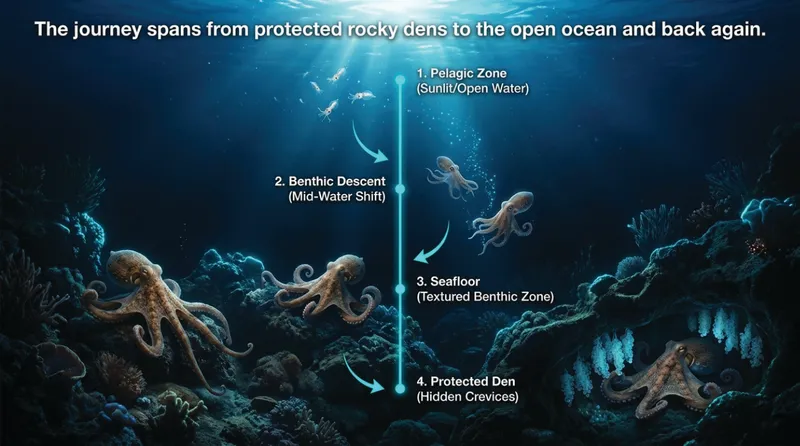
Zoom out, and an octopus's life looks like a loop through the entire water column. It starts out near the surface, drifting in sunlit open water. From there it sinks slowly through the mid-water zone, eventually landing on the textured seafloor it will call home. And when the time comes to reproduce, it retreats one layer deeper still, into a hidden crevice or den.
Surface to seafloor to sanctuary - the whole life cycle is basically a one-way trip downward, with each stop demanding something different from the animal making it.
Life Begins in the Dark
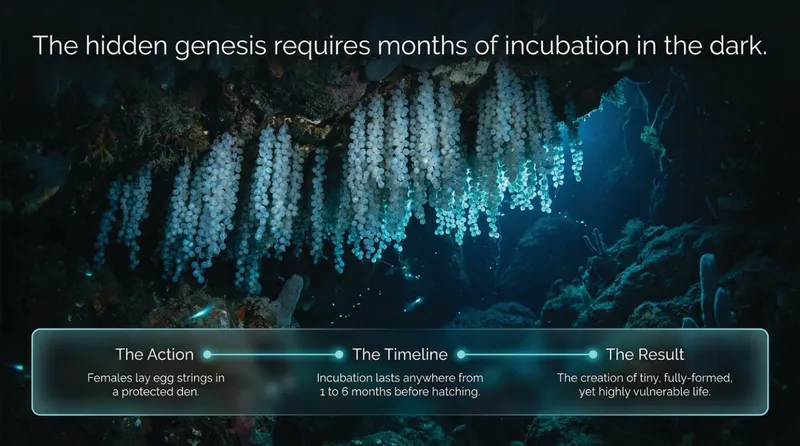
Before any of that drifting or growing happens, there's a much quieter phase: the wait inside the egg. A female lays her eggs in strings, sometimes thousands of them, hanging them like delicate curtains inside her den. Then she waits - and guards.
Incubation isn't quick. Depending on the species and water conditions, it can take anywhere from one to six months before the eggs are ready to hatch. For that entire stretch, the future of the species hangs quite literally in the dark, protected by a mother who won't live to see it emerge.
Cast Into the Current
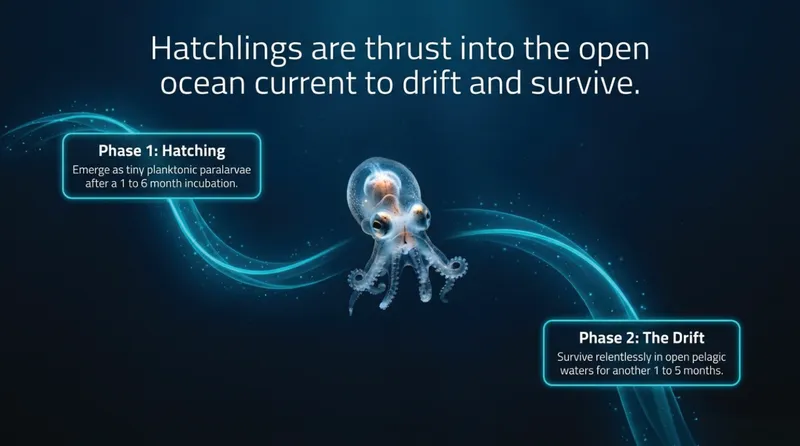
When they finally hatch, baby octopuses look nothing like the animal they'll become. They emerge as tiny, almost transparent paralarvae - barely more than a speck with eyes. And immediately, they're on their own.
There's no gentle transition here. The hatchlings are swept straight into open water, where they'll drift with the currents for another one to five months. They can't choose where they go. They can only survive whatever the ocean throws at them along the way.
Touching Down on the Reef
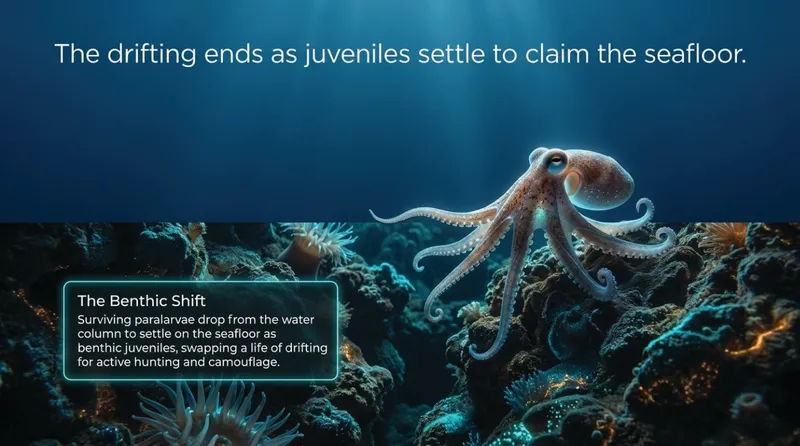
Eventually, the drifting has to end somewhere. The paralarvae that make it through - and plenty don't - drop out of the water column and settle onto the seafloor as benthic juveniles.
This is arguably the biggest turning point in the entire life cycle. Up until now, the animal has been a passenger, carried by tides it has no control over. The moment it settles on the reef, it becomes an active participant in its own survival - a hunter, a shape-shifter, a creature that finally gets to choose where it goes next.
Growing Up Fast
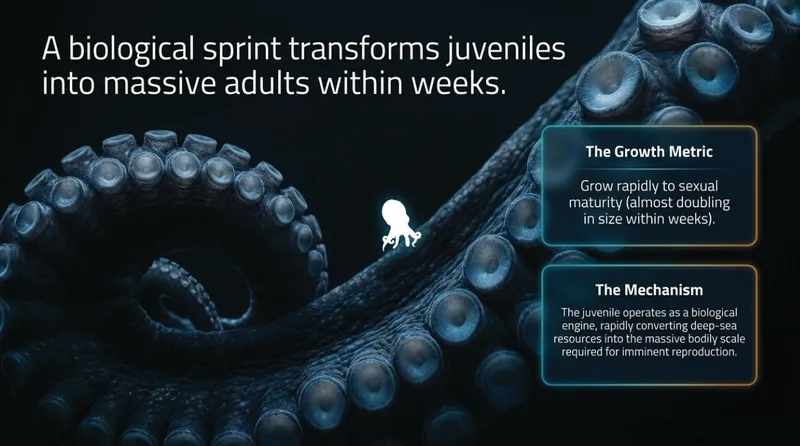
Once settled, the growth rate goes into overdrive. Juvenile octopuses can nearly double in size within just a few weeks as they race toward sexual maturity. That kind of growth doesn't happen by accident - it takes a huge, constant intake of food and a body built to convert it into mass almost immediately.
Think of the juvenile stage as a biological engine running flat out, turning everything the reef can offer into the size and strength needed for what's coming next.
The Whole Story in Four Stages
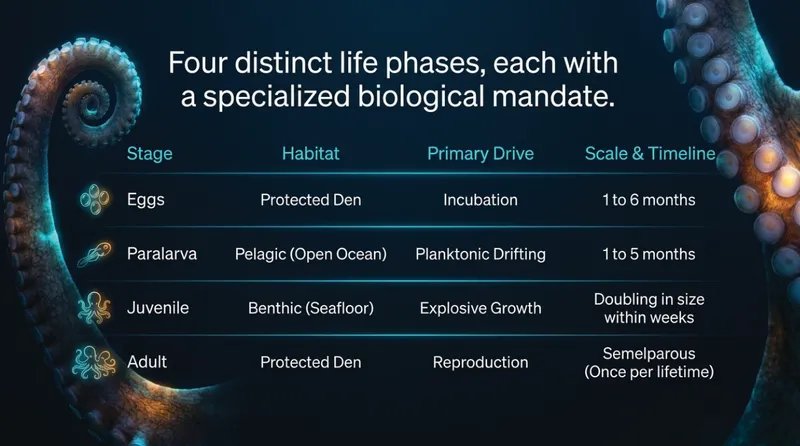
Laid out side by side, the octopus life cycle breaks down into four clear chapters, each with its own job to do:
- Eggs - tucked in a protected den, focused entirely on incubation, for one to six months
- Paralarva - adrift in the open ocean, surviving on luck and current, for one to five months
- Juvenile - settled on the seafloor, growing explosively, often doubling in size within weeks
- Adult - back in a protected den, focused on a single reproductive act, never to be repeated
No stage overlaps with the next. Each one exists purely to set up the one that follows.
A Circle That Closes Once
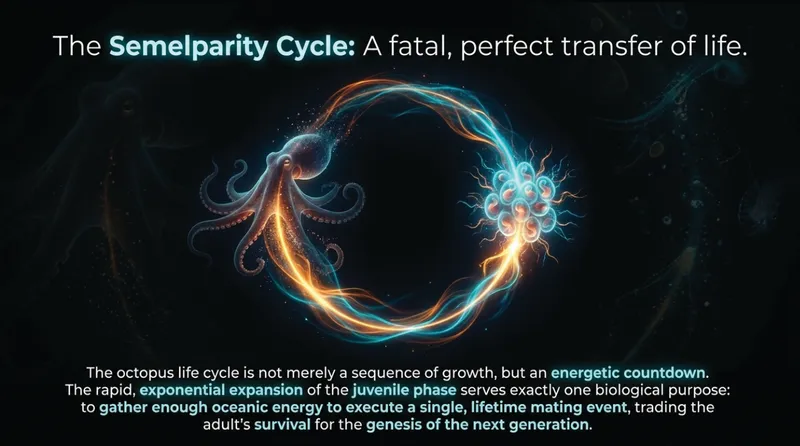
Put it all together and the octopus life cycle isn't really a story of survival - it's a story of transfer. Every month spent drifting, every week spent growing, exists for one reason only: to gather enough energy to make a single generation possible, even at the cost of the parent's own life.
It's worth sitting with that the next time you watch an octopus solve a puzzle or squeeze through an impossibly small gap. That intelligence, that ingenuity - it's all playing out on a clock far shorter than ours, aimed at a finish line the animal itself will never cross.
PADI Divemaster and underwater storyteller with over 7 years of hands-on Red Sea diving experience, documenting marine life, mapping dive sites, and promoting responsible ocean conservation.