The Biological Chimera: Decoding the Evolutionary Plagiarism of the Seahorse

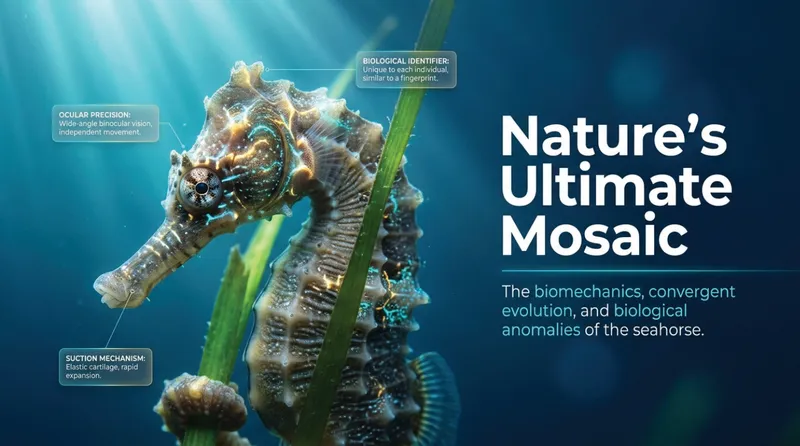
We are prone to viewing the seahorse through a lens of whimsical charm - the bobbing, upright "horse of the sea" that populates children’s fables and quiet corners of public aquaria. Yet, if we strip away the fairytale aesthetic, we are left with a creature that is perhaps nature’s most audacious biological chimera. Recent genetic and anatomical excavations reveal that the seahorse is less a "fish" in the traditional sense and more a living mosaic, a collection of evolutionary innovations "plagiarized" from across the animal kingdom and rewired into a single, improbable frame.
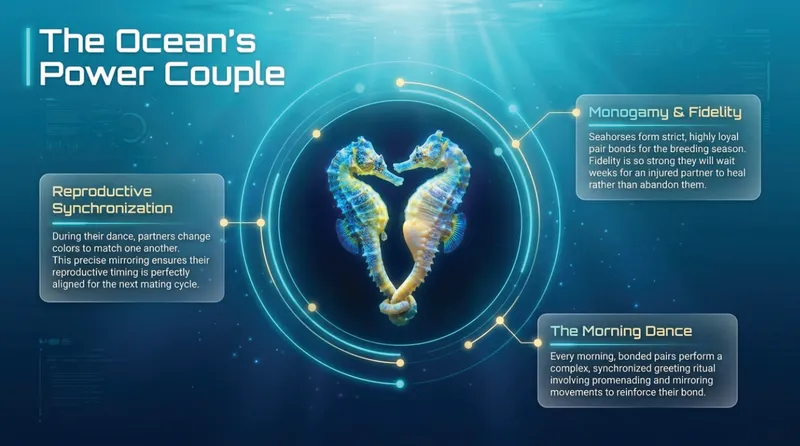
This is not merely a story of oddity; it is a masterclass in biological rule-breaking. As we decode their DNA, we find that seahorses have reached into the toolkits of mammals, reptiles, and insects to solve the problems of survival. They have flipped the script on parenthood, turned labor into a conscious performance, and abandoned the most basic vertebrate organs in favor of high-tech weaponry.
By looking closer at these "peculiar" creatures, we find a revelation of evolutionary efficiency. Nature, it seems, rarely creates from whole cloth when it can simply repurpose a brilliant design. Here are the most counter-intuitive secrets of the seahorse, where the weirdness is merely a symptom of profound innovation.
The Alchemist’s Pouch: "Motherhood" Reimagined
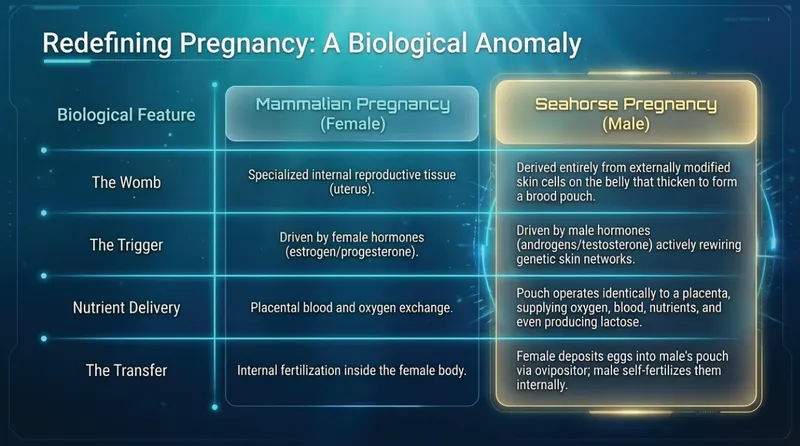
In the hierarchy of the animal kingdom, seahorses are the undisputed winners of the "Best Dad" award. While many species provide parental care, seahorse males have undergone a radical hormonal alchemy. In most vertebrates, the script of pregnancy is written in estrogen and progesterone. In seahorses, however, "motherhood" is powered by androgens - male hormones like testosterone.
Researchers discovered that exposing female seahorses to testosterone could actually trigger the development of a brood pouch. This pouch is not a repurposed reproductive organ but a highly modified patch of the father's skin, rewired to function with the complexity of a mammalian placenta. It provides oxygen, nutrients, and waste removal for the developing fry. To bridge the gap even further, seahorse fathers utilize isotocin - the fish version of the "love hormone" oxytocin - to regulate their unique pregnancy.
Evolutionary geneticist Bill Cresko describes this genetic repurposing as a patchwork masterpiece:
The evolution of the brooding pouch was not cut from whole cloth de novo but was built like a quilt with different patches of genes and cells that function the same way in different animals.
By utilizing existing genetic networks rather than inventing new ones, evolution found the most efficient path to one of the sea's most successful reproductive strategies.
Conscious Labor: Repurposing the Swimming Machine
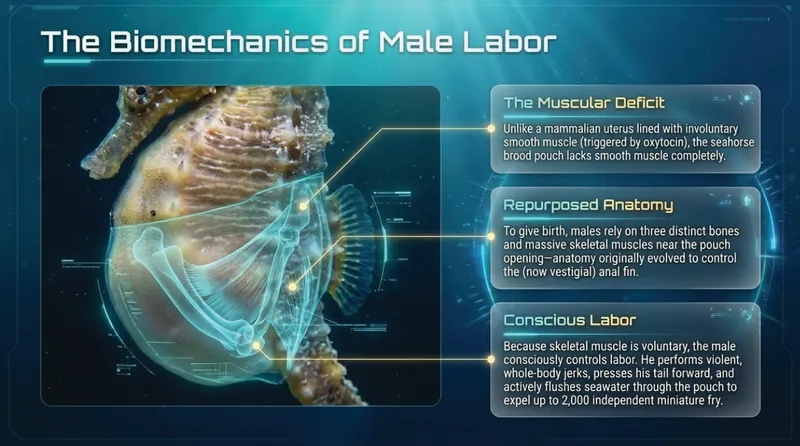
For a human mother, labor is a grueling, involuntary process driven by smooth muscle contractions beyond her conscious control. The seahorse father has opted for a far more deliberate performance. His brood pouch contains surprisingly little smooth muscle; instead, he relies on skeletal muscles - the same "voluntary" muscles we use to flex a bicep or walk.
These muscles are anchored to three specialized bones near the pouch opening. In most fish, this skeletal architecture controls the anal fin. But because the seahorse’s anal fin is a minuscule, nearly useless appendage, evolution hijacked the entire system to create a mechanism for controlling the act of birth.
The result is a labor of "pressing," "jerking," and "gaping." By bending his body and contracting these skeletal muscles, the father consciously flushes seawater through the pouch and expels hundreds of babies in a flurry. There is a profound irony in this: a fish famously ridiculed as a "poor swimmer" has taken its swimming-related anatomy and turned it into the most sophisticated, consciously controlled labor room in the ocean.
The Stealth Predator’s High-Volume Conveyor Belt
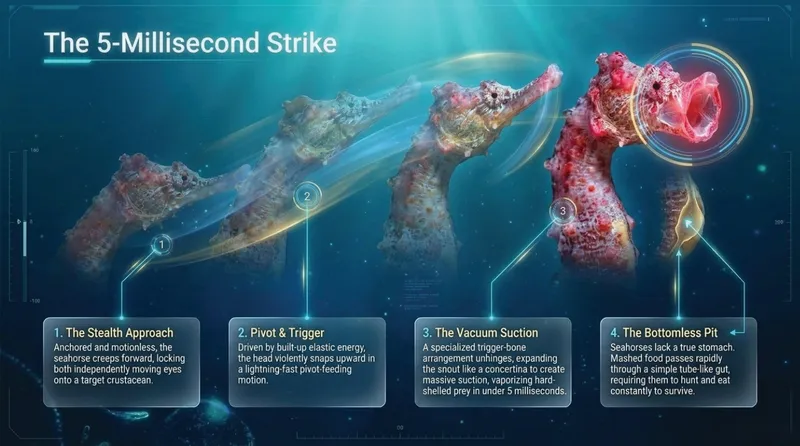
If you were to design a perfect predator, you would include the seahorse's vacuum-like snout and its independent, 360-degree eyes. Yet, internally, the seahorse’s digestive system "leaves a lot of questions." In an astonishing evolutionary trade-off, these fish lack a true stomach.
The seahorse is an eating machine by necessity. Lacking teeth to chew, it uses its powerful snout to "liquidize" prey as it is sucked in at a speed that defies the eye. From there, the food enters a digestive tract that is essentially a simple, straight tube - a "conveyor belt" that never stops. This system is so startlingly inefficient that hard-shelled prey like shrimp have been observed emerging from the other end alive and simply swimming away.
To compensate for this low-tech gut, the seahorse must graze constantly. While adults are voracious, the true scale of this appetite is seen in newborn fry, which must consume up to 3,000 particles of plankton every 24 hours just to survive. It is a portrait of a specialist that has invested everything in the hunt and nothing in the storage, forced into a life of perpetual consumption.
A Mosaic of Parallels: The Art of Convergent Evolution
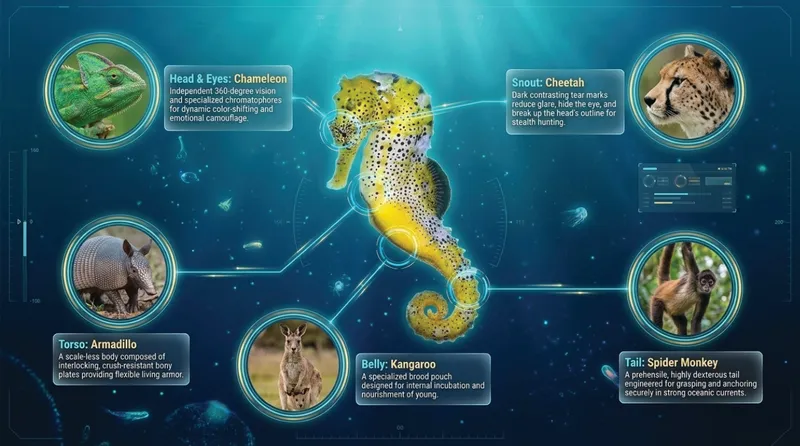
The seahorse is nature’s ultimate example of convergent evolution - the process where unrelated species develop identical solutions to the same environmental pressures. Its body is an echo of the entire animal kingdom:
- Cheetahs: Like the great cats of the savannah, certain seahorses, such as the Short Snouted Seahorse (H. hippocampus), possess dark facial patterns and eye stripes. These break up the outline of the head, hiding the eye from prey and potentially reducing glare in cluttered marine environments.
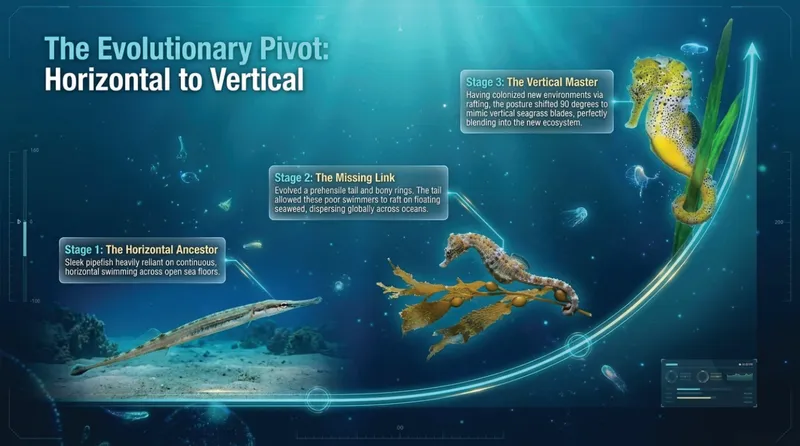
- Monkeys: Much like New World monkeys, seahorses possess a prehensile tail used as a "fifth limb." This allows them to anchor to seagrass so they aren't swept away by currents, freeing them to reach out and ambush passing prey.
- Chameleons: Seahorses share the chameleon’s ability to move each eye independently. This allows for a 360-degree scan for danger while simultaneously locking onto a meal.
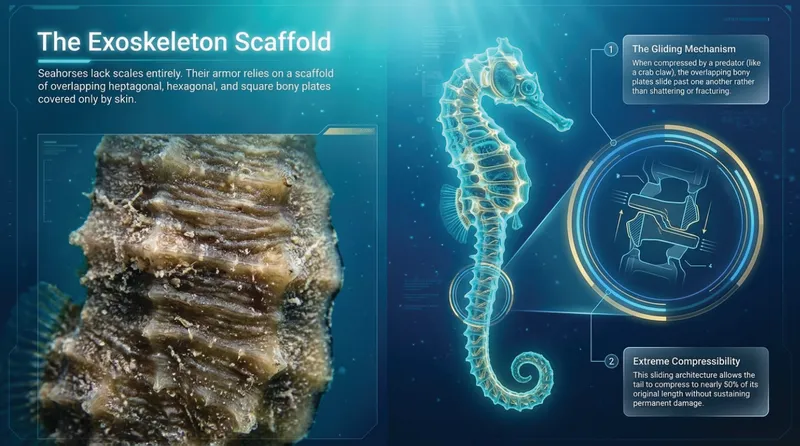
- Armadillos: Lacking traditional scales, seahorses are encased in an exoskeleton of bony armor plating arranged in interlocking rings - a crush-resistant defense shared with armadillos and tortoises.
Crucially, the seahorse’s "true neck" - a rarity among fish - evolved in parallel with the prehensile tail. As the tail allowed for a vertical life among the seagrass, the seahorse needed a neck to eliminate the massive blind spots created by an upright posture. This allowed the head to face downward, completing the horse-like silhouette and providing the visual clarity needed for its high-precision lifestyle.
The Dissection Table Discovery: The Hidden Giants of the Reef
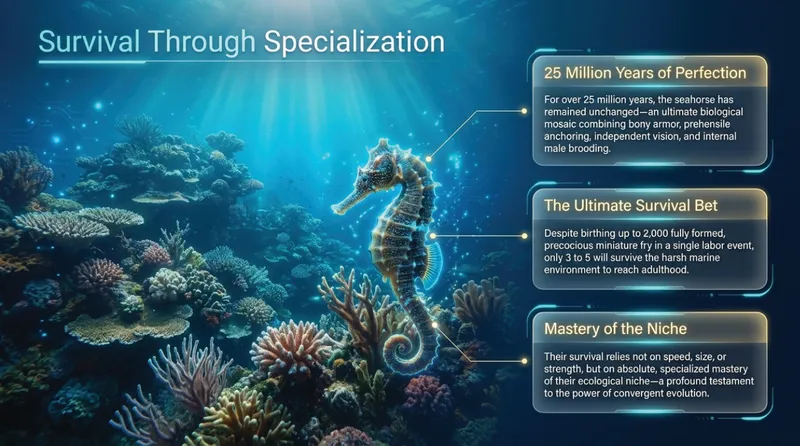
Some of the most profound seahorse secrets remained hidden simply because they were too small to see. The Pygmy Seahorse - species like H. bargibanti and the world’s smallest, H. satomiae - remained invisible to science until 1969. Even then, the discovery was an accident; researcher Georges Bargibant only noticed the tiny creatures while examining a specimen of Muricella gorgonian coral on a laboratory dissection table.
These "invisible giants" of the Coral Triangle measure as little as 1.3 centimeters. They are masters of the "hidden life," possessing a single gill opening on the back of the head rather than the two found in their larger cousins. Their existence is a humbling reminder that the natural world is full of biological wonders waiting for us to look at the right "patch" of coral.
Color as Conversation: The Mood-Driven Canvas
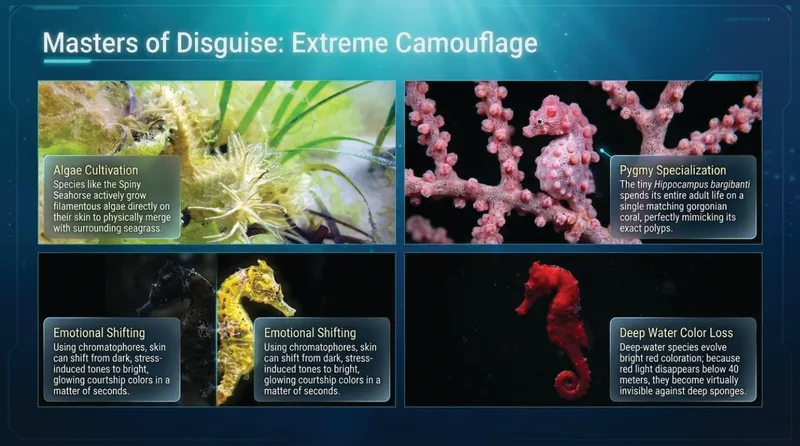
A common misconception is that a seahorse has a "natural" fixed color. In reality, their skin is a dynamic canvas controlled by chromatophores - pigment cells that expand and contract based on diet, lighting, and, most tellingly, emotion.
There is a stark difference between long-term camouflage and "emotional" color changes. Stress can turn an individual black in a heartbeat, while the "hormonal alchemy" of courtship can cause a male to "light up," turning from deep black to brilliant white or yellow. Take, for example, a famous H. erectus individual named "Jetlag" by his keepers; he was documented displaying a wide spectrum of colors, proving that for a seahorse, color is an expression of personality. Some species even grow harmless, filamentous algae on their skin to further blur the line between animal and environment.
The Future of the Mosaic
The seahorse is more than a curiosity; it is a living testament to the fact that evolution is opportunistic rather than linear. It is a creature that has "rewired" its very existence to thrive in the dense, predator-filled vegetation of the sea.
However, this biological masterpiece is under siege. The curio and traditional medicine trades claim over 150 million seahorses annually - a staggering figure that could lead to their extinction within the next 25 to 35 years. As we continue to decode the "quilt of genes" that makes these creatures possible, we must wonder how many other secrets of evolutionary rewiring are waiting in the depths, and whether we will have the chance to decode them before they vanish forever.
PADI Divemaster and underwater storyteller with over 7 years of hands-on Red Sea diving experience, documenting marine life, mapping dive sites, and promoting responsible ocean conservation.