Dolphins' Deeply Human Social Memory: How Females Protect Themselves

Imagine walking into a crowded room and instantly knowing - just by someone's voice - whether they're safe to be around. Not because of anything they're doing right now, but because of everything you remember about them from years past. That kind of social intelligence feels deeply human. As it turns out, it's also deeply dolphin.
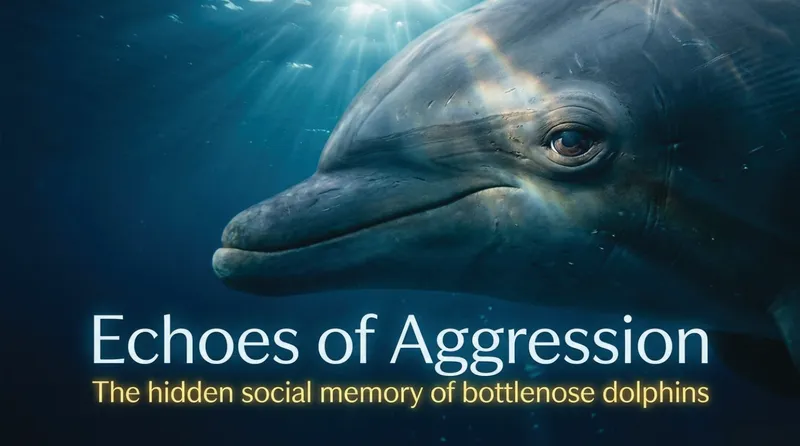
Recent research[1] published in the Proceedings of the National Academy of Sciences has revealed something remarkable: female bottlenose dolphins actively track the behavioral history of the males around them - and use that knowledge to protect themselves. They aren't simply reacting to their environment. They're navigating it, informed by years of accumulated social memory. What we're looking at isn't just animal behavior. It's a window into a form of intelligence we're only beginning to understand.
A Social Network Beneath the Surface
Bottlenose dolphins live in complex, fluid social groups where relationships shift constantly - alliances form, rivalries develop, and individuals come and go. To navigate all of this, dolphins need to know who's who. And more than that, they need to remember what each individual has done.
This is exactly what the research confirms. Female dolphins don't just recognize the individuals around them - they carry a detailed social record of each one's past behavior. That record shapes every interaction, every choice, every evasion. The ocean, for a female dolphin, is not an anonymous expanse. It is a landscape of known individuals and remembered histories.
When Mating Turns Dangerous
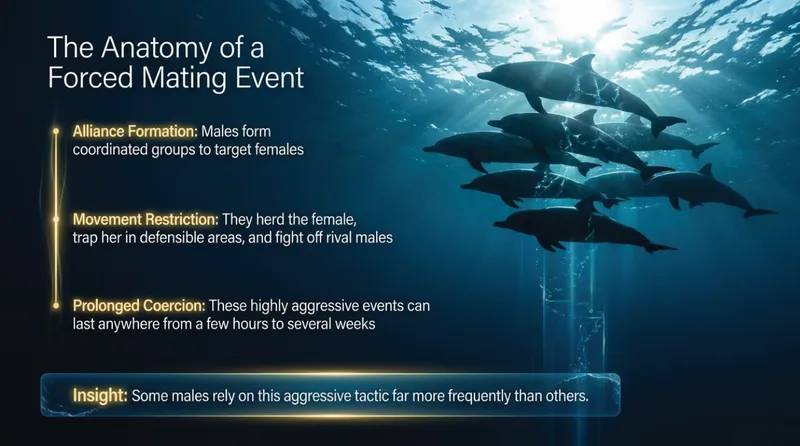
To understand why social memory matters so much, we need to look at what female dolphins are actually navigating during mating season. It isn't gentle courtship. Male bottlenose dolphins form coordinated alliances specifically designed to target females - and the process can be grueling.
Here's how it works:
- Alliance formation: Groups of males work together to single out and pursue a female.
- Movement restriction: They herd her, trap her in defensible areas, and fight off competing males to keep her there.
- Prolonged coercion: These events aren't quick. They can last anywhere from a few hours to several weeks.
The critical insight here is that not all males behave the same way. Some are far more aggressive than others - and the females notice. Remembering which males rely on this tactic most heavily isn't just useful. It's essential.
Every Dolphin Has a Name
So how do females actually identify who they're dealing with - especially at a distance, or in murky water where visual recognition fails? The answer lies in sound.
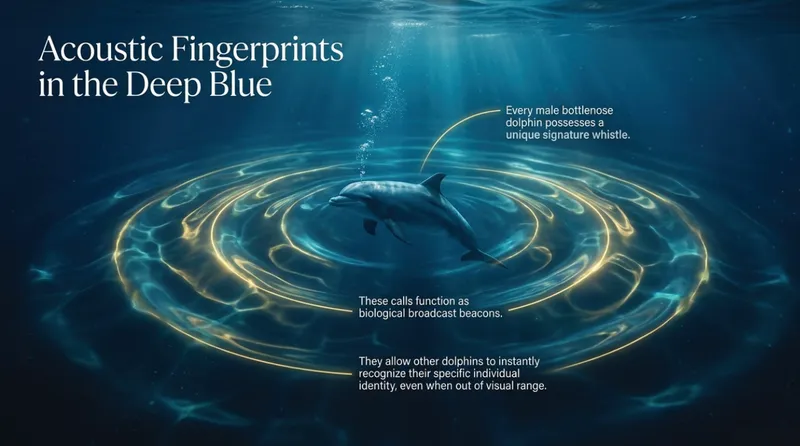
Every bottlenose dolphin develops a unique vocalization known as a signature whistle. Think of it as a biological name tag - a call that broadcasts individual identity. These whistles function as acoustic beacons: constant, recognizable, and tied to a specific individual.
What makes this especially remarkable is that recognition works even without visual contact. A female can hear a male's whistle from a distance and know exactly who it belongs to - and more importantly, what kind of history she has with him. The whistle isn't just an identifier. It's a trigger for everything she remembers about that individual.
Brute Force vs. Long Memory
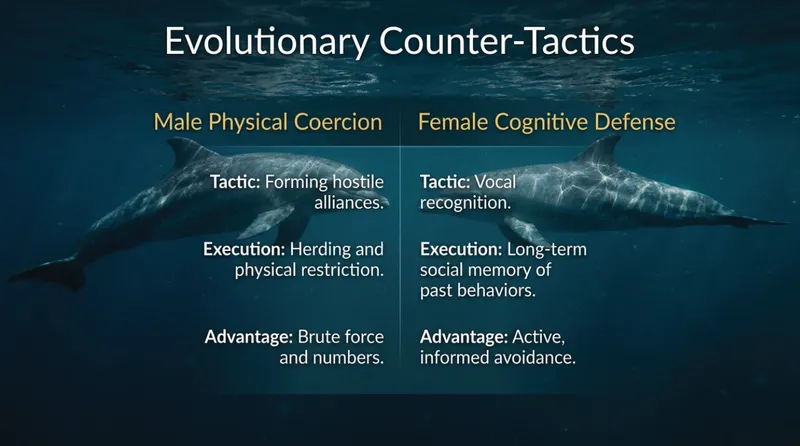
This research reveals something beautiful about evolution: physical strength isn't the only card on the table. Males and females have developed entirely different - and competing - strategies.
| Male Strategy | Female Strategy | |
|---|---|---|
| Tactic | Forming hostile alliances | Vocal recognition |
| Execution | Herding and physical restriction | Long-term memory of past behaviors |
| Advantage | Brute force and numbers | Active, informed avoidance |
Males use coordination and physical dominance. Females use intelligence and memory. It's a cognitive arms race - and it plays out silently, beneath the surface, every mating season.
Forty Years of Proof
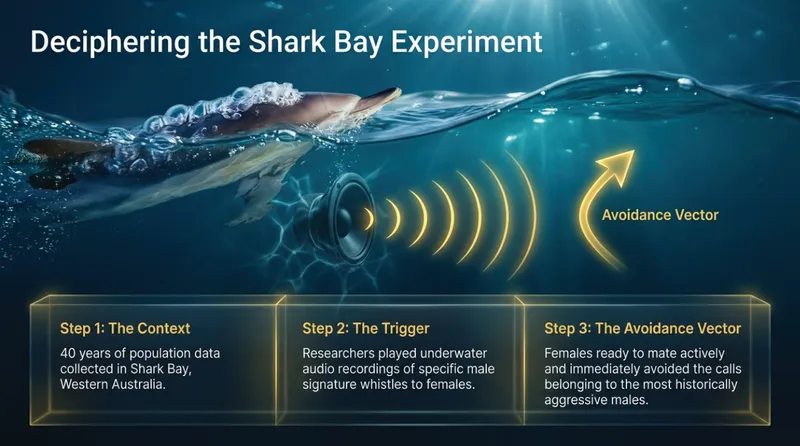
The research that confirmed all of this didn't happen overnight. It was built on four decades of continuous observation at Shark Bay, Western Australia - one of the longest-running wildlife studies in the world.
The experiment itself was elegantly simple:
- Step 1 - The Context: Researchers drew on 40 years of population data to identify which males had a history of high aggression.
- Step 2 - The Trigger: Underwater speakers played the signature whistles of specific males to females who were ready to mate.
- Step 3 - The Result: Females immediately and clearly avoided the calls of the most historically aggressive males.
The females weren't responding to something happening right now. They were responding to something they remembered. That distinction changes everything. It means their avoidance isn't instinct - it's a calculated decision grounded in years of social experience.
Memory as a Survival Tool
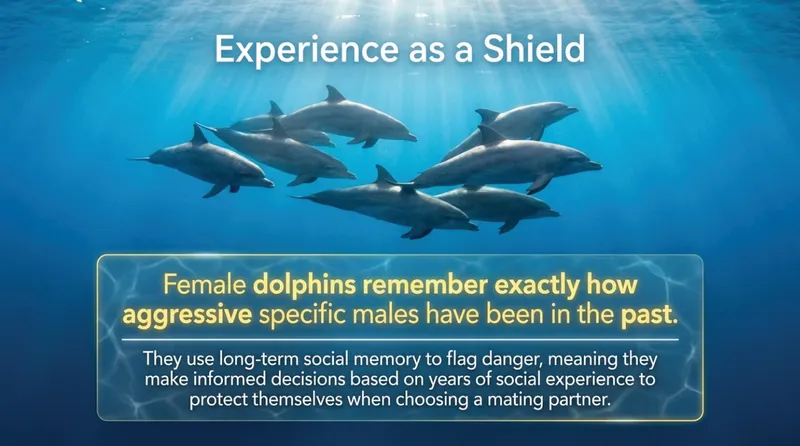
What this study ultimately shows is that for female dolphins, experience is armor.
Female dolphins remember exactly how aggressive specific males have been in the past. They use long-term social memory to flag danger - making informed decisions based on years of social experience to protect themselves when choosing a mating partner.
Being herded and restricted by an aggressive male alliance comes at a real physical cost. Energy is burned. Stress accumulates. The risks are tangible. By identifying and avoiding the most dangerous individuals before an encounter even begins, females preserve their own wellbeing and make smarter reproductive choices.
Social memory, in this context, isn't just impressive. It's life-saving.

What Else Are They Remembering?
This discovery pushes us to ask a bigger question: if dolphins can track individual behavioral histories across decades, build cognitive profiles of the animals around them, and use that information to make complex decisions - what else is happening beneath the surface that we haven't found yet?
"Nature is full of survival intelligence we're only just beginning to understand, and it is wonderful that we are able to do so."
We tend to think of intelligence as something we hold a monopoly on. Research like this gently corrects that assumption. The ocean is full of minds - minds that remember, calculate, and adapt. We're only now developing the tools and patience to truly listen.
And the answers, when we find them, may reshape everything we thought we knew about intelligence in the natural world.
PADI Divemaster and underwater storyteller with over 7 years of hands-on Red Sea diving experience, documenting marine life, mapping dive sites, and promoting responsible ocean conservation.