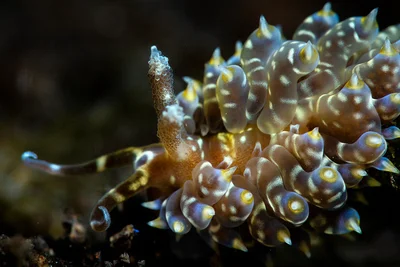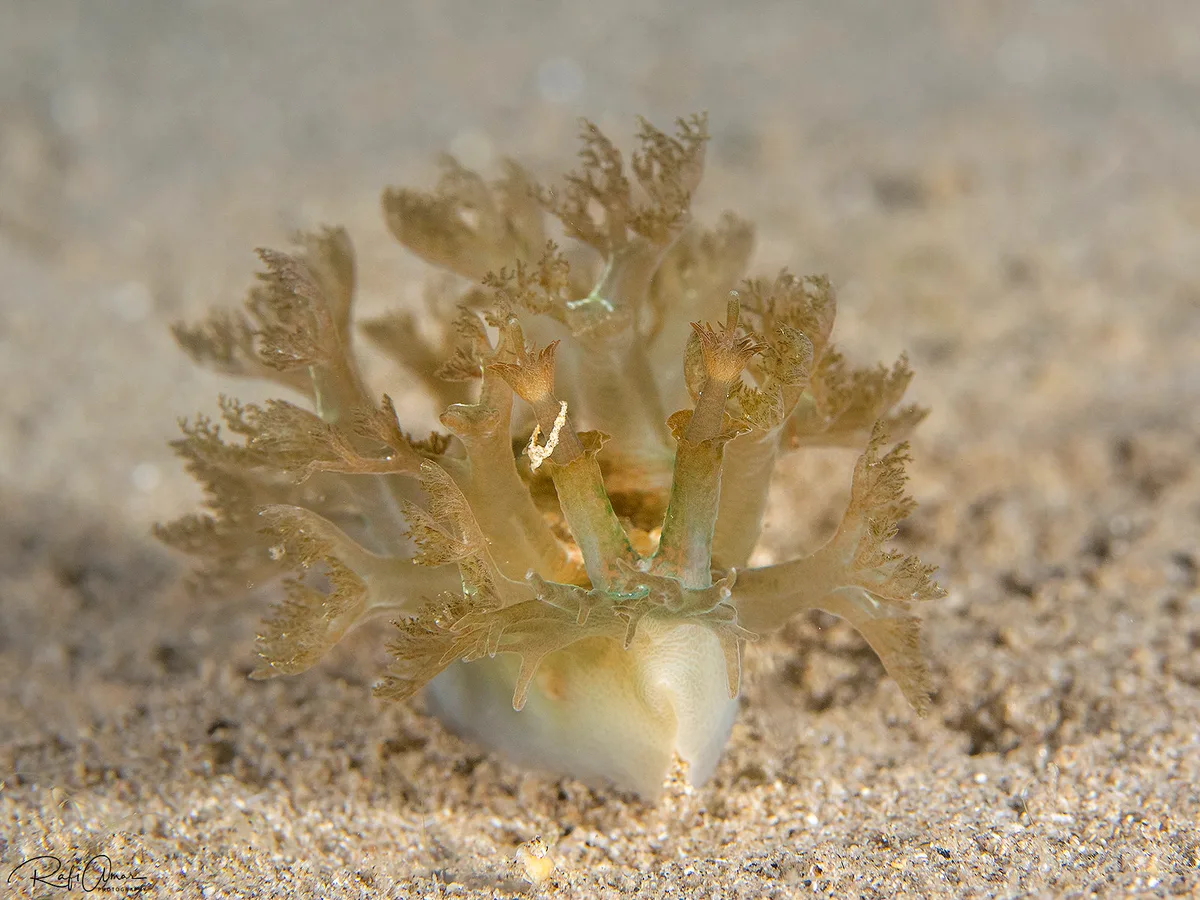
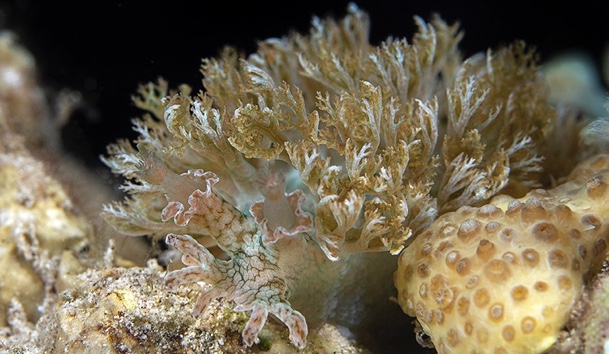
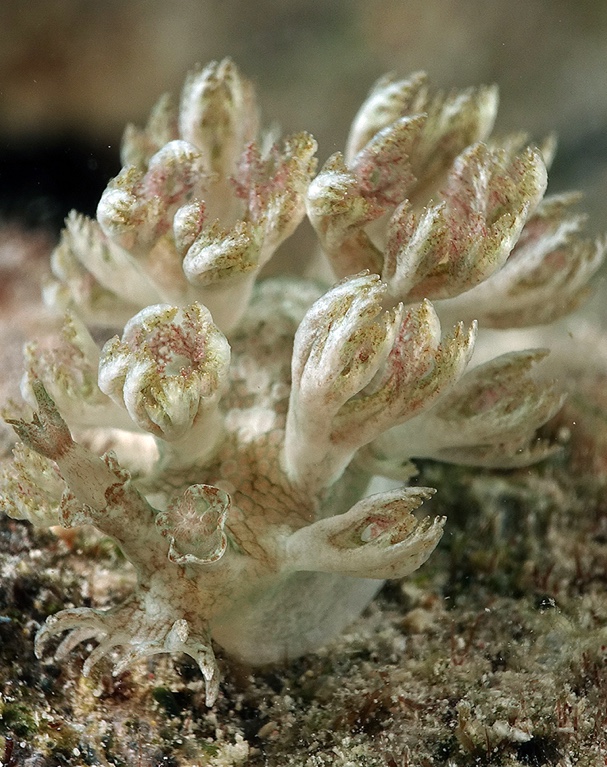
Two things mark a tritoniid and neither of them is a dorid feature. The gills are not a rosette on the back; they are a row of branched tufts running down each side. And the front of the head carries a veil divided into fine branches, covered in chemical sensors, which the animal uses to feel out soft corals in the dark. It is a search tool, and it happens to look exactly like a piece of the coral it is searching for.
This species is the reticulated one. The back carries tubercles with a raised net running between them, a pattern of ridges rather than of color, and the gills are greenish shot through with pink and branched so finely they read as clumps of moss on the flanks. Six centimeters (2.4 in).
It works over soft corals at night and spends daylight pushed back into a crevice, which is the standard tritoniid arrangement and the reason these are so rarely seen: everything about them happens at hours and in places most divers do not go.
The label carries Rüppell and Leuckart, 1828, and so does the other Marionia in this catalogue. Both were written up from 🌊 Red Sea material in the same wave of collecting almost two hundred years ago, and their names have stood since.
The book gives it for this sea alone, but confirmed records have come out of 🇰🇪 Kenya and 🇲🇿 Mozambique, which makes it a western 🌊 Indian Ocean animal rather than one of ours exclusively.
- a net of raised reticulations running between the tubercles on the back
- gills greenish shot with pink, and very finely branched
- gills in a row down each side, not a plume on the back
- a heavily divided veil across the front of the head