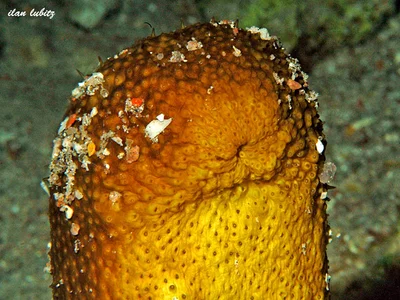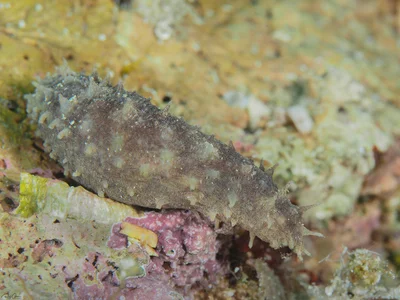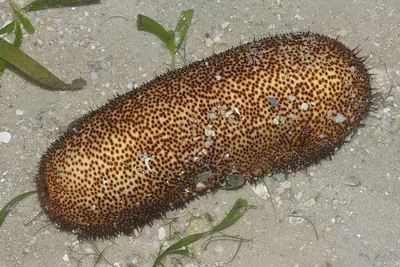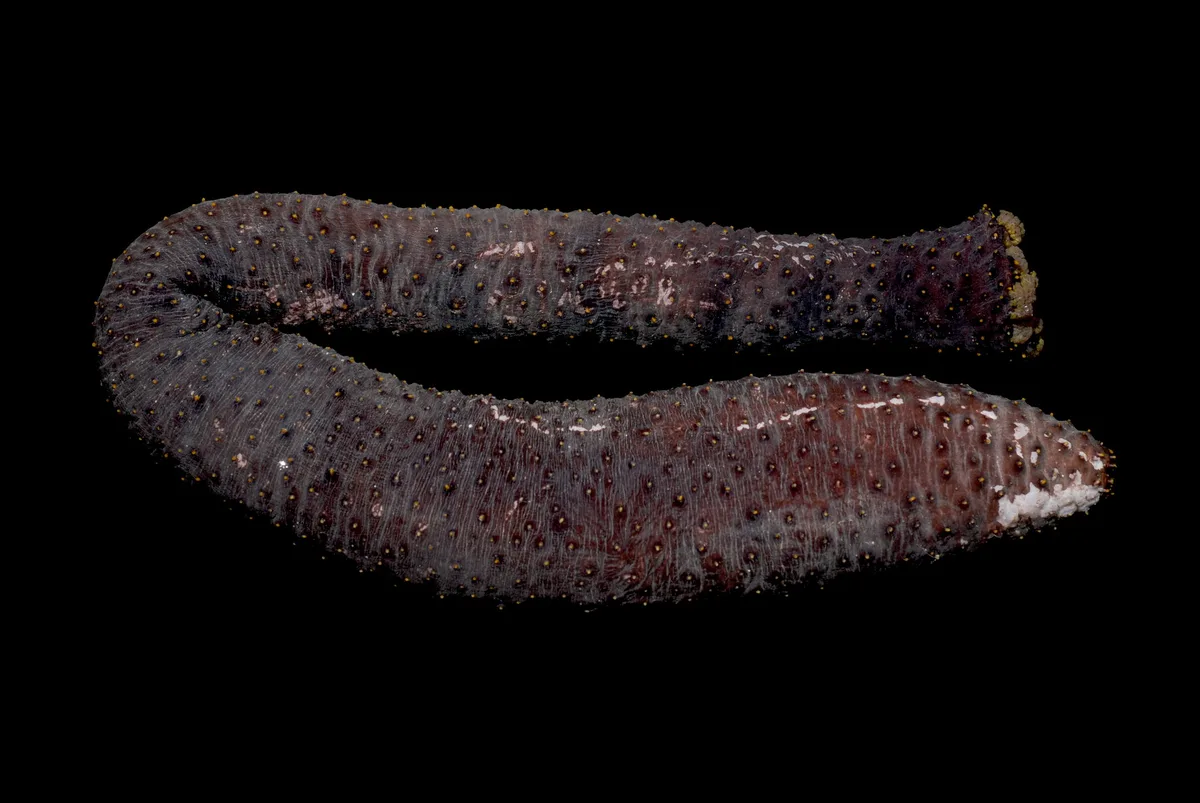
A large, dark holothurian reaching about 60 cm (24 in), its back set with papillae whose orange tips stand out clearly against the brown body - the feature that names the species and the quickest way to recognize it. The body wall is thick and firm, and the animal holds its shape rather than sagging when lifted by the current.
It lives on sand and rubble slopes below the reef, from about 3 m to 40 m (10 to 130 ft), sheltering by day and feeding through the night on detritus and the organic coating of sediment grains. Size and a thick body wall make it commercially valuable, and it is taken wherever fisheries reach; a slow-growing animal that broadcasts eggs into open water recovers badly from that, since scattered survivors rarely spawn close enough together for fertilisation to succeed. Populations along this coast benefit from the reefs being steep and largely protected, but a diver sees far fewer of these than of the small common species, and a large one on open sand is worth a photograph rather than a hand.
- large dark body with orange-tipped papillae
- papillae arranged in irregular rows along the back
- thick firm body wall
- length up to 60 cm
Why it's threatened
Threat classification from the IUCN Red List.